
Frontiers
(This page is based on the paper Frontiers in Large Igneous Province Research, by R.E. Ernst, I.H. Campbell, and K.L. Buchan, recently published in Lithos Special Issue 79, edited by A. Kerr, R. England, and P. Wignall, p. 271-297). download pdf (800 Kb)
Taking the pulse of planet Earth: a proposal for a new multi-disciplinary flagship project in Canadian solid-Earth sciences, by Wouter Bleeker, has been published in Geoscience Canada (December, 2004, 31: 179-190). The proposal centres on mafic magmatism in Canada, but is significant to LIP frontiers worldwide. download pdf (2.9 Mb)
- Database expansion
- Original size & areal extent
- Melt production rate
- Plumbing system
- Mantle source region (geochemistry)
- Links with ore deposits
Testing plume & non-plume origins
Distribution of LIPs in space and time (Archean to Present)
- Link with climatic change and extinction events
- Time series analysis of LIP record
- LIP clusters (“superplume events”)
- Link with supercontinent breakup and juvenile crust production
Comparison of LIPs on Earth, Venus and Mars
Characterization of LIPs
Database expansion:
Until recently characterizing LIPs has relied almost exclusively on the Mesozoic and Cenozoic record (e.g. Coffin and Eldholm, 1994, 2001; Courtillot and Renne, 2003). R elatively well preserved, this young record remains an important source of additional information on LIPs and their origin. Progress has recently been made in extending the LIP record back to the Paleozoic, Proterozoic and Archean (Ernst and Buchan, 1997; Condie, 2001; Tomlinson and Condie 2001; Arndt et al. 2001; Ernst and Buchan, 2001, 2002; Isley & Abbott, 1999, 2002). Although older LIPs are less well preserved than younger LIPs, they will be particularly valuable in investigating changes in LIP properties with time (continuous changes, cyclical changes), in understanding the plumbing system of LIPs.
Click to open/close References References
Arndt N, G. Bruzak, and T. Reischmann, The oldest continental and oceanic plateaus: geochemistry of basalts and komatiites of the Pilbara craton, Australia, In Ernst, R. E., and Buchan, K. L., eds. Mantle Plumes: Their Identification Through Time. Geological Society of America Special Paper 352: 359-387, 2001.
Ayer J, Y, Amelin, F. Corfu, S. Kamo, J. Ketchum, K. Kwok, and N. Trowell, Evolution of the southern Abitibi greenstone belt based on U-Pb geochronology: authochthonous volcanic construction followed by plutonism, regional deformation and sedimentation. Precam. Res.. 115: 63-95, 2002.
Bleeker, W., Archaean tectonics: a review with illustrations from the Slave craton: in Fowler, C.M.R., C.J. Ebinger, and C.J. Hawkesworth, eds., The Early Earth: Physical, Chemical and Biological Development: Geological Society, London, Special Publications 199, 151-181, 2002.
Coffin, M.F., and O. Eldholm, Large igneous provinces: crustal structure, dimensions, and external consequences. Rev. Geophys. 32, 1-36, 1994.
Coffin M. F., and O. Eldholm, Large igneous provinces: progenitors of some ophiolites? In Ernst, R. E., and Buchan, K. L., eds. Mantle Plumes: Their Identification Through Time. Geological Society of America Special Paper 352: 59-70, 2001.
Condie K.C., Mantle Plumes and Their Record in Earth History. Oxford, UK: Cambridge Univ. Press. 306 pp, 2001.
Courtillot, V.E. and P.R. Renne, P.R., On the ages of flood basalt events. C.R. Geoscience 335: 113-140, 2003.
Eriksson, P.G., K.C. Condie, W. van der Westhuizen, R. van der Merwe, H. de Bruiyn, et al., Late Archaean superplume events: a Kaapvaal-Pilbara perspective. J. Geodyn. 34: 207 247, 2002.
Ernst R.E., and K.L. Buchan, Giant radiating dyke swarms: their use in identifying pre-Mesozoic large igneous provinces and mantle plumes. In: Mahoney J, and M. Coffin (eds). Large Igneous Provinces: Continental, Oceanic, and Planetary Volcanism, AGU Geophys. Monogr. Ser. 100: 297-333, 1997.
Ernst, R.E., and K.L. Buchan, Large mafic magmatic events through time and links to mantle plume heads. In Ernst, R.E., and K.L. Buchan, eds. Mantle Plumes: Their Identification Through Time. Geological Society of America Special Paper 352: 483-575, 2001.
Ernst, R.E., and K.L. Buchan, Recognizing mantle plumes in the geological record. Ann Rev. Earth Planet. Sci., 31, 469-523, 2003.
Isley AE, and D.H. Abbott, Plume-related mafic volcanism and the deposition of banded iron formation. J. Geophys. Res. 104(B7):15461-15477, 1999.
Isley AE, and D.H. Abbott, Implications of the temporal distribution of high-Mg magmas for mantle plume volcanism through time. J. Geol. 110:141-158, 2002.
Sproule, R.A., C.M. Lesher, J.A. Ayer, P.C. Thurston, and C.T. Herzberg C, Spatial and temporal variations in the geochemistry of komatiites and komatiitic basalts in the Abitibi greenstone belt: Precam. Res., 115, 153-186, 2002.
Thurston, P.C., and K.M. Chivers, Secular variation in greenstone sequence development emphasizing Superior Province, Canada, Precam. Res., 46, 21-58, 1990.
Tomlinson, K.Y., and K.C. Condie, Archean mantle plumes: evidence from greenstone belt geochemistry: in Ernst, R.E. and K.L. Buchan, eds., Mantle Plumes: Their Identification Through Time: Geological Society of America Special Paper 352, pp. 341-357, 2001.
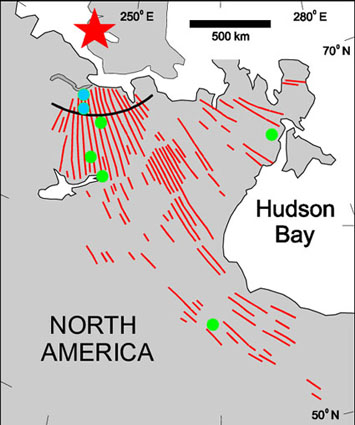
LIP plumbing system, 1270 Ma Mackenzie giant radiating dyke swarm of northern Canada. Dots indicate areas where flow direction was determined. Arcuate line indicates boundary between vertical flow (close to swarm centre) and horizontal flow (at all greater distances).
From Baragar WRA, R.E. Ernst, L. Hulbert, T. Peterson, Longitudinal petrochemical variation in the Mackenzie dyke swarm, northwestern Canadian Shield. J. Petrol. 37: 317-359, 1996.
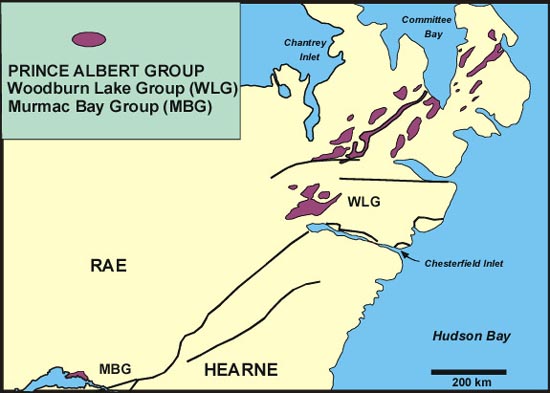
Possible LIP in northern Canada, extending for 2000 km along an Archean continental margin consisting of 2730 -2700 Ma komatiite-bearing greenstone belts: Murmac Bay Group, Woodburn Lake Group, Prince Albert Group, and probable equivalent (Mary River Group) on Baffin Island to the northeast.
Click to open/close References References
Aspler, L.B., and Chiarenzelli, J.R. Stratigraphy, sedimentology and physical volcanology of the Henik Group, central Ennadai-Rankin greenstone belt, Northwest Territories, Canada: Late Archean paleogeography of the Hearne Province and tectonic implications. Precambrian Research, v. 77, p. 59-89, 1996.
Aspler, L.B., Chiarenzelli, J. R., Cousens, B.L., and Valentino, D.. Precambrian geology, northern Angikuni Lake, and a transect across the Snowbird tectonic zone, western Angikuni Lake, Northwest Territories (Nunavut). Geological Survey of Canada Current Research 1999-C: 107-118, 1999.
Chandler, F.W., Jefferson, C.W., Nacha, S., Smith, J.E.M., Fitzhenry, K. and Powis, K. Progress on geology and resource assessment of the Archean Prince Albert Group, Laughland Lake area, Northwest Territories. Geological Survey of Canada Paper 93-1C, 209-219, 1993.
Donaldson, J.A. and de Kemp, E.A. Archaean quartz arenites in the Canadian Shield: examples from the Superior and Churchill Provinces. Sedimentary Geology, 120: 153-176, 1998.
Frisch, T. Precambrian geology of the Prince Albert Hills, western Melville Peninsula, Northwest Territories. Geological Survey of Canada Bulletin 346, 70 pp, 1982.
Hartlaub, R.P., K.E. Ashton, L.M. Heaman, T. Chacko. Was there an ~2000 km long Neoarchean extensional event in the Rae Craton? Evidence form the Murmac Bay Group of northern Saskatchewan. [abstract] in Saskatoon 2002, Joint annual meeting of the Geological Association of Canada, and Mineralogical Association of Canada, Saskatoon Saskatchewan, Canada, May 27-29, 2002.
Jackson, G.D., Hunt, P.A., Loveridge, W.D., and Parrish, R.R. Reconnaissance geochronology of Baffin Island, N.W.T. Geological Survey of Canada Paper 89-2: 123-148, 1990.
MacHattie, T.G., L. Heaman, R. Creaser, T. Skulski, and H. Sandeman. Chemical and stratigraphic relationships between basalt and komatiite in the Archean Prince Albert group, Churchill Province, Nunavut. [abstract] in Vancouver 2003, Joint meeting of the Geological Association of Canada, Mineralogical Association of Canada and the Society of Exploration Geophysicists, 25-28 May 2003.
Scammell, R.J., and Bethune, K.M. Archean and Proterozoic lithology, structure, and metamorphism in the vicinity of Eqe Bay, Baffin Island, Northwest Territories. Geological Survey of Canada Paper 1995-C: 53-66, 1995.
Schau, M. Geology of the Archean Prince Albert Group in the Richards Bay area, northeastern Melville Peninsula, District of Franklin, Northwest Territories. Geological Survey of Canada Bulletin, 44 p, 1997.
Schau, M., and Ashton, K.E. The Archean Prince Albert Group, northeastern Canada: evidence for crustal extension within a >2.9 Ga continent. [abstract] Geological Society of America Abstracts With Program, v. 20, p. A50, 1988.
Skulski, T., H. Sandeman, M. Sanborn-Barrie, T. MacHattie, M. Young, C. Carson, R. Berman, J. Brown, N. Rayner, D. Panagapko, D. Byrne, and C. Deyell. Bedrock geology of the Ellice Hills map area and new constraints on the regional geology of the Committee Bay area, Nunavut. Geological Survey of Canada Current Research 2003-C22, 2003.
Skulski, T.M., H. Sandeman, T. MacHattie, M. Sanborn-Barrie, N. Rayner, and D. Byrne, Tectonic setting of the 2.73-2.70 Ga Prince Albert group, Rae domain, Nunavut. [abstract] in Vancouver 2003, Joint meeting of the Geological Association of Canada, Mineralogical Association of Canada and the Society of Exploration Geophysicists, 25-28 May, 2003.
Zaleski, E., W.J. Davis, H.A. Sandeman. Continental extension, mantle magmas and basement cover relationships, In Extended Abstracts, 4th International Archean Symposium 2001, (eds.) K.F. Cassidy, J.M. Dumphy, and M.J. Van Kranendonk. Australian Geological Survey Organization - Geoscience Australia, Record 2001/37, p. 374-376, 2001.
Original size & areal extent:
Size is an important parameter in the study of LIPs. It has been used to draw conclusions about the flux of mafic magma from the mantle, the relationship between continental and oceanic LIPs, the origin of LIPs (e.g. plume vs. non-plume), the variation in plume size and the existence of super-sized plumes, climatic effects of LIPs, etc. For example, it is critical to establish if LIPs have a relatively uniform size, or if there are large differences in size which might reflect different origins. However, there are a number of uncertainties in estimating LIP size. Estimating the intrusive component of LIPs (especially underplating) is particularly difficult. In the older record, only remnants of the extrusive component have escaped erosion, and the LIP may have been fragmented by plate tectonic processes. Even in the younger record, where erosion and plate tectonic effects are less pronounced, the estimated size of a LIP may increase dramatically as additional components are recognized through better dating, modeling and stratigraphic correlation. A recent example is a doubling in the recognized size of the 250 Ma Siberian Traps based on dating of basalts recovered by drill core from beneath the West Siberian basin (Reichow et al., 2002). It is clear that a more robust database of LIP sizes is needed.
Click to open/close References References
Coffin M. F., and O. Eldholm, Large igneous provinces: progenitors of some ophiolites? In Ernst, R. E., and K.L. Buchan, eds. Mantle Plumes: Their Identification Through Time. Geological Society of America Special Paper 352: 59-70, 2001.
Courtillot, V.E. and P.R. Renne, P.R., On the ages of flood basalt events. C.R. Geoscience 335: 113-140, 2003.
Ernst, R.E., and K.L. Buchan, The use of mafic dike swarms in identifying and locating mantle plumes. In: Ernst, R.E., and K.L. Buchan, (Eds.), Mantle Plumes: Their Identification Through Time. Geol. Soc. America Spec. Paper 352, pp. 247-265, 2001.
Ernst, R.E., and K.L. Buchan, Maximum size and distribution in time and space of mantle plumes: evidence from large igneous provinces. In: Condie, K.C., D. Abbot, D.J. Des Marais, (Eds.), Superplume Events in Earth’s History: Causes and Effects, J. Geodynamics (Special Issue), 34: 309-342, 2002 [Erratum, J. Geodynamics, 34:711-714, 2002].
Hames, W.E., J.G. McHone, P.R. Renne, and C. Ruppel (Eds.), The Central Atlantic Magmatic Province: insights from fragments of Pangea. American Geophysical Union, Geophysical Monograph 136, 267 p, 2003.
Reichow, M.K., A.D. Saunders, R.V. White, M.S. Pringle, A.I. Al-Mukhamedov, A.I. Medvedev, and N.P. Kirda, 40Ar/39Ar dates from the West Siberian Basin: Siberian flood basalt province doubled. Science 296, 1846-1849, 2002.
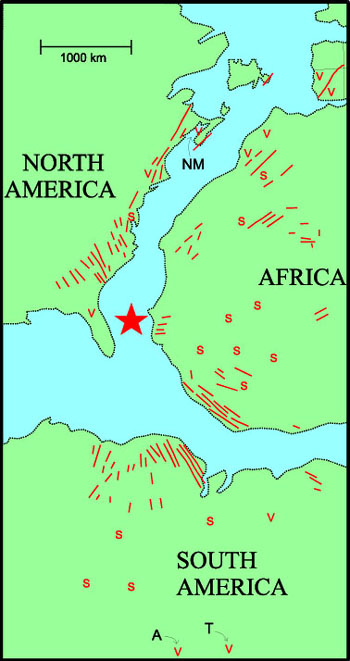
Reconstructed 200 Ma Central Atlantic Magmatic Province LIP. Lines are dykes, s = sills and v= volcanics. Note the importance of continental reconstruction (i.e. closing the Atlantic Ocean) in restoring the primary giant radiating dyke swarm pattern and revealing the extent of the event.
After Ernst and Buchan (2001); note different interpretation of dyke swarm pattern in some papers of Hames et al. (2003).
Melt production rate:
One of the most important parameters associated with LIP events is the melt production rate, especially its variation through the course of the event, including its peak value(s). Some events such as the Columbia River event feature a single pulse of magmatism at 17 Ma, followed by a protracted period of magmatism as a much lower rate. Other events may exhibit two or more pulses of high volume activity, an original that can be linked to a mantle plume head and the second coincident with the onset of rifting.
Unfortunately, current estimates of melt production rate for most LIPs are very imprecise owing to the uncertainties related to event size (see above), and the small number of precise ages available for most events which preclude accurate estimates of their duration.
There is a need to generate curves of melt production rate vs. time for a variety of events through time as well as events in different settings (e.g. oceanic vs. continental; rift vs. non-rift settings; thickened lithosphere vs. ‘thinspots’, etc.).
Plumbing system:
Mapping the LIP plumbing system of dykes, sills and layered intrusions is important in order to identify centres at which melt from sub-lithospheric mantle source areas is transported through lithospheric mantle and into the crust, and to determine the pattern of magma distribution from these centres within the crust and onto the surface as flood basalts. Of particular interest is the recognition of giant radiating dyke swarms (e.g. Halls, 1982; Fahrig 1987; Ernst & Buchan 1997; 2001; Wilson and Head 2003), links with feeder chambers marked by layered intrusions (Baragar et al. 1996), and patterns of sublithospheric channelling of plume mantle (Ebinger and Sleep 1998; Wilson 1997).
Click to open/close References References
Baragar WRA, R.E. Ernst, L. Hulbert, T. Peterson, Longitudinal petrochemical variation in the Mackenzie dyke swarm, northwestern Canadian Shield. J. Petrol. 37: 317-359, 1996.
Ernst, R.E., and K.L. Buchan, Layered mafic intrusions: a model for their feeder systems and relationship with giant dyke swarms and mantle plume centres. S. Afr. J. Geol. 100, 319-334, 1997.
Ernst, R.E., and K.L. Buchan, The use of mafic dike swarms in identifying and locating mantle plumes. In: Ernst, R.E., and K.L. Buchan, (Eds.), Mantle Plumes: Their Identification Through Time. Geol. Soc. America Spec. Paper 352, pp. 247-265, 2001.
Ernst, R.E. E.B. Grosfils, D. Mège, Giant dike swarms: Earth, Venus, and Mars. Ann. Rev. Earth Planet. Sci. 29: 489-534, 2001.
Ebinger, C.J., and N.H. Sleep, Cenozoic magmatism throughout East Africa resulting from impact of a single plume. Nature 395, 788-791, 1998.
Fahrig, W.F., The tectonic settings of continental mafic dyke swarms: failed arm and early passive margin. In: Halls, H.C., and W.F. Fahrig, (eds.) Mafic Dyke Swarms. Geological Association of Canada Special Paper 34, 331-348, 1987.
Halls, H.C., The importance and potential of mafic dyke swarms in studies of geodynamic processes. Geoscience Canada, 9, 145-154, 1982.
Wilson, M. Thermal evolution of the Central Atlantic passive margins: continental break-up above a Mesozoic super-plume. J. Geol. Soc. London 154: 491-495, 1997.
Wilson, L., and J.W. Head, Tharsis-radial graben systems as the surface manifestation of plume-related dike intrusion complexes: models and implications. J. Geophys. Res., 107 (E8), 10.1029/2001JE001593, 2002.
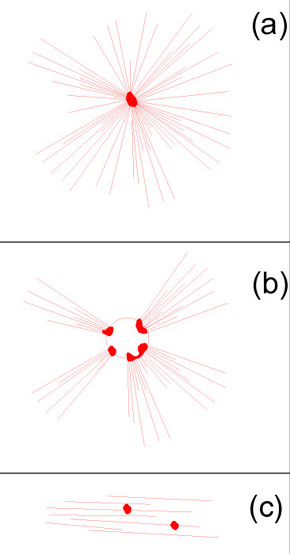
Some models for locations of feeder chambers for giant dyke swarms (after Ernst et al., 2001).
a) Centrally located chamber (as implied by ‘novae’ on Venus)
b) off axis chambers (e.g. Mackenzie swarm, Earth; Baragar et al. 1996)
c) chambers along a linear swarm.
For more about giant radiating dyke swarms click here.
Mantle source region (geochemistry):
LIP geochemistry can be used to characterize mantle sources, provide it is not overprinted by continental crust contamination, a common problem with continental LIPs. The involvement of known mantle reservoirs, DMM, EMI, EMII, HIMU and FOZO, can be assessed using isotopes and trace elements. Of particularly current interest is the role of eclogite in the source area (Campbell, 1998; Takahashi et al., 1998; Cordery et al., 1997), which probably derives from fossil subducted slabs. Using trace elements and isotopes it should prove possible to model the cycling of components (e.g. Campbell, 2002).
Click to open/close References References
Campbell, I.H., Implications of Nb/U, Th/U and Sm/Nd in plume magmas for the relationship between continental and oceanic crust formation and the development of the depleted mantle. Geochim. et Cosmochim. Acta 66, 1651-1661, 2002.
Condie KC., Mantle Plumes and Their Record in Earth History. Oxford, UK: Cambridge Univ. Press. 306 pp., 2001.
Cordery MC, G.F. Davies, I.H. Campbell, Genesis of flood basalts from eclogite-bearing mantle plumes. J. Geophys. Res. 102: 20179-20197, 1997.
Ernst, R. E., and K.L. Buchan, Recognizing mantle plumes in the geological record. Ann. Rev. Earth Planet. Sci. 31, 469-523, 2003.
Hart, S.R, E.H. Hauri, L.A. Oschmann, J.A. Whitehead. Mantle plumes and entrainment: isotopic evidence. Science 256: 517-520, 1992.
Takahashi E., K. Nakajima, T.L.Wright., Origin of the Columbia River basalts: melting model of a heterogeneous plume head. Earth Planet. Sci. Lett. 162:63-80, 1998.
Van Keken, P.E., E.H. Hauri, C.J. Ballentine, Mantle mixing: the generation, preservation, and destruction of chemical heterogeneity. Ann. Rev. Earth Planet. Sci. 30: 493-525, 2002.
Wyman, D.A., A 2.7 Ga depleted tholeiite suite: evidence of plume-arc interation in the Abitibi belt, Canada. Precam. Res. 97, 27-42, 1999.
Wyman, D.A., and R. Kerrich,. Formation of Archean continental lithospheric roots: the role of mantle plumes. Geology 30, 543-546, 2002.
Xie Q, and R. Kerrich, Silicate-perovskite and majorite signature komatiites from Archean Abitibi Belt: implications for early mantle differentiation and stratification. J. Geophys. Res. 99, 15799-15812, 1994.
Xie Q, R. Kerrich, and J. Fan,. HFSE/REE fractionations recorded in three komatiite-basalt sequences, Archean Abitibi greenstone belt: implications for multiple plume sources and depths. Geochim. Cosmochim. Acta 57, 4111-4118, 1993.
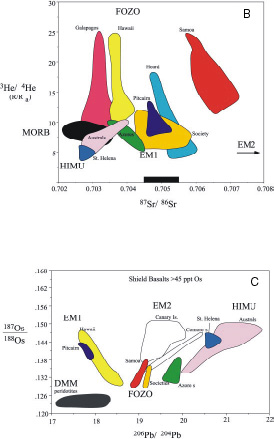
A) Mantle tetrahedron with components DM, EM1, EM2, HIMU) and FOZO (e.g. Hart et al. 1992; Condie 2001).
B) and C) Note patterns in Os and He converging toward FOZO (after van Keken et al. 2002).
Links with ore deposits:
At present the link between LIPs and ore deposits is poorly understood. The most important link is with PGEs. Prominent examples are the Noril’sk deposits (of the 250 Ma Siberian Trap event) which produce most of the world’s palladium and the 2060 Ma Bushveld intrusion which is the largest known mafic-ultramafic intrusion and is the world’s most important producer of platinum and chrome. Archean komatiites are also an important source of Ni.
Click to open/close References References
Naldrett, A.J., Key factors in the genesis of Noril'sk, Sudbury, Jinchuan, Voisey's Bay and other world-class Ni-Cu-PGE deposits: implications for exploration. Austral. J. Earth Sci. 44, 283-316, 1997.
Naldrett, A.J., World-class Ni-Cu-PGE deposits: key factors in their genesis. Mineralium Deposita, 34, 227-240, 1999.
Pirajno F. Ore Deposits and Mantle Plumes. Dordrecht, Neth: Kluwer Acad. 556 pp, 2000.
Schissel D, and R. Smail, Deep-mantle plumes and ore deposits. pp. 291—322. in: Ernst, R.E. and Buchan, K.L. (Eds.), Mantle Plumes: Their Identification Through Time. Geol. Soc. America Spec. Paper 352, 2001.
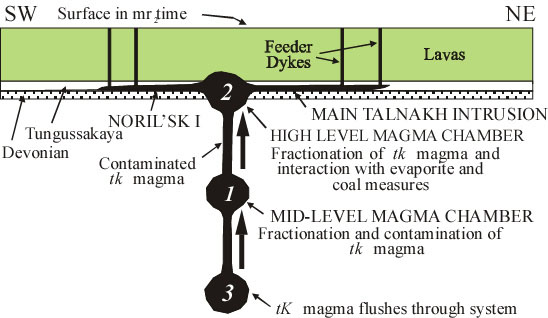
Model for feeder system of Norilsk deposits associated with the Siberian Traps (Naldrett 1997, 1999; Pirajno 2000, p. 432).
Testing plume & non-plume origins
A fundamental question in LIP research involves their origin. Many LIPs have been attributed to deep mantle plumes (e.g. Campbell et al. 1989; Griffiths and Campbell, 1990, 1991; Campbell 1998, 2001; Courtillot et al. 2003). Other models involve decompression melting in a rift setting (White and McKenzie, 1989, 1995), back-arc setting (Rivers and Corrigan 2000), edge-driven convection (Anderson, 1996, 1998; King and Anderson, 1998; Hames et al. 2003), and meteorite impact (Jones et al., 2002).
There is a pressing need for the development and application of a set of rigorous tests to distinguish between different origins for LIPs. Several possible tests include: seismic tomography; presence or absence of domal uplift; and relative timing of rifting and magmatism.
Click to open/close References References
Anderson, D.L., The edges of the mantle, In: Gurnis, M., M.E. Wysession, E. Knittle, B.A. Buffett, (eds.) The Core-Mantle Boundary Region. AGU Geodynamics Series 28, 255-271, 1996.
Burke K., The African Plate. S. Afr. J. Geol. 99:341-409, 1996.
Burke K, and J. Dewey, Plume-generated triple junctions: key indicators in applying plate tectonics to old rocks. J. Geol. 81: 406-433, 1973.
Wilson M, and R. Patterson, Intraplate magmatism related to short-wavelength convective instabilities in the upper mantle: Evidence from the Tertiary-Quaternary volcanic province of western and central Europe, In Ernst, R. E., and Buchan, K. L., eds. Mantle Plumes: Their Identification Through Time. Geological Society of America Special Paper 352: 37-58, 2001.
Campbell, I.H., The mantle’s chemical structure: insights from the melting products of mantle plumes. In: Jackson I.N.S., ed. The Earth’s Mantle: Composition, Structure and Evolution. New York: Cambridge Univ. Press, p. 259-310, 1998.
Campbell, I. H., Identification of ancient mantle plumes. In Ernst, R. E., and Buchan, K. L., eds. Mantle Plumes: Their Identification Through Time. Geological Society of America Special Paper 352: 1-21, 2001.
Campbell I.H., and R.W. Griffiths, Implications of mantle plume structure for the evolution of flood basalts. Earth Planet. Sci. Lett. 99, 79-93, 1990.
Campbell, I.H., R.W. Griffiths, and R.I. Hill, Melting in an Archaean mantle plume: heads it’s basalts, tails it’s komatiites. Nature 339, 697-699, 1989.
Coffin, M.F., and O. Eldholm, Large igneous provinces: crustal structure, dimensions, and external consequences. Rev. Geophys. 32, 1-36, 1994.
Cordery, M.C., G.F. Davies, and I.H. Campbell, Genesis of flood basalts from eclogite-bearing mantle plumes. J. Geophys. Res. 102, 20179-20197, 1997.
Courtillot V, C. Jaupart, I. Manighetti, P. Tapponnier, J. Besse , On causal links between flood basalts and continental breakup. Earth Planet. Sci. Lett. 166:177-195, 1999.
Courtillot, V., A. Davaille, J. Besse, and J. Stock, J. Three distinct types of hotspots in the Earth’s mantle. Earth Planet. Sci. Lett., 205, 295-308, 2003.
Cox, K.G., The role of mantle plumes in the development of continental drainage patterns. Nature 342: 873-77, 1989.
Czamannske, G.K., A.B. Gurevitch, V. Fedorenko, O. Simonov. Demise of the Siberian plume: Paleogeographic and paleotectonic reconstruction from the prevolcanic and volcanic records, north-central Siberia, Int. Geol. Rev., 40, 95-115, 1998.
Gower, C.F., and T.E. Krogh,. A U-Pb geochronological review of the Proterozoic history of the eastern Grenville Province. Can. J. Earth Sci., 39, 795-829, 2002.
Griffiths, R.W., and I.H. Campbell, Stirring and structure in mantle starting plumes. Earth Planet. Sci. Lett. 99, 66-78, 1990.
Griffiths, R.W., and I.H. Campbell. Interaction of mantle plume heads with the Earth’s surface and onset of small-scale convection. J. Geophys. Res., 96, 18295-18310, 1991.
Hames, W.E., J.G. McHone, P.R. Renne, and C. Ruppel (Eds.), The Central Atlantic Magmatic Province: insights from fragments of Pangea. American Geophysical Union, Geophysical Monograph 136, 267 p, 2003.
He, B, Y-G. Xu, S-L. Chung,, L. Xiao, Y. Wange, Sedimentary evidence for rapid, kilometer-scale crustal doming prior to the eruption fo the Emeishan flood basalts. Earth Planet. Sci. Lett., 213: 391-405, 2003.
Hill RI. Starting plumes and continental break-up. Earth Planet. Sci. Lett. 104: 398-416, 1991.
Jones, A.P., G.D. Price, N.J. Pricea, P.S. DeCarli, and R.A. Clegg, Impact induced melting and the development of large igneous provinces. Earth Planet. Sci. Lett. 202, 551-561, 2002.
King, S.D., and D.L. Anderson, Edge-driven convection. Earth Planet. Sci. Lett, 160, 289-296, 1998.
Menzies M.A., S.L. Klemperer, C.J. Ebinger, J. Baker. Characteristics of volcanic rifted margins. pp. 1-14, In: Menzies MA, Klemperer SL, Ebinger CJ, Baker J, eds. Volcanic Rifted Margins GSA Spec. Pap. 362. 230 p., 2002.
Meyers, J.B., B.R. Rosendahl, C.G.A. Harrison, and Z.D. Ding, Deep-imaging seismic and gravity results from the offshore Cameroon Volcanic Line, and speculation of African hotlines. Tectonophysics 284, 31-63, 1998.
Pavoni N., Geotectonic bipolarity- evidence of bicellular convection on the Earth’s mantle. S. Afr. J. Geol. 100: 291—99, 1997.
Rainbird R, and R.E. Ernst, The sedimentary record of mantle-plume uplift, In:Ernst, R.E., Buchan. K.L. (Eds.), Mantle Plumes: Their Identification Through Time. Geol. Soc. America Spec. Paper 352, p. 227-245, 2001.
Ritsema, J., and R.M. Allen, The elusive mantle plume. Earth Planet. Sci. Lett., 207, 1-12, 2003.
Rivers, T., and D. Corrigan, Convergent margin on southeastern Laurentia during the Mesoproterozoic: tectonic implications. Can. J. Earth Sci. 37, 359-383, 2000.
S¸engör, A.M.C., Elevation as indicator of mantle-plume activity. In: Ernst, R.E. and Buchan, K.L. (Eds.), Mantle Plumes: Their Identification Through Time. Geol. Soc. America Spec. Paper 352, 183-225, 2001.
Sengör, A.M.C. and B.A. Natal’in, Rifts of the world. In: Ernst, R.E. and K.L. Buchan, (Eds.), Mantle Plumes: Their Identification Through Time. Geol. Soc. America Spec. Paper 352, 389-482, 2001.
White, R.S. and D. McKenzie, Magmatism at rift zones: the generation of volcanic continental margins and flood basalts. J. Geophys. Res. 94, 7685-7729, 1989
White RS, and D. McKenzie, Mantle plumes and flood basalts. J. Geophys. Res. 100, 17543-17585, 1995.
Zhao D. Seismic structure and origin of hotspots and mantle plumes. Earth Planet. Sci. Lett. 192, 251-265, 2001.
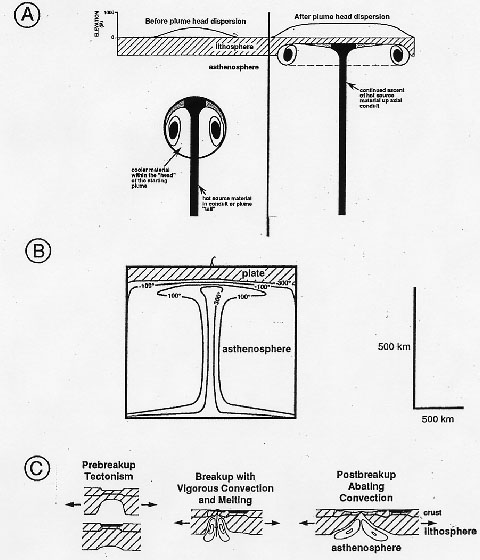
Models for origin of Large Igneous Provinces. After Coffin and Eldholm (1994).
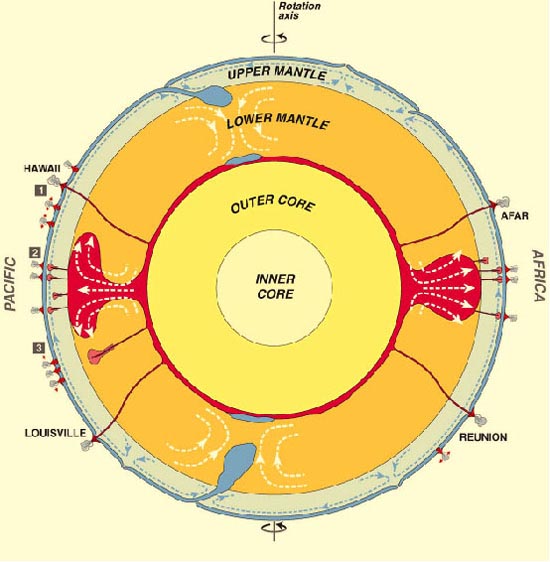
Three distinct types of hotspots in the Earth’s mantle (after Courtillot et al. 2003)
Seismic tomography:
Seismic tomography offers the most direct method of assessing temperature and compositional variations in the mantle beneath a LIP. Hence, the shape, size and location of zones of anomalous mantle linked to the generation of a LIP can be imaged and interpreted in terms of LIP origin. For example, a deep mantle plume tail should yield a long narrow anomaly extending upward from the vicinity of the core-mantle boundary. However, at present tomography has insufficient resolution to image plume tails (e.g. Ritsema and Allen 2003). An upwelling at the core-mantle boundary should produce a broad anomaly in the lower mantle. Such anomalies have been imaged beneath the Afar region of Africa and beneath the western Pacific Ocean. Once again, resolution is not sufficient at present to determine if narrow plumes are spawned from the top of such upwellings as proposed by Courtillot et al. (2003).
Presence or absence of domal uplift:
Broad domal uplift is a key test for the existence of a plume (Sengor 2001). The nature and timing of this uplift has been calculated by Griffiths and Campbell, 1991. However, it is important to note that the plume hypothesis only predicts magnitude and timing of uplift prior to volcanism. As Campbell (2001) has pointed out, lateral redistribution of magma away from the central region can reduce or remove the pre-volcanic uplift.
The best studied LIPs are of young (Cenozoic-Mesozoic age). Cox (1989) identified domical uplift in the Parana, Deccan and Karoo LIPs by the presence of a radiating pattern of river drainage. The Central Atlantic Magmatic Province was associated with an uplift radius of about 1000 km; this is inferred from the interruption of the sedimentation pattern in pre-existing rift basins (Hill, 1991; Rainbird and Ernst, 2001). An uplift radius of about 800 km is determined from stratigraphic patterns associated with the 258 Ma Emeishan event (He et al., 2003). In contrast the Siberian Traps seem to lack associated uplift (Czamanske et al., 1998).
Relative timing of rifting & magmatism:
It has been shown that many LIPs are associated with continental rifting and breakup events (e.g. Hill, 1991; Courtillot et al., 1999). A plume origin for a LIP requires that initial volcanism precedes rifting (Campbell and Griffiths, 1990). However, this does not preclude a second pulse of volcanism associated with the rifting itself or even later volcanism associated with the plume tail. On the other hand, models in which LIPs are generated by decompression melting associated with rifting (White and McKenzie, 1989) or by edge-driven convection associated with discontinuities in the thickness of the lithosphere at the edge of cratons (Anderson, 1998) require that rifting precede LIP volcanism.
Distribution of LIPs in space and time (Archean to Present)
Link with climatic change and extinction events:
Numerous studies have explored the link between LIPs and climate change and extinction events. Climate change can be monitored through changes in seawater isotopic chemistry recorded by marine carbonates, and changes in faunal and floral abundances.
Click to open/close References References
Coffin, M. F., and O. Eldholm, Large igneous provinces: crustal structure, dimensions, and external consequences. Rev. Geophys. 32:1-36, 1994.
Condie KC., Mantle Plumes and Their Record in Earth History. Oxford, UK: Cambridge Univ. Press. 306 pp., 2001.
Courtillot V, J.J. Jaeger, Z. Yang, G. Féraud, C. Hofmann,.The influence of continental flood basalts on mass extinctions: where do we stand? GSA Spec. Pap. 307: 513-525, 1996.
Courtillot, V.E. and P.R. Renne, On the ages of flood basalt events. C.R. Geoscience 335: 113-140, 2003.
Ernst, R. E., and K.L. Buchan, Recognizing mantle plumes in the geological record. Ann. Rev. Earth Planet. Sci. 31, 469-523, 2003.
Rampino, M. R., and K. Caldeira, Major episodes of geologic change: correlations, time structure and possible causes. Earth Planet.Sci. Lett. 114:215-227, 1993.
Stothers, R.B. 1993. Flood basalts and extinction events. Geophys. Res. Lett. 20, 1399-1402.
Wignall PB., Large igneous provinces and mass extinctions. Earth-Sci. Rev. 53:1—33, 2001.
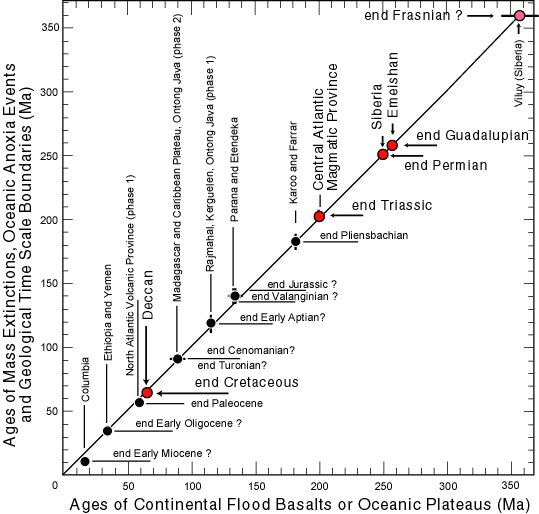
Age correlations between LIP events and major extinction events (after Courtillot and Renne 2003).
Time series analysis of LIP record:
A recent wavelet analysis of the Ernst and Buchan database reveals only weakly developed cycles during the period 3500-present (Prokoph et al., 2003), broadly similar to the results of the fourier analysis of Isley and Abbott (2002). These cycles are at 730-550, 330, 170, 100, and 30 Myr. However, given the broadband nature and weak persistence of most of these cycles, their significance and link with forcing functions remains uncertain.
Possible controls on LIP production that have been previously advanced included: a 800 Myr nutation frequency of the core, a 300-500 Myr supercontinent formation/breakup, and 30 Myr meteorite impact cycle (Isley and Abbott, 2002). As the LIP database improves, appropriate time series analysis (including wavelet analysis) will yield more definitive results.
Click to open/close References References
Ernst, R.E., and K.L. Buchan, Large mafic magmatic events through time and links to mantle plume heads. In Ernst, R.E., and K.L. Buchan, eds. Mantle Plumes: Their Identification Through Time. Geological Society of America Special Paper 352: 483-575, 2001.
Ernst, R.E., and K.L. Buchan, Maximum size and distribution in time and space of mantle plumes: evidence from large igneous provinces. In: Condie, K.C., D. Abbot, D.J. Des Marais, (Eds.), Superplume Events in Earth’s History: Causes and Effects, J. Geodynamics (Special Issue), 34: 309-342, 2002 [Erratum, J. Geodynamics, 34:711-714, 2002].
Isley, A. E., and D.H. Abbott, Plume-related mafic volcanism and the deposition of banded iron formation. J. Geophys. Res. 104:15461-15478, 1999.
Isley, A. E., and D.H. Abbott, Implications for the temporal distribution of high-Mg magmas for mantle plume volcanism through time. J. Geol. 110:141-158, 2002.
Prokoph, A., R.E. Ernst, and K.L. Buchan, K.L. Time-series analysis of large igneous provinces: 3500 Ma to present. J. Geol., in press.
Yale, L. B., and S.J. Carpenter, Large igneous provinces and giant dike swarms: proxies for supercontinent cyclicity and mantle convection. Earth Planet. Sci. Lett. 163:109-122, 1998.
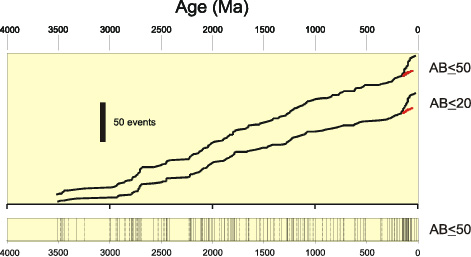
Time series analysis of LIPs through time. Upper part is cumulative percentage diagram showing nearly constant rate of 1 LIP per 20 Myr for post-Archean time. The two curves are based on different age uncertainty criteria; details are in Ernst and Buchan (2002). ‘Bar-code’ diagram shows distribution of events (Ernst and Buchan 2001).
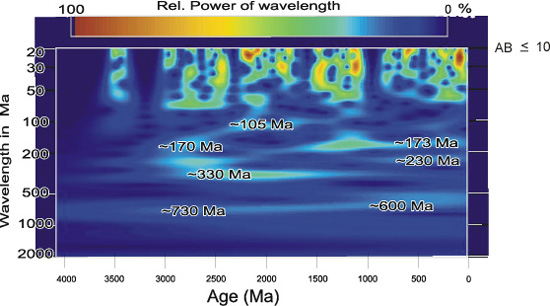
Wavelet analysis revealing weak cycles at 730-550, 230, and 170 Myr (after Prokoph et al. in press).
LIP clusters (“superplume events”), and link with supercontinent breakup and juvenile crust production:
Clusters of LIPs have been linked with supercontinent breakup (Storey, 1995; Li et al., 2003) and with bursts of juvenile crustal production (Condie, 2001). Therefore, an important frontier is the use of the expanded LIP record through time to assess their importance in the geological record. At about 30 times since 3.5 Ga, coeval mafic magmatism is recognized on more than one continental block (Ernst and Buchan, 2001, 2003). However, the absence of reliable Precambrian continental reconstructions (Buchan et al., 2000, 2001) prevents the assessment of which of these represent single fragmented LIPs and which represent clusters of independent LIPs. Determination of reliable Precambrian reconstructions is therefore an important LIP frontier.
Click to open/close References References
Buchan, K.L. S. Mertanen, R.G. Park, J.L. Pesonen, S.- Å Elming, N. Abrahamsen, and G. Bylund. Comparing the drift of Laurentia and Baltica in the Proterozoic: the importance of key palaeomagnetic poles. Tectonophys. 319: 167-198, 2000.
Buchan KL, R.E. Ernst, M.A. Hamilton, S. Mertanen, L.J. Pesonen, and S-Å. Elming, Rodinia: the evidence from integrated palaeomagnetism and U-Pb geochronology. Precambrian Res. 110: 9-32, 2001.
Condie, K.C., Episodic continental growth and supercontinents: A mantle avalanche connection? Earth Planet. Sci. Lett. 163, 97-108, 1998.
Condie KC., Mantle Plumes and Their Record in Earth History. Oxford, UK: Cambridge Univ. Press. 306 pp., 2001.
Condie, K. C., The supercontinent cycle: are there two patterns of cyclicity? J. Afr. Earth Sci. 35:179-183, 2002.
Ernst, R.E., and K.L. Buchan, Large mafic magmatic events through time and links to mantle plume heads. In Ernst, R.E., and K.L. Buchan, eds. Mantle Plumes: Their Identification Through Time. Geological Society of America Special Paper 352:483-575, 2001.
Ernst, R.E., and K.L. Buchan, Maximum size and distribution in time and space of mantle plumes: evidence from large igneous provinces. In: Condie, K.C., D. Abbott, and D.J. Des Marais (Eds.), Superplume Events in Earth’s History: Causes and Effects, J. Geodynamics (Special Issue), 34:309-342, 2002 [Erratum, J. Geodynamics, 34:711-714, 2002].
Storey BC., The role of mantle plumes in continental breakup: case histories from Gondwanaland. Nature 377: 301-308, 1995.
Li, Z.X., X.H. Li, P.D. Kinny, J. Wang, S. Zhang, H. Zhou, Geochronology of Neoproterozoic syn-rift magmatism in the Yangtze Craton, South China and correlations with other continents: evidence for a mantle superplume that broke up Rodinia. Prec. Res., 122: 85-109, 2003..
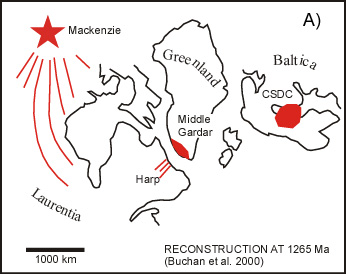
A) Evidence for more than one centre at 1270 Ma. Mackenzie gaint radiating dyke swarm of northern Canada is too distant from Central Scandinavian Dolerite sill Complex of Baltica to be related to the same event. Harp dyke swarm and coeval Gardar magmatism may represent a third node of activity (after Ernst and Buchan 2002).
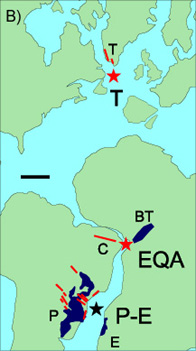
B) Multiple centres of activity at 135 Ma (Ernst and Buchan 2002).
Comparison of LIPs on Earth, Venus and Mars
Plate tectonics; coronae: LIPs are present on both Mars and Venus (Head and Coffin, 1997). On Mars they consist of massive individual volcanic edifices of the Tharsis Montes region and individual flows that can be 1800 km long (Fuller and Head, 2003). On Venus, they are associated with large flow fields averaging 0.2 Mkm2, and large volcanic edifices hundreds of km across. In addition, an important class of LIPs on Venus is associated with widespread annular structures (diameter 50-2600 km) termed coronae, which are interpreted to result from mantle diapirs. Does erosion mask identification of their characteristic annular topography or were coronae never present on Earth?
Difference between LIPs on Mars and Venus and those on Earth are thought to reflect, at least in part, the absence of plate tectonics on Mars and Venus. Therefore, LIPs on these planets can be studied in the context of non-plate boundary (in traplate) processes.
Click to open/close References References
Ernst, R.E. and D.W. Desnoyers, Lessons for Venus for understanding mantle plumes on Earth. Special issue of Physics of the Earth and Planetary Interiors, submitted.
Fuller, E.R., and J.W. Head, Olympus Mons, Mars: Detection of extensive preaureole volcanism and implications for initial mantle plume behavior, Geology 31: 175-178, 2003.
Head, J.W., and M.F. Coffin, Large Igneous Provinces: A planetary perspective. In: Mahoney, J.J., and M.F. Coffin, (Eds.), Large Igneous Provinces: Continental, Oceanic and Planetary Flood Volcanism. American Geophys. Union, Geophys. Monograph 100, 411-438, 1997.
Crumpler, L.S., and J.C. Aubele, Volcanism on Venus. In: Sigurdsson, H. (Ed.), Encyclopedia of Volcanoes. Academic Press, San Diego, pp. 727-769, 2000.
Hansen, V.L., J.J. Willis, and W.B. Banerdt, Tectonic overview and synthesis. In: Bougher, S.W., Hunten, D.M., Phillips, R.J. (Eds.). Venus II: Geology, Geophysics, Atmosphere, and Solar Wind Environment, pp. 797-844, Univ. of Arizona Press, Tucson, Arizona, 1997.
Jellinek, A.M., A. Lenardic, and M. Manga, The influence of interior mantle temperature on the structure of plumes: heads for Venus, tails for the Earth. Geophys. Res. Lett. 29, 11, 10.1029/2001GL014624, 2002.
Magee, K.P., and J.W. Head, Large flow fields on Venus: implications for plumes, rift associations, and resurfacing. In: Ernst, R.E., K.L. Buchan (Eds.), Mantle Plumes: Their Identification Through Time. Geol. Soc. America Special Paper 352, 81-101, 2001.
Squyres, S.W., D.M. Janes, G. Baer, D.L. Bindschadler, G. Schubert, V.L. Sharpton, E.R. Stofan, The morphology and evolution of coronae on Venus. J. Geophys. Res. 97: 13611-13634, 1992.
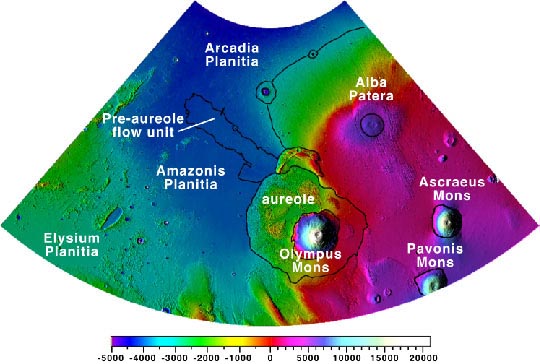
1800 km long and 300 km wide preaureole lave flow emanating from Olympus Mons, Mars (Fuller and Head 2003).
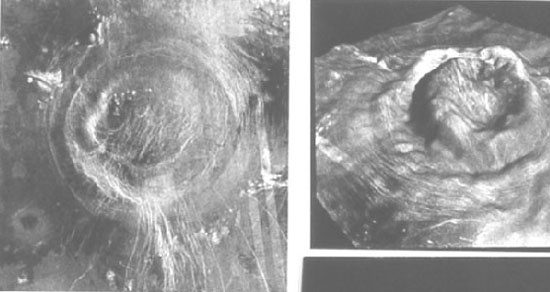
Fatua corona, Venus (image 690 km across). After Squyres et al. (1992).