
2026 September LIP of the Month
700 to 694 Ma Olumi Sumbi large igneous province emplaced in the middle Sturtian cryochron
Cedric Djeutchou1,2, Frantz G. Ossa Ossa1,2,3, Ulf Söderlund4,5, HervéWabo3, Michiel de Kock3, Hafida El Bilali6, Richard E. Ernst6, Axel Hofmann3 & Andrey Bekker3,7
1Earth Sciences Department, Khalifa University of Science and Technology, P.O. Box: 127788, Abu Dhabi, United Arab Emirates
2Polar Research Center, Khalifa University of Science and Technology, P.O. Box: 127788, Abu Dhabi, United Arab Emirates
3Department of Geology, University of Johannesburg, PO Box 524, Auckland Park 2006, South Africa
4Department of Geology, Lund University, Lund 223 62, Sweden
5Department of Geosciences, Swedish Museum of Natural History, Stockholm 104 05, Sweden
6Department of Earth Sciences, Carleton University, Ottawa, ON, Canada
7Department of Earth & Planetary Sciences, University of California, Riverside, CA 92521, USA
Extracted and modified from:
Djeutchou, C., Ossa, F.O., Söderlund, U., Wabo, H., de Kock, M., Bilali, H.E., Ernst, R.E., Hofmann, A. and Bekker, A., 2026. 700 to 694 Ma Olumi Sumbi large igneous province emplaced in the middle Sturtian cryochron. Communications Earth & Environment. https://doi.org/10.1038/s43247-026-03984-0
Abstract
The Sturtian Snowball Earth interval (ca. 717–660 Ma) represents the longest known episode of global glaciation, but the processes responsible for maintaining such prolonged icehouse conditions remain uncertain. New high-precision ID-TIMS U–Pb baddeleyite dates of 700.6 ± 9.5 Ma from the Olumi dolerite dyke swarm in Gabon and 694.0 ± 2.0 Ma from the Sumbi dolerite sills in the Democratic Republic of Congo identify a previously unrecognized ca. 700–694 Ma Olumi–Sumbi large igneous province (LIP). Paleomagnetic data from the Olumi dykes indicate emplacement at low paleolatitudes, implying that the Congo Craton was positioned close to the equator at this time. In combination with the ca. 719 Ma Franklin LIP, these low-latitude magmatic events may have played a role not only in the onset but also in the prolonged development of the Sturtian glaciation. Individual magmatic pulses could initially have promoted short-lived warming through volcanic CO₂ release, whereas subsequent rapid weathering of fresh mafic rocks would have enhanced atmospheric CO₂ consumption and favoured a return to extensive ice cover. The occurrence of major LIP magmatism in tropical regions may therefore have been an important control on the climatic evolution and persistence of the Sturtian Snowball Earth.
Introduction
Large igneous provinces (LIPs) expose extensive basaltic surfaces that consume atmospheric CO2 through silicate weathering, particularly under the warm, humid conditions of tropical latitudes (Dessert et al., 2001; Donnadieu et al., 2006; Johansson et al., 2018). Low-latitude LIP emplacement can therefore enhance CO2 drawdown and potentially trigger or sustain global glaciation. The Franklin LIP, emplaced at low latitudes shortly before the Sturtian glaciation (ca. 719–659 Ma), has been linked to glacial onset through two mechanisms: prolonged CO2 consumption by basalt weathering and transient cooling from volcanic sulfate aerosols (Ernst & Youbi,2017; Donnadieu et al., 2006; Pu et al., 2022; Cox et al., 2016; Denyszyn et al., 2009; Macdonald et al., 2010). Constraining the timing and paleolatitude of other Neoproterozoic magmatic events is therefore essential for evaluating their role in Sturtian cryochron evolution.
The Congo Craton preserves Neoproterozoic glacial successions, but its paleogeography and regional LIP record remain poorly constrained by limited paleomagnetic data and precise emplacement ages (Straathof, 2011; Trindade et al., 2021; Li et al., 2008; Johansson et al., 2014). Here, we present high-precision U–Pb isotope-dilution thermal-ionization mass-spectrometry (ID-TIMS) baddeleyite ages for an Olumi dyke intruding the Paleoproterozoic Francevillian Group in Gabon and a Sumbi sill intruding Sturtian glacial deposits of the West Congolian Group in the Democratic Republic of Congo (Figure 1). Combined with high-temperature paleomagnetic data from the dated dyke, these results indicate that this magmatism occurred at tropical latitudes during the Sturtian cryochron. Our findings suggest that low-latitude LIPs may have modulated climatic oscillations between colder and relatively warmer intervals, helping sustain glacial conditions during the Sturtian cryochron.
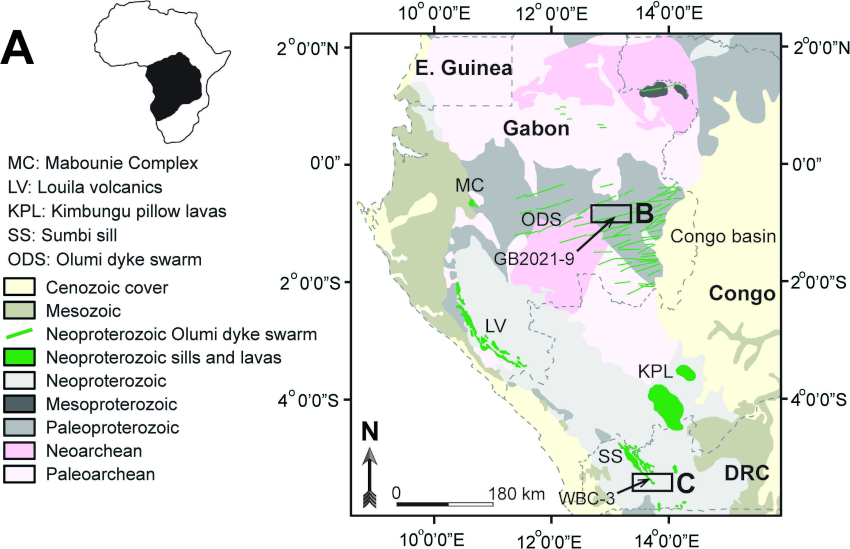
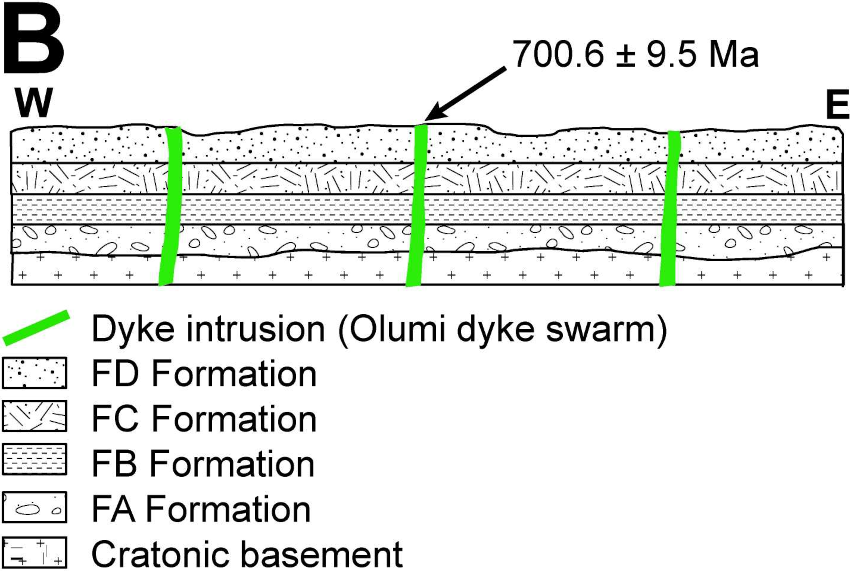
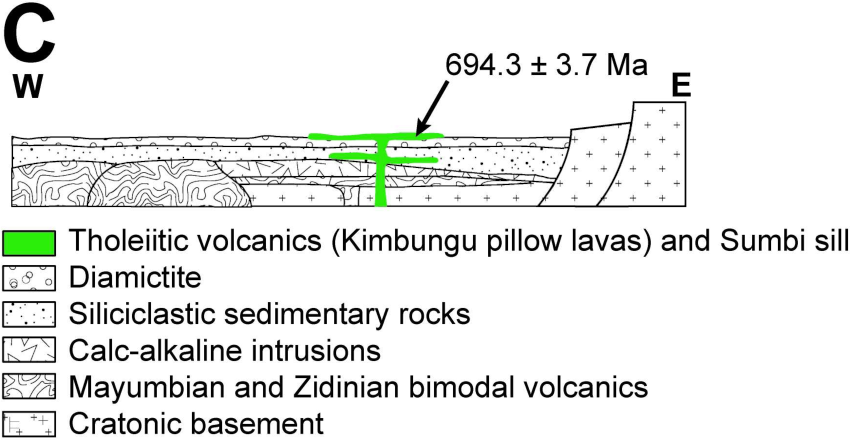
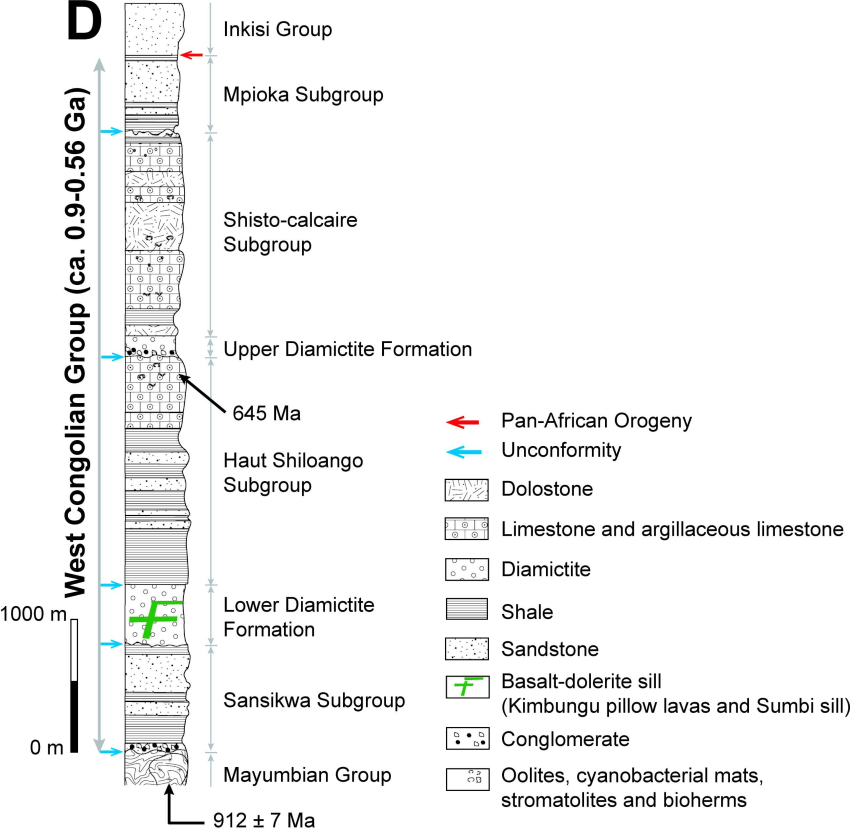
Figure 1. Simplified geological map of the Congo Craton. A sampling site. B, C Simplified cross-sections of the Francevillian and West Congolian basins showing dolerite intrusions. D Stratigraphic column of the West Congolian Group (Straathof, 2011).
Results
Geochronology
Approximately 30 grains of light-brown, euhedral, well-preserved, and unaltered baddeleyite crystals, up to ~100 microns in length, were recovered from the Olumi dyke sample (GB2021-9; coordinates 00° 52' 30.5'' S, 012° 58' 28.6'' E) via mineral separation. The baddeleyite grains were grouped into three fractions, each comprising 3 to 4 grains, and analyzed using the ID-TIMs method. The U-Pb data overlap and plot concordantly within analytical uncertainties (Fig. 2A). The Concordia age is 696.1 ± 5.1 Ma, and the weighted mean of 207Pb/206Pb dates is 700.6 ± 9.5 Ma (MSWD = 1.0; Fig. 2A), taken as the best age estimate for the Olumi dyke. The mineral separation and analytical procedures for the Sumbi sill sample (WBC-3, coordinates 04° 56' S, 13° 36' E) followed those for the Olumi dyke, and baddeleyite grains up to ~100 µm in length were extracted. The three baddeleyite fractions plot variably discordant, with two fractions intersecting the Concordia curve within 2s errors. Regression yields an upper intercept of 694.0 ± 2.0 Ma when using a forced lower intercept of 0 ± 100 Ma (MSWD = 0.10) (Fig. 2B). The 694.0 ± 2.0 Ma intercept is interpreted as the crystallization age of the Sumbi sill.
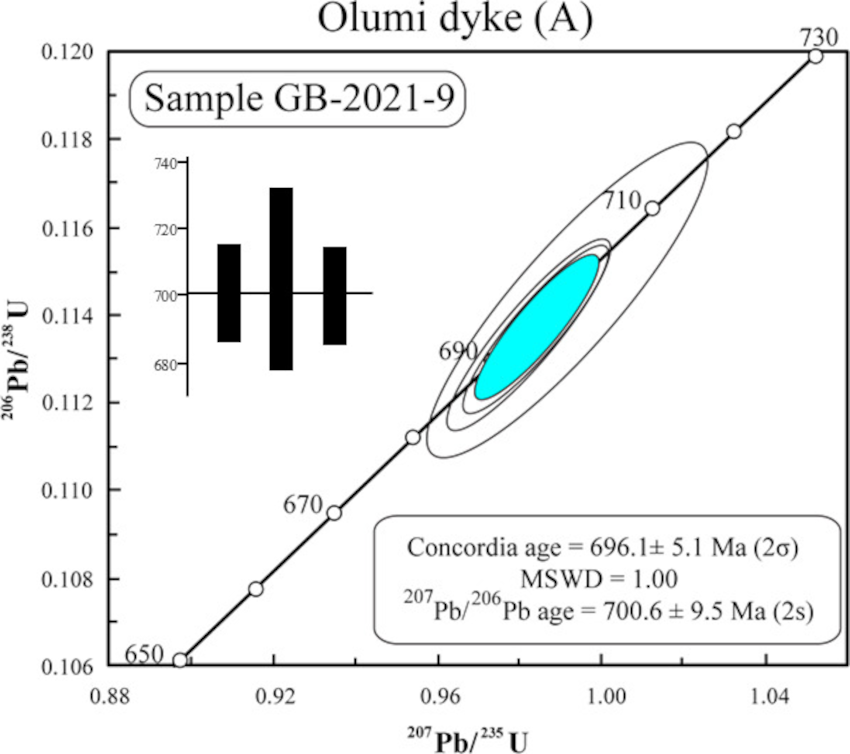
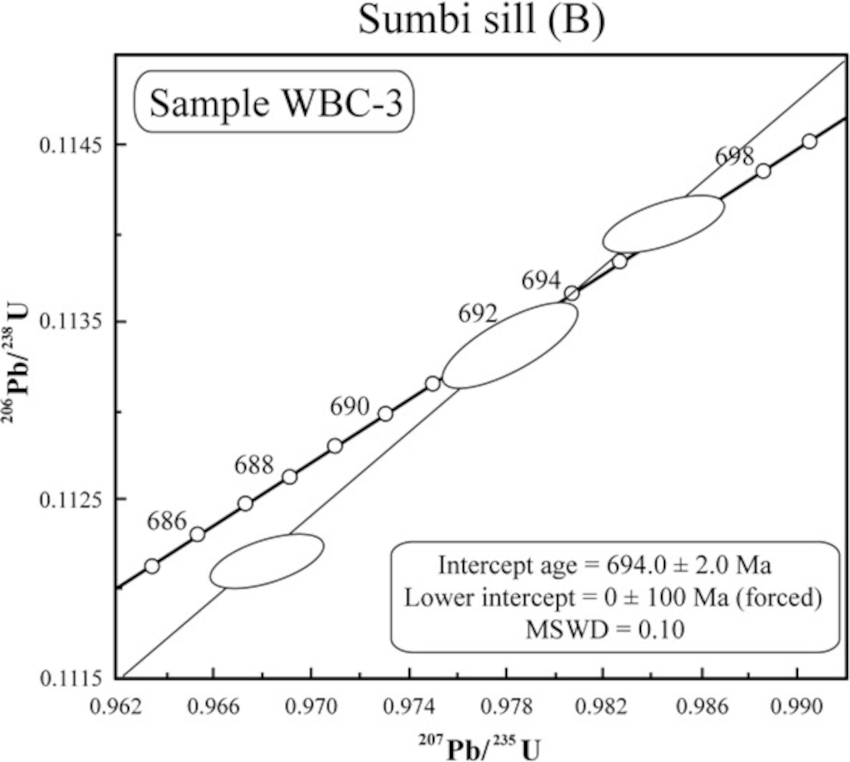
Figure 2. U-Pb ID-TIMS baddeleyite ages for the Olumi dyke (A) and Sumbi sill (B). The inset in A shows 207Pb/206Pb dates in Myrs for the three fractions of the Olumi dyke analyzed (2s errors).
Paleomagnetism
All seven specimens from the dated Olumi dyke (GB2021-9) displayed consistent demagnetization behavior, revealing two magnetic components. Below 350°C, a low-temperature component (LOW) with shallow inclinations was observed, with four samples clustering in the southeast-up direction (D=114.7°, I=–25.1°, α95=12.6°, n=4; Fig. 3A). A southeast-down, shallow inclined high-temperature component (HIG) unblocked around 550°C (D=99.7°, I=23.2°, α95=8.9°, n=7; Fig. 3B). Variation of magnetic susceptibility upon heating revealed a Hopkinson peak followed by a sharp drop in susceptibility at 540°C (i.e., the Curie point), suggesting the dominance of titanomagnetite as a magnetic carrier. High susceptibilities above 600°C, observed upon cooling, revealed the presence of hematite, likely formed by the inversion of maghemite and/or goethite during thermal treatment. Samples 8 and 9, drilled from quartz sandstone approximately 60 cm and 1 m from the dyke margin, respectively, both carried a high-stability magnetization that is indistinguishable from the HIG of the dyke. However, sample 10, collected from unbaked quartz sandstone some 3 m away from the dyke, displayed a direction clearly different from the HIG direction. Although a small number of unbaked samples do not allow a robust constraint on the unbaked direction, the test nevertheless provides support for the primary nature of the HIG direction.
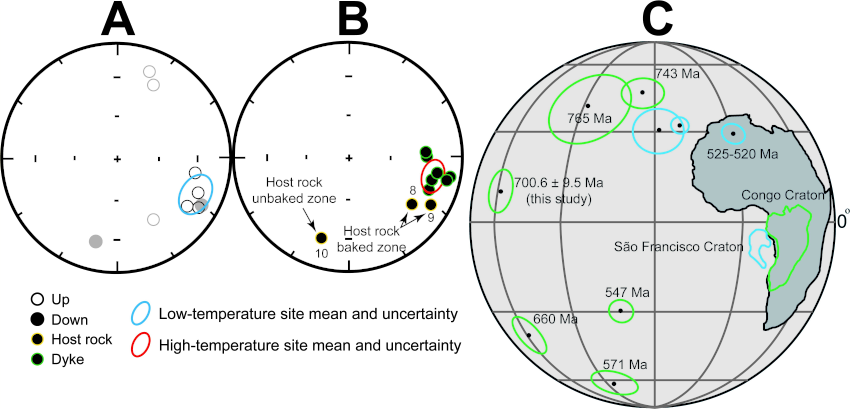
Figure 3. Low-temperature (A) and high-temperature (B) remanence directions for the Olumi dyke specimens and the host rock. Filled = down; open = up. Ellipses show α95 confidence cones. Virtual geomagnetic pole (VGP) for the Olumi dyke compared to the Congo and São Francisco craton paleopoles (C).
Discussion
The U–Pb ID-TIMS baddeleyite ages of 700.6 ± 9.5 Ma for the Olumi dyke and 694 ± 2.0 Ma for the Sumbi sill overlap within uncertainty, supporting a ca. 700–694 Ma magmatic event across the Congo Craton. These intrusions, separated by approximately 300 km, together with their tentative association with the Kimbungu pillow lavas in the Lower Diamictite Formation (De Paepe et al., 1975), suggest a newly recognized Olumi–Sumbi LIP. Broadly contemporaneous magmatism in the São Francisco Craton and Laurentia places this event within a wider interval of Cryogenian magmatic activity (Ernst & Bleeker, 2010; Da Silva Rosa et al., 2007; Teixeira et al., 1997). However, the extent, origin, and regional correlations of the proposed province require further investigation. The high-temperature remanence of the dated Olumi dyke is interpreted as primary, although limitations of the baked contact test leave some uncertainty. The resulting virtual geomagnetic pole (VGP) indicates a paleolatitude of approximately 12.1°, supporting reconstructions that place the Congo Craton near the equator during the Sturtian glaciation (Hoffman et al., 2017; Zhang et al., 2013). Because this result represents a single dyke and does not provide a time-averaged paleomagnetic pole, it offers only a first-order paleolatitude constraint and is insufficient for robust global reconstructions. Nevertheless, its radiometric age supports the emplacement of the Olumi–Sumbi magmatism in a tropical setting during the Sturtian cryochron. The Olumi–Sumbi LIP occurred approximately 40 Myr before the Sturtian cryochron termination and broadly coincided with records interpreted as reflecting glacial–interglacial variability in South China and Laurentia (Lan et al., 2015; Lund et al., 2003) (Figure 4). Volcanic CO2 emissions could have promoted warming, whereas sulfate aerosols would have produced cooling too brief to sustain the prolonged glaciation (Hoffman et al., 2017; Macdonald & Wordsworth, 2017; McKenzie et al., 2016). A longer-term climatic influence may instead have involved renewed weathering of tropical basalts exposed during warmer intervals, drawing down CO2 and promoting renewed glaciation after episodes of volcanic CO2 accumulation (Cox et al., 2016; Crowley et al., 2001). Such feedback could have supported repeated climatic oscillations over tens of millions of years. Subglacial and seafloor weathering may also have contributed to carbon sinks, while differences in deglaciation thresholds offer an alternative explanation for the exceptional duration of the Sturtian cryochron (Hoffman et al., 2017; Kadoya & Daswani, 2026). Our findings, therefore, suggest that tropical LIPs helped modulate the Sturtian cryochron, although their causal role and contribution to glacial duration remain unresolved.
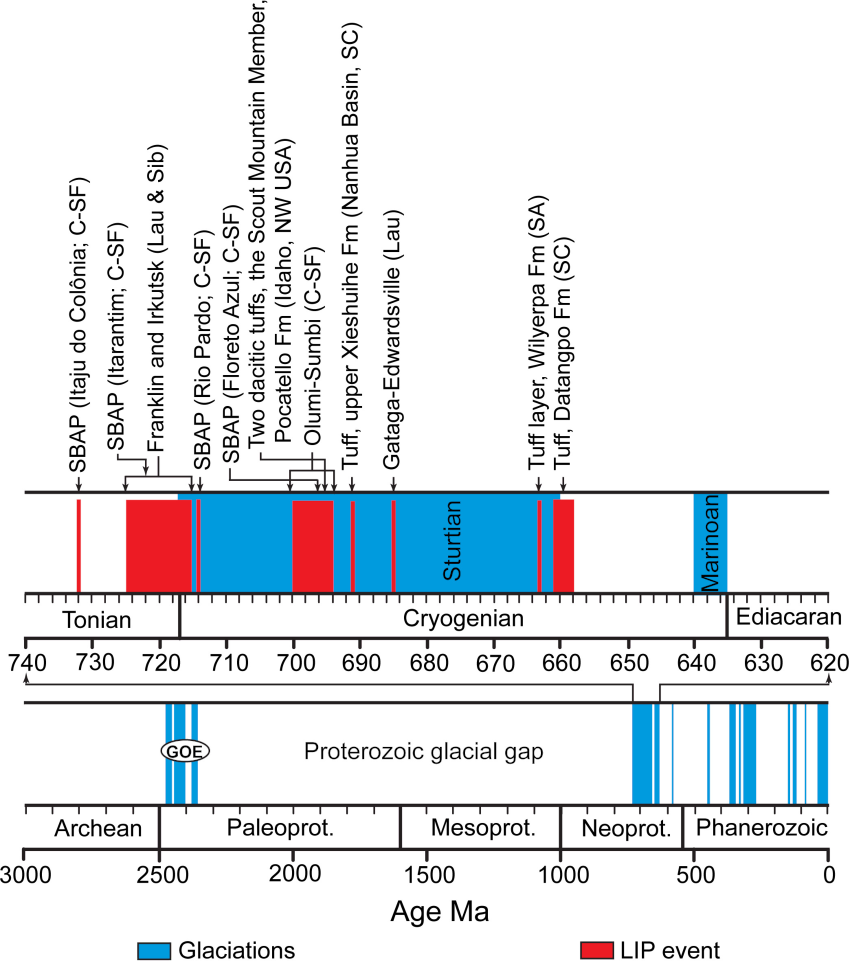
Figure 4. Sturtian and Marinoan cryochrons vs. LIP emplacements modified from (Hoffman et al., 2017).SBAP: Southern Bahia Alkaline Province; Lau: Laurentia; Sib: Siberia; SA: South Australia; SC: South China; C-SF: Congo-São Francisco cratons. Olumi-Sumbi; SBAP (Da Silva Rosa et al., 2007); Franklin (Macdonald et al., 2010); Irkutsk (Ernst et al., 2016); tuff layer of the Wilyerpa Formation (Cox et al., 2016); tuffs at the base of the Datangpo Formation (Xu et al., 2024); Gataga–Edwardsville (Ernst et al., 2010; Le Hir et al., 2008); tuff of the upper Xieshuihe Formation from the Nanhua Basin, South China (Lan et al., 2015); two dacitic tuffs of the Scout Mountain Member, Pocatello Formation (Idaho, NW USA) (Lund et al., 2003; Lund et al., 2010) are labeled.
Conclusion
The prolonged Sturtian cryochron likely reflected interacting atmospheric, terrestrial, and oceanic processes. Tropical emplacement of the pre-glacial Franklin LIP (ca. 719 Ma) may have promoted cooling through enhanced silicate weathering and CO2 drawdown. Subsequent emplacement of the syn-glacial Sumbi–Olumi LIP (ca. 700–694 Ma) and coeval magmatic events may have modulated atmospheric CO2 through volcanic outgassing and basalt weathering, contributing to climatic variability and the persistence of the Sturtian cryochron.
References
Cox, G. M. et al. Continental flood basalt weathering as a trigger for Neoproterozoic Snowball Earth. Earth Planet. Sci. Lett. 446, 89–99 (2016).
Crowley, T. J., Hyde, W. T. & Peltier, W. R. CO2 levels required for deglaciation of a “near-snowball” Earth. Geophys. Res. Lett. 28, 283–286 (2001).
Da Silva Rosa, M. L. et al. Neoproterozoic anorogenic magmatism in the Southern Bahia Alkaline Province of NE Brazil: U–Pb and Pb–Pb ages of the blue sodalite syenites. Lithos 97, 88–97 (2007).
De Paepe, P., Hertogen, J. & Tack, L. Mise en évidence de laves en coussins dans les faciès volcaniques basiques du massif de Kimbungu (Bas-Zaïre) et implications pour le magmatisme ouest-congolien. Ann. Soc. Geol. Belg. 98, 251–270 (1975).
Denyszyn, S. W., Halls, H. C., Davis, D. W. & Evans, D. A. D. Paleomagnetism and U–Pb geochronology of Franklin dykes in high Arctic Canada and Greenland: a revised age and paleomagnetic pole constraining block rotations in the Nares Strait region. Can. J. Earth Sci. 46, 689–705 (2009).
Dessert, C. et al. Erosion of Deccan Traps determined by river geochemistry: impact on the global climate and the ⁸⁷Sr/⁸⁶Sr ratio of seawater. Earth Planet. Sci. Lett. 188, 459–474 (2001).
Donnadieu, Y. et al. A GEOCLIM simulation of climatic and biogeochemical consequences of Pangea breakup. Geochem. Geophys. Geosyst. 7, Q11P19 (2006).
Ernst, R. E. & Bleeker, W. Large igneous provinces (LIPs), giant dyke swarms, and mantle plumes: significance for breakup events within Canada and adjacent regions from 2.5 Ga to the present. Can. J. Earth Sci. 47, 695–739 (2010).
Ernst, R. E. & Youbi, N. How large igneous provinces affect global climate, sometimes cause mass extinctions, and represent natural markers in the geological record. Palaeogeogr. Palaeoclimatol. Palaeoecol. 478, 30–52 (2017).
Ernst, R. E. et al. Long-lived connection between southern Siberia and northern Laurentia in the Proterozoic. Nat. Geosci. 9, 464–469 (2016).
Hoffman, P. F. et al. Snowball Earth climate dynamics and Cryogenian geology–geobiology. Sci. Adv. 3, e1600893 (2017).
Johansson, Å. From Rodinia to Gondwana with the “SAMBA” model — a distant view from Baltica towards Amazonia and beyond. Precambrian Res. 244, 226–235 (2014).
Johansson, L., Zahirovic, S. & Müller, R. D. The interplay between the eruption and weathering of large igneous provinces and the deep-time carbon cycle. Geophys. Res. Lett. 45, 5380–5389 (2018).
Kadoya, S. & Daswani, M. M. Continued continental weathering during Snowball Earth mitigated greenhouse gas buildup and prolonged global glaciation. Earth Planet. Sci. Lett. 679, 119837 (2026).
Lan, Z., Li, X.-H., Zhang, Q. & Li, Q.-L. Global synchronous initiation of the 2nd episode of Sturtian glaciation: SIMS zircon U–Pb and O isotope evidence from the Jiangkou Group, South China. Precambrian Res. 267, 28–38 (2015).
Le Hir, G., Ramstein, G., Donnadieu, Y. & Goddéris, Y. Scenario for the evolution of atmospheric pCO₂ during a snowball Earth. Geology 36, 47–50 (2008).
Li, Z. X. et al. Assembly, configuration, and break-up history of Rodinia: a synthesis. Precambrian Res. 160, 179–210 (2008).
Lund, K. et al. SHRIMP U-Pb dating of recurrent Cryogenian and Late Cambrian–Early Ordovician alkalic magmatism in central Idaho: Implications for Rodinian rift tectonics. GSA Bull. 122, 430–453 (2010).
Lund, K., Aleinikoff, J. N., Evans, K. V. & Fanning, C. M. SHRIMP U-Pb geochronology of Neoproterozoic Windermere Supergroup, central Idaho: Implications for rifting of western Laurentia and synchroneity of Sturtian glacial deposits. Geol. Soc. Am. Bull. 115, 349–372 (2003).
Macdonald, F. A. & Wordsworth, R. Initiation of Snowball Earth with volcanic sulfur aerosol emissions. Geophys. Res. Lett. 44, 1938–1946 (2017).
Macdonald, F. A. et al. Calibrating the Cryogenian. Science 327, 1241–1243 (2010).
McKenzie, N. R. et al. Continental arc volcanism as the principal driver of icehouse–greenhouse variability. Science 352, 444–447 (2016).
Pu, J. P. et al. Emplacement of the Franklin large igneous province and initiation of the Sturtian Snowball Earth. Sci. Adv. 8, eadc9430 (2022).
Straathof, G. B. Neoproterozoic low latitude glaciations: An African perspective. Ph.D. thesis, University of Edinburgh (2011).
Teixeira, W., Kamo, S. L. & Arcanjo, J. B. A. U-Pb zircon and baddeleyite age and tectonic interpretation of the Itabuna alkaline suite, São Francisco Cráton, Brazil. J. South Am. Earth Sci. 10, 91–98 (1997).
Trindade, R. I. F., D’Agrella-Filho, M. S., Antonio, P. Y. J. & Teixeira, W. The Precambrian drift history and paleogeography of Congo-São Francisco craton. in Ancient Supercontinents and the Paleogeography of Earth (eds. Pesonen, L. J. et al.) 445–464 (Elsevier, 2021).
Xu, L. et al. Termination of Sturtian glaciation with protracted, multiple volcanic eruptions. Earth-Sci. Rev. 251, 104826 (2024).
Zhang, S., Evans, D. A. D., Li, H., Wu, H., Jiang, G., Dong, J., Zhao, Q., Raub, T. D. & Yang, T. Paleomagnetism of the late Cryogenian Nantuo Formation and paleogeographic implications for the South China Block. J. Asian Earth Sci. 72, 164–177 (2013).