
March 2026 LIP of the Month
Dyke swarm history of Eastern Eistla Regio, Venus and implications for its plume origin
A. Hasanainea, H. El Bilalib, R.E. Ernstb, *, K.L. Buchanc
a Department of Geology, Faculty of Sciences-Semlalia, Cadi Ayyad University, Marrakesh, Morocco
b Department of Earth Sciences, Carleton University, Ottawa, Ontario, Canada
c 273 Fifth Ave., Ottawa, Ontario, Canada
Based on Hasanaine et al 2026 (see this publication for full details)
Hasanaine, A., El Bilali, H., Ernst, R.E., Buchan, K.L. (2026). Dyke swarm history of Eastern Eistla Regio, Venus and implications for its plume origin. Icarus 451 (2026) 117006
Importance of Venus for understanding terrestrial plume-generated Large Igneous Provinces (LIPs)
Our neighboring planet Venus is of similar size and interior structure to Earth, and has a robust intraplate magmatic history, including the presence of analogues to terrestrial LIPs (Head and Coffin, 1997; Buchan and Ernst, 2021; El Bilali and Ernst, 2024). Furthermore, given the absence of plate tectonics and the absence of surface erosion (due to the hot surface and absence of a water cycle), Venus provides the opportunity to improve our understanding of plume-generated LIPs, with lessons for those on Earth.
Here we focus on a major magmatic center on Venus, Eastern Eistla Regio, and use detailed geological mapping of its complex dyke swarm record to develop its geological history and understand the variety of discrete magmatic centers (four coronae in this case) as the product of a large mantle plume rising from the deep mantle.
Eastern Eistla Regio plume /LIP
Eistla Regio on Venus comprises three east–west–aligned regional topographic highs interpreted as products of mantle plume activity (e.g., Stofan et al., 1995; Senske et al., 1992; Ernst et al., 2007) (Fig. 1). Western Eistla generally peaks between 0.5 and 1.0 km, with the Sif and Gula mountains reaching elevations of 2 to 3 km. Central Eistla Regio rises to 1 km, this elevation being dominated by Irnini Mons/Sappho Patera and Anala Mons. Eastern Eistla is dominated by Ninmah, Isong, Pavlova and Didilia coronae. We selected Eastern Eistla Regio as the focus of this research (Hasanaine et al., 2026) in order to investigate the setting and age relationships of four well-developed similar-sized coronae above a single large mantle plume (Fig. 2).
Our study area includes portions of two quadrangle-scale (1:5,000,000) geological maps, Mead Quadrangle V-21 (Campbell and Clark, 2006) and Bell Regio Quadrangle, V-9 (Campbell and Campbell, 2002). Our study reconstructs the geological evolution of Eastern Eistla Regio with 1:500,000-scale mapping using NASA Magellan SAR imagery focused on extensional lineaments of the four principal coronae: Isong, Ninmah, Pavlova, and Didilia (Fig. 2, Hasanaine et al., 2026). A fifth corona, Calakomana, predates and is unrelated to Eastern Eistla Regio. Tepev Mons and Nyx Mons belong to the separate Bell Regio.
We mapped 70,000 extensional lineaments (grabens and fissures) (Fig. 3) and grouped them into radiating, circumferential and linear systems, which we interpreted as surface expressions of mafic dyke swarms (cf., Grosfils and Head, 1994; Ernst et al., 2003; Buchan and Ernst, 2021; El Bilali et al., 2023). Radiating and circumferential dyke swarms are closely associated with the four coronae and their underlying plumes or diapirs (Fig. 4). Twenty radiating systems are identified, including eight with radii >400 km and four >1000 km. Ninmah, Pavlova, and Didilia each host multiple radiating centers, whereas Isong exhibits a single center (Fig. 4). Circumferential swarms occur at Ninmah and Isong. Seven linear dyke swarms are also recognized, of which at least three likely originated by lateral emplacement from magmatic centers outside the study area (for full details see Hasanaine et al., 2026).
The size of the plume heads responsible for each radiating swarm can be determined from the distance at which a radiating swarm deviates from radiality (e.g., Buchan and Ernst, 2021; El Bilali et al. 2023). As illustrated in Figure 5 the radiating swarms associated with each center vary in size, but the inferred plume center sizes for all four coronae fit within the overall ~1300 km-radius region interpreted as the Eastern Eistla Regio mantle plume.
Relative chronology based on cross-cutting relationships and dyke trend changes indicates overlapping magmatic activity among the coronae, with principal radiating swarm development progressing from Isong to Ninmah, Pavlova, and Didilia. Pavlova also records late-stage activity (Fig. 6).
Bouguer gravity and crustal thickness anomalies (see Hasanaine et al., 2026) link Isong and Ninmah and also link Pavlova and Didilia, and suggest that each of these pairs of coronae are linked to an underlying zone of approximately similar trending (25◦W and 10◦W) lithospheric weakness spaced ~800 km apart that locally focused plume-related uplift and magmatism from the overall Eastern Eistla Regio plume (Fig. 7).
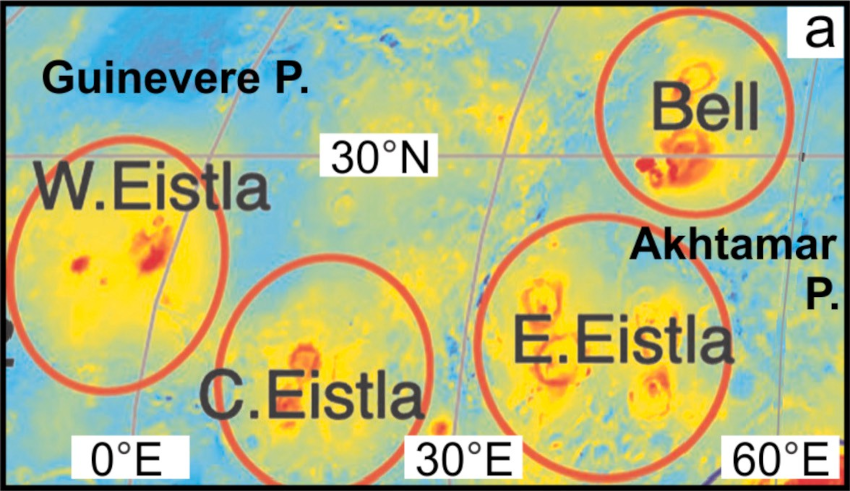
Figure 1. Eistla Regio (Western, Central and Eastern Eistla) and Bell Regio plume centers located on altimetry map (with the red to blue spectrum corresponding to high low topography). Extracted and modified from Hansen (2018).
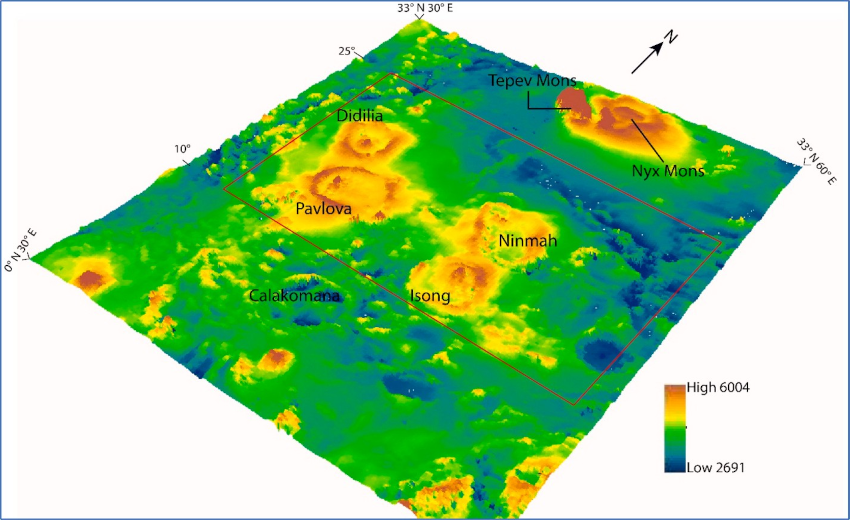
Figure 2. Topography of Eastern Eistla Regio and surrounding region (from NASA Magellan altimetry data). Note that Tepev Mons and Nyx Mons belong to a separate plume center (Bell Regio). Also note that Calakomana Corona has a much flatter topography and is inferred to be older and unrelated to the Eastern Eistla Regio plume.
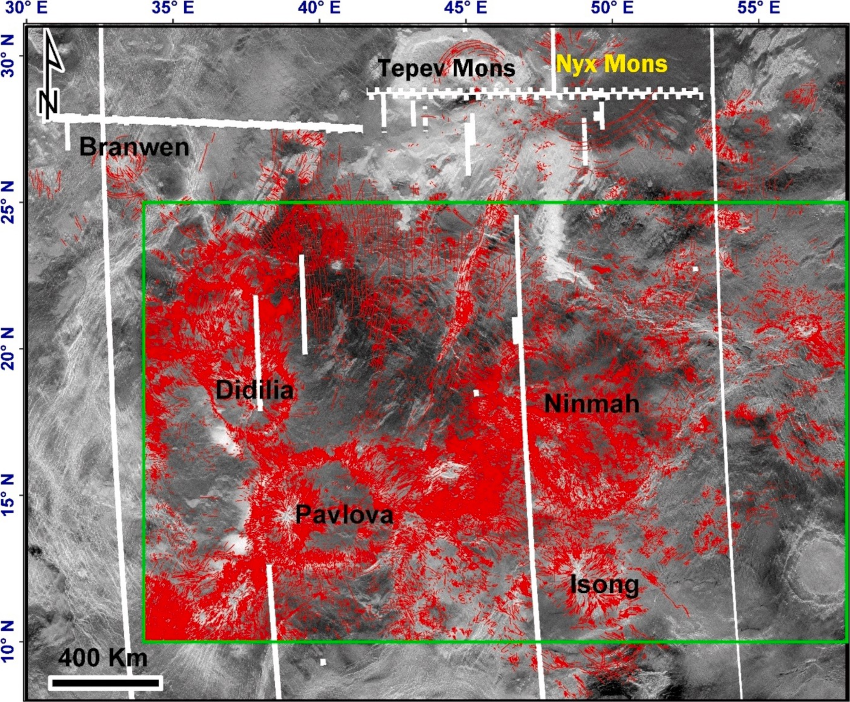
Figure 3. Distribution of our mapping of 70,000 extensional lineaments (grabens and fissures) in ArcGIS Pro, on background NASA Magellan SAR (Synthetic Aperture Radar) images.
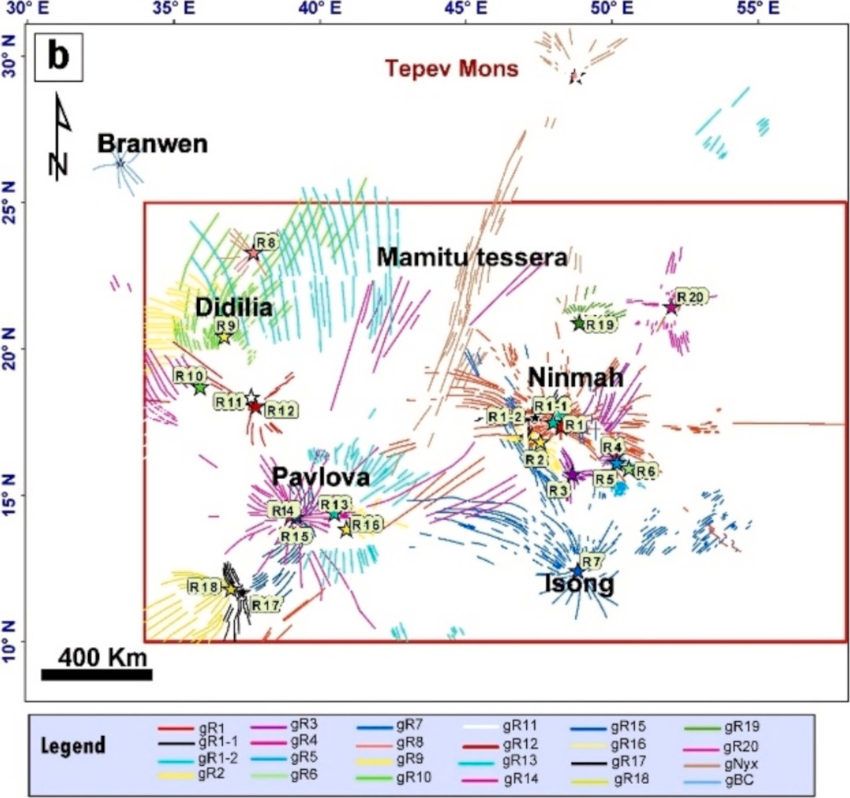
Figure 4. Generalized version of radiating swarms distinguished by colour. Stars mark the foci of radiating swarms. Note the multiple radiating swarms associated with each corona (except Isong). Coronae often host multiple distinct radiating systems (e.g. Ernst et al. 2003; Tessier et al. 2024).
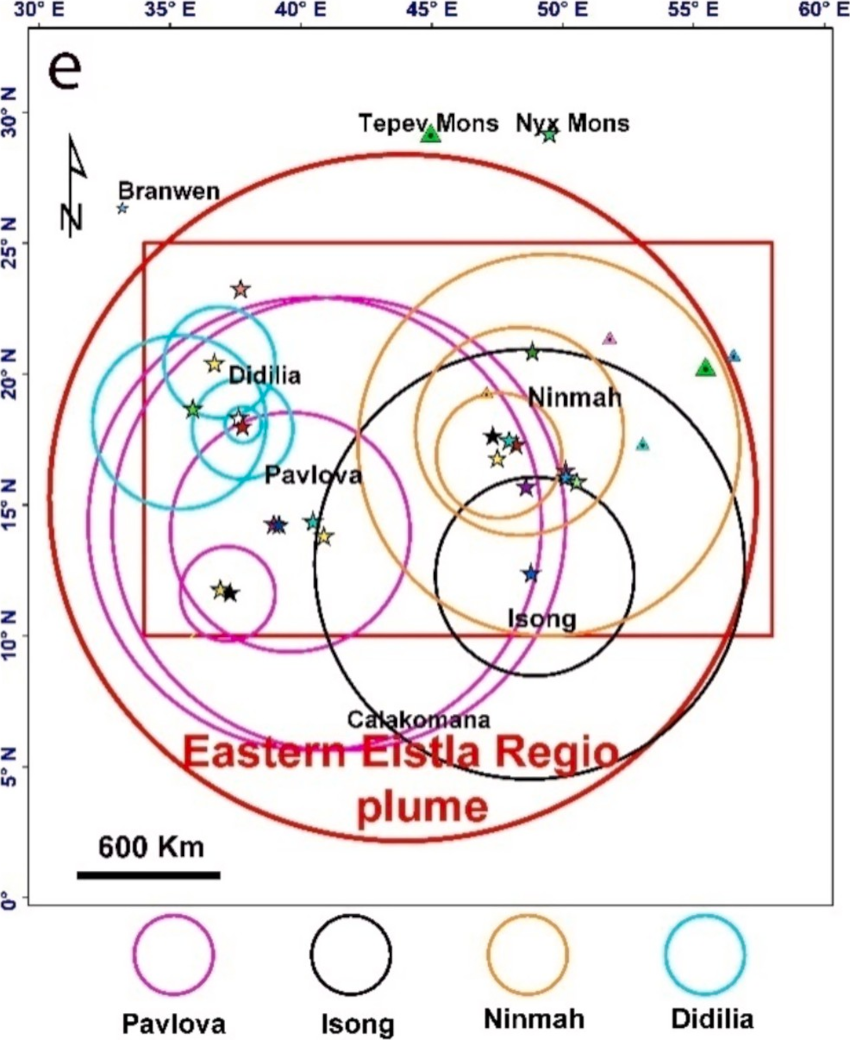
Figure 5. Sizes of all the plumes associated with the four different coronae (Didilia, Pavlova, Ninmah, and Isong). The sizes of the multiple plume heads associated with each corona were estimated from individual radiating swarms (Fig. 4) from the distance at which they deviate from radiality (e.g,. Hasanaine et al., 2026; see also El Bilali and Ernst, 2024). All of the local plume head sizes are located within the overall 1300 km radius of the Eastern Eistla Regio plume head (outer red circle) and presumably represent more local upwelling within the overall large plume (Fig. 7). Note that Tepev Mons and Nyx Mons belong to the separate Bell Regio plume, and that the Calakomana Corona is older and unrelated to the Eastern Eistla Regio plume.
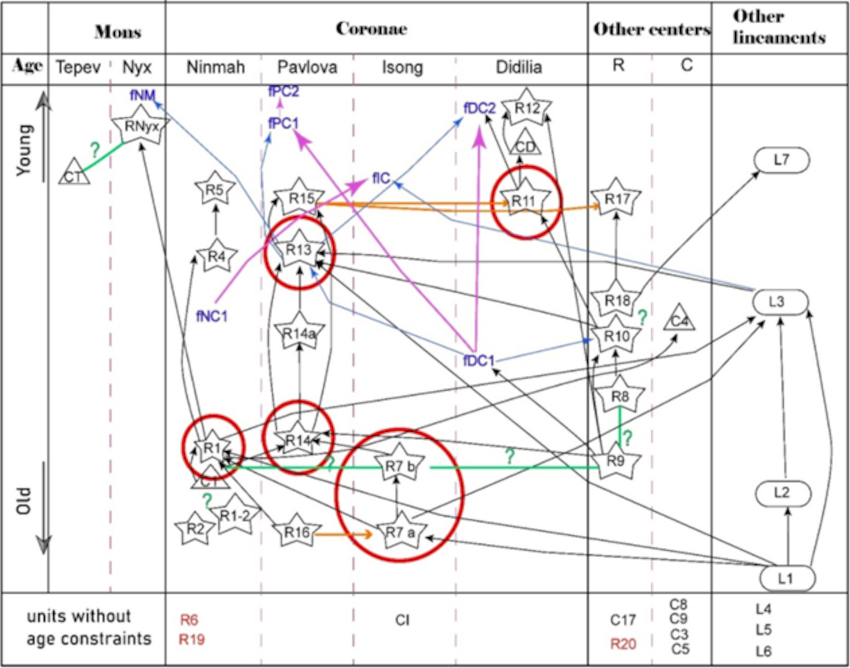
Figure 6. Geological history based on age relationships between graben-fissure systems (interpreted as dyke swarms). Full details are in Hasanaine et al. (2026).
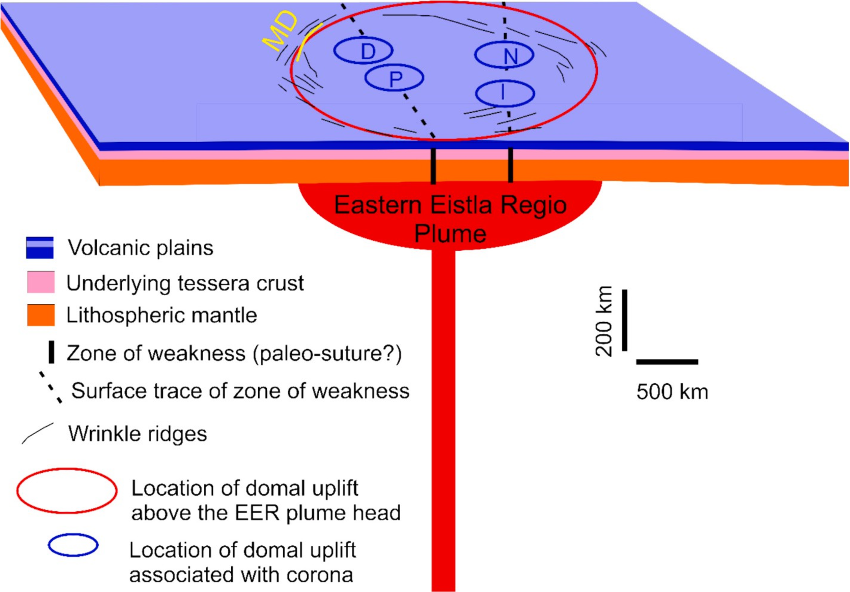
Figure 7. Model of Eastern Eistla Regio mantle plume spawning four coronae along two approximately parallel zones of weakness in the lithospheric mantle that are recognized on the basis of Bouguer gravity anomalies linking Didilia and Pavlova coronae and linking Ninmah and Isong coronae (see Hasanaine et al., 2026 for details). MD = Metelitsa Dorsa.
References
Buchan, K.L., Ernst, R.E., 2021. Plumbing systems of large igneous provinces (LIPs) on Earth and Venus: investigating the role of giant circumferential and radiating dyke swarms, coronae and novae, and mid-crustal intrusive complexes. Gondw. Res. 100, 25–43.
Campbell, I.H., 2007. Testing the plume theory. Chem. Geol. 241, 153–176.
Campbell, B.A., Campbell, P.G., 2002. Geologic map of the Bell Regio Quadrangle (V-9), Venus. US Geological Survey, Scientific Investigations Series Map I-2743.
Campbell, B.A., Clark, D.A., 2006. Geologic Map of the Mead Quadrangle (V–21), Venus. US Geological Survey, Scientific Investigations Map 2897 (Map and Pamphlet).
El Bilali, H., Ernst, R.E., 2024. Far-travelled 3700 km lateral magma propagation just below the surface of Venus. Nat. Commun. 15, 1759.
El Bilali, H., Ernst, R.E., Buchan, K.L., Head, J.W., 2023. Dyke swarms record the plume stage evolution of the Atla Regio superplume on Venus. Commun. Earth Environ. 4 (1), 23
Ernst, R.E., Buchan, K.L., Desnoyers, D.W., 2007. Plumes and plume clusters on Earth and Venus: evidence from Large Igneous Provinces (LIPs). In: Yuen, D.A., Maruyama, S., Karato, S.-I., Windley, B.F. (Eds.), Superplumes: Beyond Plate Tectonics. Springer, pp. 537–562.
Grosfils, E.B., Head, J.W., 1994. The global distribution of giant radiating dike swarms on Venus: implications for the global stress state. Geophysics Research Letters, 21: 701–704.
Hansen, V.L., 2018. Global tectonic evolution of Venus, from exogenic to endogenic over time, and implications for early Earth processes. Phil. Trans. R. Soc. A 376, 20170412
Head, J.W., Coffin, M.F., 1997. Large Igneous Provinces: a planetary perspective. AGU Geophysical Monograph, 100: 411–438
Hasanaine, A., El Bilali, H., Ernst, R.E., Buchan, K.L., 2026. Dyke swarm history of Eastern Eistla Regio, Venus and implications for its plume origin. Icarus 451 (2026) 117006
Senske, D.A., Schaber, G.G., Stofan, E.R., 1992. Regional topographic rises on Venus: geology of Western Eistla Regio and comparison to Beta Regio and Atla Regio. J. Geophys. Res. 97 (E8), 13395–13420.
Stofan, E.R., Smrekar, S.E., Bindschadler, D.L., Senske, D.A., 1995. Large topographic rises on Venus: implications for mantle upwelling. J. Geophys. Res. 100 (E11), 23317–23327.
Tessier, A.D., Ernst, R.E., El Bilali, H., 2024. Heng-o corona, Venus: dyke swarms record evolution of its underlying mantle plume. Icarus 417, 116090 [corrigendum: 2025. Icarus 425, 116332.].