
2026 June LIP of the Month
Sr-Nd-Pb-Os-O isotope evidence of limited crustal contamination in Deccan Traps basalts from the Western Ghats
Marzoli A. 1*, Reisberg L. 2, Capriolo M. 3, Callegaro S. 4, Renne P. R. 5, 6, Chiaradia M. 7, Meyzen C. M. 8, Self S. 6, Vanderkluysen L. 9, Boscaini A. 10
- Dipartimento del Territorio e Sistemi Agro-Forestali, Università di Padova, Italy
- Centre de Recherches Pétrographiques et Géochimiques, CNRS-University of Lorraine, Nancy, France
- School of Geography, Earth and Environmental Sciences, University of Birmingham, United Kingdom
- Department of Biological Geological and Environmental Sciences, University of Bologna, Italy
- Berkeley Geochronology Center, Berkeley, USA
- Department of Earth and Planetary Science, University of California, Berkeley, USA
- Department of Earth Sciences, University of Geneva, Switzerland
- Dipartimento di Geoscienze, Università di Padova, Italy
- Department of Biodiversity, Earth and Environmental Science, Drexel University, Philadelphia, USA
- Département des Sciences de la Terre et de l’Atmosphère/Geotop, Université du Québec à Montréal, 201, avenue du Président-Kennedy, Montréal, Québec, H2X 3Y7, Canada
Extracted and modified after Marzoli et al., 2026, see this EPSL publication for full details.
A common paradigm in studies of large igneous provinces (LIPs) is that the high eruption rates of basaltic magmas should cause a widespread melting of continental basement rocks. Therefore, the distinct geochemical features of continental LIPs compared to oceanic basalts (OIBs and MORBs) are frequently attributed to large-scale crustal assimilation processes. The Archean-to-Proterozoic age and strongly enriched isotopic compositions of the Indian basement rocks make the 66 Ma Deccan Province an ideal setting for assessing the extent of crustal contamination. The combined use of Re-Os with traditional isotopic tracers (Sr, Nd, Pb, O) offers a powerful tool for detecting potential contributions of assimilated continental lithospheric components (Capriolo et al., 2024; Marzoli et al., 2026).
The Deccan
The Deccan LIP (Fig. 1) was emplaced between ca. 66.8 and 65.4 Ma (e.g., Schoene et al., 2019; Sprain et al., 2019; Tholt et al., 2023), straddling the Cretaceous–Paleogene boundary (ca. 66.0 Ma; Sprain et al., 2018) and arguably contributing to the end-Cretaceous extinction event (e.g., Callegaro et al., 2023). On the Western Ghats (WG) escarpment East of Mumbai, central-western India, more than 3 km of composite volcanic stratigraphy are exposed (Beane et al., 1986). Based on field evidence and geochemical compositions (in particular, Sr, Nd and Pb isotopic ratios), the WG lavas have been subdivided into 3 subgroups (from base to top: Kalsubai, Lonavala and Wai) and 11 lava flow formations (Fig. 1b; e.g., Beane et al., 1986; Kale et al., 2019; Self et al., 2022), erupted from distinct generations of dykes (Vanderkluysen et al., 2011).
Initial Sr-Nd-Pb isotopic ratios of Deccan basalts show a very wide range of compositions. The most depleted compositions (e.g., 87Sr/86Sri ca. 0.7040, 143Nd/144Ndi ca. 0.51280) are observed in Wai basalts, which are isotopically close to present-day Réunion OIBs. Highly enriched isotopic compositions (e.g., 87Sr/86Sri up to ca. 0.715, 143Nd/144Ndi to ca. 0.5117; Marzoli et al., 2022, 2026 and ref. therein) are observed in Kalsubai and Lonavala basalts. By contrast, most initial 187Os/188Osi range from 0.120 to 0.146 (Allègre et al., 1999; Marzoli et al., 2026; Peters et al., 2016; Peters and Day, 2017). The low 187Os/188Osi of Ambenali basalts is tentatively interpreted as reflecting limited interaction with peridotites of the sub-continental lithospheric mantle, particularly sulfides hosted within the SCLM. In general, Kalsubai basalts tend to have the highest 187Os/188Osi values (0.140 to 0.210).
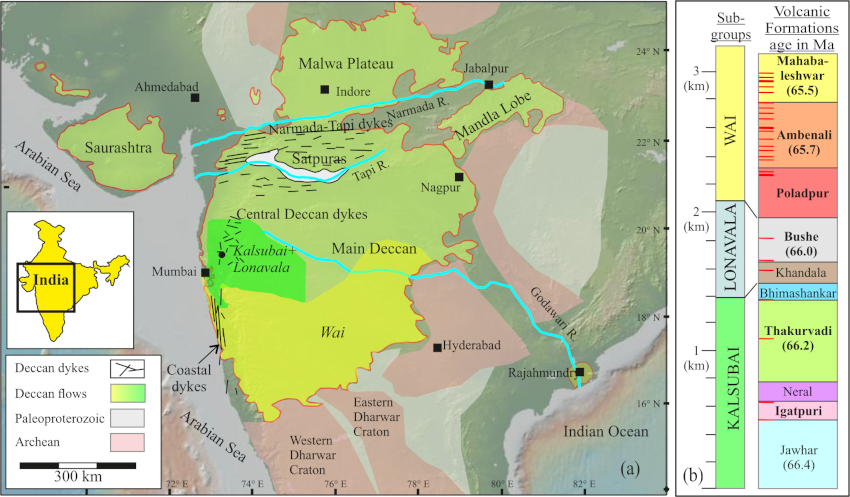
Figure 1: (a) The Deccan in India (contoured in red). Figure modified after Marzoli et al., (2026) and Self et al. (2022). (b) shows the schematic stratigraphy of the Western Ghats, including the three sub-groups and the 11 volcanic formations, with ages in Ma (Sprain et al., 2019; Schoene et al., 2019).
Modelling and interpretation
The large scatter of Sr-Nd-Pb isotopic compositions of Deccan basalts can be explained by variable, though generally limited contamination by the 2-3 Ga-old and strongly enriched Indian basement (87Sr/86Sri from 0.7023 to > 1.0, 143Nd/144Ndi 0.5120-0.5103; 206Pb/204Pbi 14.5-23.3, values recalculated to 66 Ma; references in Marzoli et al., 2026), possibly combined with contributions from slightly distinct parental magmas derived from heterogeneous mantle sources (Melluso et al., 2006). Assimilation modelling using both EC-AFC and MCS (energy-constrained AFC and magma chamber simulator programs; Spera and Bohrson, 2001; Bohrson et al., 2020) of the major and trace elements and Sr-Nd-Pb-Os isotopic compositions of Deccan basalts suggests the following conclusions:
-
Assimilation of lower crustal mafic rocks from the Archean or Paleoproterozoic basement can be ruled out for most Deccan samples and is unlikely to exceed 2% for any of the Deccan basalts;
-
Assimilation of the felsic upper crust may be possible for the Kalsubai and Lonavala basalts, but is generally limited to less than 5 wt.% and only rarely reaches 8 wt.%. Most Wai samples appear to be uncontaminated or only weakly contaminated.
We suggest that the main reason for the low degree of contamination is that crustal heating by LIP basaltic magmas is slow, because conductive heat transfer in rocks is inefficient. Numerical models show that the crust requires hundreds of thousands of years of sustained magmatic intrusion before extensive partial melting develops (Annen et al., 2006; Karakas and Dufek, 2015). By contrast, LIP eruptions occurred as extremely intense but short-lived pulses, often lasting less than a century while erupting enormous magma volumes. These rapid eruptions did not allow enough time for surrounding crustal rocks to heat up and melt significantly, thereby limiting assimilation. It is also possible that mantle plume migration contributed to this effect, as shifting magma systems would have prevented heat from remaining focused within a single crustal region long enough to cause substantial crustal melting.
Melt inclusions, volatiles, and crystal mush
Combined with microstructural constraints from Synchrotron radiation X-ray microtomography, O isotope data from melt inclusion glass and their host clinopyroxenes in WG lavas provide further insights into the evolution of this LIP (Capriolo et al., 2024). O isotopic values of augitic clinopyroxenes (ca. + 5 ‰ δ18OVSMOW, i.e., expressed in δ notation normalized to Vienna Standard Mean Ocean Water) indicate crystallization from mafic melts with mantle-like signatures, whereas O isotopic values of melt inclusion glasses (ca. + 6 up to + 16 ‰ δ18OVSMOW) imply the entrapment of intermediate to felsic melts (andesitic to rhyolitic) ranging from mantle-like to crust-dominated oxygen isotopic compositions. Melt inclusions also contain gas bubbles, indicating the presence of at least 0.3 wt.% CO2 in the entrapped melts. The clinopyroxene-dominated glomerocrysts, which contain abundant bubble-bearing melt inclusions, are interpreted as relics of a multiphase crystal mush, recording the dynamic evolution of the Deccan magma plumbing system, where crystals, silicate melts, and exsolved fluids coexisted and interacted throughout a transcrustal magmatic system.
Conclusions
In conclusion, integrated whole-rock, isotopic and microstructural evidence indicates that crustal contamination in the Deccan Traps was generally limited, despite an emplacement through ancient and isotopically enriched continental crust. Sr-Nd-Pb-Os and O isotope systematics, together with melt inclusion data, suggest that most Deccan magmas largely retain mantle-derived signatures, with localized assimilation of felsic crust occurring only under specific thermal and magmatic conditions. These results imply that rapid emplacement of the Deccan LIP restricted large-scale crustal melting, although transient crustal assimilation may have contributed to the destabilization of crystal mush zones and helped trigger eruptive events within the magma plumbing system.
References
Allègre, C.J., Birck, J.L., Capmas, F., Courtillot, V., 1999. Age of the Deccan traps using 187Re–187Os systematics. Earth Planet. Sci. Lett. 170, 197–204, https://doi.org/10.1016/S0012-821X(99)00110-7
Annen, C., Blundy, J. D., Sparks, R.S.J., 2006. The Genesis of Intermediate and Silicic Magmas in Deep Crustal Hot Zones. J. Petrol. 47, 505–539, https://doi.org/10.1093/petrology/egi084
Basu, A.R., Saha-yannopoulos, A., Chakrabarty, P. 2020. Lithos A precise geochemical volcano-stratigraphy of the Deccan traps. Lithos 376–377, 105754, https://doi.org/10.1016/j.lithos.2020.105754
Beane, J.E., Turner, C.A., Hooper, P.R., Subbarao, K. V, Walsh, J.N., 1986. Stratigraphy, composition and form of the Deccan Basalts, Western Ghats, India. Bull. Volcanol. 48, 61–83. https://doi.org/10.1007/BF01073513
Bohrson, W. A., Spera, F. J., Heinonen, J. S., Brown, G. A., Scruggs, M. A., Adams, J. V., Takach, M. K., Zeff, G., and Suikkanen, E., 2020. Diagnosing open-system magmatic processes using the Magma Chamber Simulator (MCS): part I—major elements and phase equilibria. Contrib. Mineral. Petrol. 175, 1-29.
Callegaro, S., Baker, D.R., Renne, P.R., Melluso, L., Geraki, K., Whitehouse, M.J., De Min, A., Marzoli, A., 2023. Recurring volcanic winters during the latest Cretaceous: Sulfur and fluorine budgets of Deccan Traps lavas. Sci. Adv. 9, eadg8284, https://doi.org/10.1126/sciadv.adg8284
Capriolo, M., Callegaro, S., Deegan, F.M., Merle, R., Jeon, H., Whitehouse, M.J., Aradi, L.E., Storm, M., Renne, P.R., Baker, D.R., Dal Corso, J., Newton, R.J., Szabó, C., Carvalho, B.B., Youbi, N., Marzoli, A., 2024. Dynamic Evolution of the Transcrustal Plumbing System in Large Igneous Provinces: Geochemical and Microstructural Insights from Glomerocrysts and Melt Inclusions. J. Petrol. 65, egae103, https://doi.org/10.1093/petrology/egae103
Kale, V.S., Dole, G., Shandilya, P., Pande, K., 2019. Stratigraphy and correlations in Deccan Volcanic Province, India: Quo vadis? GSA Bull. 132, 588–607, https://doi.org/10.1130/B35018.1
Karakas, O., Dufek, J., 2015. Melt evolution and residence in extending crust: Thermal modeling of the crust and crustal magmas. Earth Planet. Sci. Lett. 425, 131-144, https://doi.org/10.1016/j.epsl.2015.06.001.
Marzoli, A., Reisberg, L., Capriolo, M., Callegaro, S., Renne, P.R., Chiaradia, M., Meyzen, C.M., Self, S., Vanderkluysen, L., Boscaini, A. (2026). Limited crustal contamination in large igneous province basalts: Sr-Nd-Pb-Os isotope evidence from the Western Ghats, Deccan Traps. Earth and Planetary Science Letters, 678, 119847, https://doi.org/10.1016/j.epsl.2026.119847.
Marzoli, A., Renne, P.R., Andreasen, R., Spiess, R., Chiaradia, M., Ruth, D.C.S., Tholt, A.J., Pande, K., Costa, F., 2022. The Shallow Magmatic Plumbing System of the Deccan Traps, Evidence from Plagioclase Megacrysts and Their Host Lavas. J. Petrol. 63, 1–32. https://doi.org/10.1093/petrology/egac075
Melluso, L., Mahoney, J.J., Dallai, L., 2006. Mantle sources and crustal input as recorded in high-Mg Deccan Traps basalts of Gujarat (India). Lithos 89, 259-274, https://doi.org/10.1016/j.lithos.2005.12.007.
Peters, B.J., Day, J.M.D., 2017. A geochemical link between plume head and tail volcanism. Geochemical Perspect. Lett. 5, 29–34, https://doi.org/10.7185/geochemlet.1742
Peters, B.J., Day, J.M.D., Taylor, L.A., 2016. Early mantle heterogeneities in the Réunion hotspot source inferred from highly siderophile elements in cumulate xenoliths. Earth Planet. Sci. Lett. 448, 150–160, https://doi.org/10.1016/j.epsl.2016.05.015
Schoene, B., Eddy, M.P., Samperton, K.M., Keller, C.B., Keller, G., Adatte, T., Khadri, S.F.R., 2019. U-Pb constraints on pulsed eruption of the Deccan Traps across the end-Cretaceous mass extinction. Science 363, 862–866, https://doi.org/10.1126/science.aau2422
Self, S., Mittal, T., Dole, G., Vanderkluysen, L., 2022. Toward Understanding Deccan Volcanism. Annu. Rev. Earth Planet. Sci. 50, 477–506, https://doi.org/10.1146/annurev-earth-012721-051416
Spera, F.J., Bohrson, W.A., 2001. Energy-constrained open-system magmatic processes I: General model and energy-constrained assimilation and fractional crystallization (EC-AFC) formulation. Journal of Petrology 42 (5), 999–1018, https://doi.org/10.1093/petrology/42.5.999
Sprain, C.J., Renne, P.R., Vanderkluysen, L., Pande, K., Self, S., Mittal, T., 2019. The eruptive tempo of Deccan volcanism in relation to the Cretaceous-Paleogene boundary. Science 363, 866–870, https://doi.org/10.1126/science.aav1446
Tholt, A.J., Renne, P.R., Marzoli, A., Vanderkluysen, L., Mohabey, D., Samant, B., Dhobale, A., Pande, K., Self, S., 2023. Geochronological Constraints on the Evolution and Petrogenesis of the Malwa Plateau Subprovince of the Deccan Traps. Geochemistry, Geophys. Geosystems 24, e2023GC011137, https://doi.org/10.1029/2023GC011137