
2026 July LIP of the Month
Quasi-rehealing of the eastern North China craton by the 0.9 Ga Xuhuai mantle plume
Xiangdong Su1*, Peng Peng2, 3*, Zhuyin Chu2, Peng Liou2, Yanjie Tang1
1Hubei Key Laboratory of Petroleum Geochemistry and Environment, YU-CUGW Joint Research Center on Deep Earth and Surface Dynamic Coupling, College of Resources and Environment, Yangtze University, Wuhan 430100, China; Email: xiangdongsu@outlook.com (X. Su),
2State Key Laboratory of Lithospheric and Environmental Coevolution, Institute of Geology and Geophysics, Chinese Academy of Sciences, Beijing 100029, China; Email: pengpengwj@mail.iggcas.ac.cn (P. Peng).
3College of Earth and Planetary Sciences, University of Chinese Academy of Sciences, Beijing, 100049, China
Extracted and modified after Su et al., 2026, Earth and Planetary Science Letters 685, 120040; see this publication for full details (Su et al., 2026).
Introduction
Cratonic mantle roots, the deep and buoyant keels that stabilize ancient continents, were long thought to be indestructible. However, an increasing number of studies show that both oceanic subduction and mantle plume events can thin or even remove these keels (Hu et al., 2018; Liu et al., 2021; Shi et al., 2021; Wu et al., 2019). Large igneous provinces (LIPs) are commonly found within ancient craton regions across the globe. Some of these LIPs are believed to be associated with earlier instances of lithospheric thinning and subsequent rehealing beneath the thinned cratons (Liu et al., 2021; Su et al., 2023). However, the question remains: can the newly restored mantle lithosphere regain the stability as its original status. For example, both the eastern North China Craton (NCC) and the Wyoming Craton, which underwent lithospheric thinning and destruction, have undergone LIP magmatism in the past. Could the instability observed today in these cratons, which have lost their mantle roots, be attributed to the influence of LIP magmatism throughout Earth’s history?
Here, by combining trace elements and Sr‑Nd‑Hf‑Os isotopes on mafic rocks from the Xuhuai LIP with Re‑Os systematics of mantle xenoliths, the authors show that while the Xuhuai plume indeed triggered lithospheric thinning and subsequent rehealing, the restored root is only “quasi‑rehealed”, a metastable state that is mechanically weaker and more vulnerable to later destruction than the original Archean keel. This study provides a new framework for understanding why some cratons that experienced ancient plume activity (e.g., Wyoming, eastern NCC) eventually succumbed to delamination.
The Xuhuai LIP
The Xuhuai LIP (also known as the Dashigou LIP; Peng et al., 2011a; Su and Peng, 2025) is an early Neoproterozoic LIP exposed in the southeastern margin of the North China craton (Fig. 1a). It consists of an early far‑field radiating dyke swarm (Dashigou dykes; ca. 920 Ma; Peng et al., 2011a) and central sill complexes (Chulan sills; 940–920 Ma), followed by late near‑center sill complexes (Fig. 2; Chulan sills, Dalian sills and Sariwon sills; 915–890 Ma; Peng et al., 2011b; Su et al., 2018). The total volume is estimated at ~0.65 Mkm2, comparable to many Phanerozoic LIPs. Similar field and petrographic features are also observed in the São Francisco–Congo cratons, for example, the Bahia dyke swarm (Fig. 2; ca. 925 Ma). These sills and dykes are composed of mafic rocks ranging from more primitive gabbros (MgO = 6–10 wt%) and Fe-Ti oxides-rich dolerites (MgO = 4 wt%), to highly evolved quartz-bearing dolerites (MgO = 2 wt%, Su et al., 2018). Most of them are tholeiites and the evolution trend of these rocks were controlled by the saturation and crystallization of olivine, plagioclase, clinopyroxene and titano-magnetite, with insignificant crustal components contamination (Su et al., 2026; Su et al., 2020). The evolution of this LIP magmatism (εNdt = –1.93 to +3.13), under conditions of low oxygen fugacity (∆QFM–1 to ∆QFM) and low water contents (~0.2 wt%). Importantly, the Xuhuai LIP records a temporal geochemical transition: early tholeiites show oceanic‑island basalt (OIB) affinities, whereas later basalts resemble mid‑ocean ridge basalts (MORBs; Su et al., 2020). This transition reflects progressive lithospheric thinning as the plume thermally and mechanically eroded the overriding cratonic root. The initial melting pressures and the potential mantle temperatures (TP) of the Xuhuai LIP, derived from reverse crystallization modeling and thermo-barometric calculations, are 3.0 GPa and 1520°C (Su et al., 2023), respectively. The unusual high TP and the radial pattern of the magma plumbing systems indicated that they are driven by a deep mantle plume event. Additionally, the evolution of its magmatic plumbing systems is interpreted as evidence for a subcontinental break-up event (Peng et al., 2011b; Su et al., 2021).
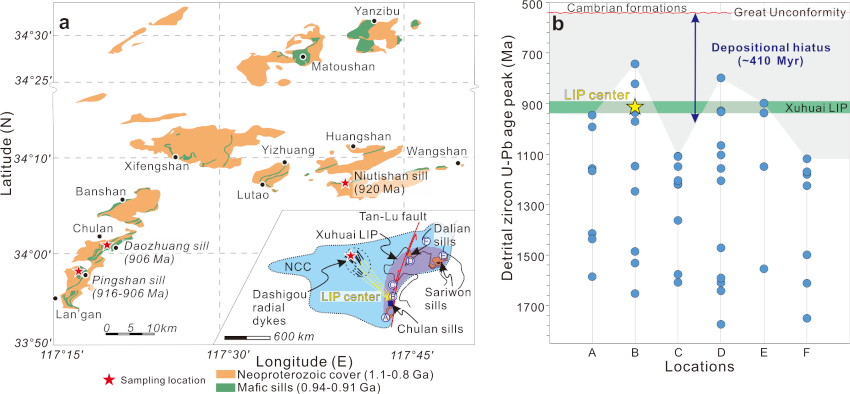
Figure 1. (a) Simplified map of the North China craton showing the elements of the 0.9 Ga Xuhuai LIP, including the far‑field radial Dashigou dykes and near‑center Xuhuai sill complexes. The purple domain outlines the Xuhuai rift. (b)The distribution of detrital zircon age peaks obtained from the Meso-Proterozoic to the Neo-Proterozoic formations along the eastern margin of the NCC. A great unconformity between these Proterozoic formations and the overlying Cambrian should be noted. The locations of A–F are shown in Fig. 1a from south to north. A=Huainan region; B=Huaibei region; C=Western Shandong; D=Southern Liaoning; E=Pyongnam basin, North Korea; F=Southern Jilin. Modified from Su et al. (2026).
Multi‑isotope evidence for plume–lithosphere interaction
Su et al. (2026) present new Sr‑Nd‑Hf‑Os isotope data for mafic rocks from the Xuhuai LIP, integrated with published datasets. The key findings are:
-
Depleted plume source. A Re‑Os isochron age of 933 ± 37 Ma (MSWD = 3.4) is indistinguishable from zircon/baddeleyite U‑Pb crystallization ages. The initial 187Os/188Os ratio of 0.106 ± 0.080 indicates a depleted mantle source, consistent with a deep mantle plume origin. Strongly fractionated PGE patterns (depleted in IPGEs relative to PPGEs and Re) further support a highly melt‑depleted source.
-
Limited crustal contamination. Reverse fractional crystallization modelling shows that the evolution of Xuhuai LIP magmas was controlled mainly by fractional crystallization of olivine, plagioclase, clinopyroxene and titanomagnetite under low water contents (0.2 wt%) and low oxygen fugacity (ΔQFM –1 to ΔQFM), with insignificant crustal assimilation.
-
Significant SCLM interaction (1–10%). Sr‑Nd‑Hf isotopes reveal decoupling: initial 87Sr/86Sr increases systematically from early to late suites (0.704 to 0.707), whereas εNdt and εHft remain relatively uniform (near‑CHUR to slightly positive). This decoupling cannot be explained by crustal contamination. Mixing models indicate that Xuhuai magmas represent hybrids of depleted plume‑derived melts (dominant) with variable 1–10% contributions from the sub‑continental lithospheric mantle (SCLM). The enriched SCLM end‑member includes both ancient (~2.5 Ga) and younger (~1.8 Ga) lithospheric mantle components, as well as a pyroxenite component.
- Combined Nd–Os and Sr–Os systematics. The Xuhuai mafic rocks define mixing arrays between depleted mantle (DMM) and enriched SCLM. In εNdi vs. 187Os/188Osi, samples cluster near the DMM with low initial Os ratios, indicating a plume‑dominated source with minor SCLM input. The 87Sr/86Sri vs. 187Os/188Osi plot also supports binary mixing between depleted plume melts and radiogenic SCLM components. The extremely low initial 187Os/188Os of the plume end‑member (0.106 ± 0.080) confirms a long‑term depleted mantle source, with SCLM contribution limited to <10% and negligible crustal assimilation.
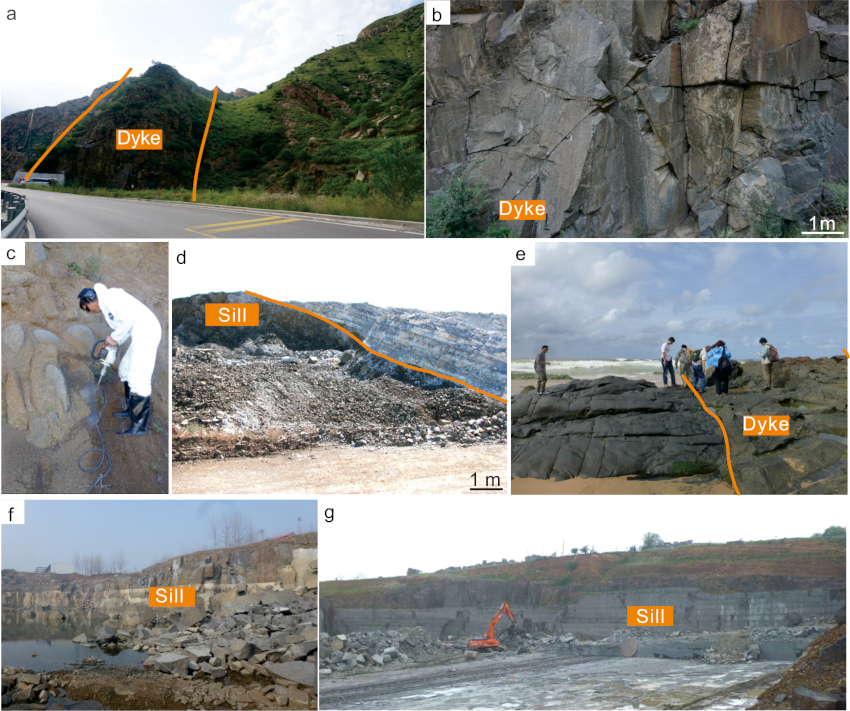
Figure 2. Field photograph of typical mafic dykes and sills from the North China and São Francisco-Congo cratons. (a-c) Dashigou dykes, where (c) is the spherical weathering of the dykes. (d) Mafic sills emplaced into the Neoproterozoic sedimentary rocks in the Liaodong Peninsula; (e) Bahia dykes from the São Francisco craton; (f-g) Mafic sills emplaced into the Neoproterozoic sedimentary rocks in the Xuhuai area, SE North China craton.
Mantle xenoliths and lithospheric rehealing
The most compelling evidence for lithospheric rehealing comes from Re‑depletion model ages (TRD) of mantle peridotite xenoliths entrained in Cenozoic basalts from the eastern NCC. TRD ages record the timing of the last major melt extraction event from the mantle. Su et al. (2026) compile a dataset and identify a prominent TRD peak at 1.0–0.8 Ga, coincident with the activity of the Xuhuai LIP (0.94–0.89 Ga).
This age peak is interpreted as the accretion of buoyant, melt‑depleted peridotite residues generated during plume‑SCLM interaction. As Xuhuai plume magmas traversed the lithosphere, they extracted melts, leaving behind refractory residues that are less dense than the surrounding mantle. These residues accreted to the base of the thinned lithosphere, partially restoring its thickness and buoyancy, a process termed “rehealing”.
Quasi‑rehealing: why the restored root is not as stable as the original
Despite the accretion of buoyant residues, Su et al. (2026) argues that the rehealed lithospheric root beneath the eastern NCC is fundamentally different from, and weaker than, its original Archean precursor. They coin the term “quasi‑rehealing” to describe this metastable state (Fig. 3). Several lines of evidence support this interpretation:
-
Heterogeneous patchwork structure. Unlike the original coherent Archean root that formed through extensive melt depletion and tectonic thickening, the quasi‑rehealed root comprises a patchwork of peridotites with diverse ages and origins (2.5 Ga, 1.8 Ga and 0.9 Ga residues). This heterogeneity inherently lacks the mechanical coherence of a unified cratonic keel.
-
Inherited rheological weaknesses. The plume‑lithosphere interaction zone likely generated or reactivated a mid‑lithosphere discontinuity (MLD), a seismically low‑velocity layer at ~100 km depth with inherently weaker rheological properties. Modern seismic surveys image an MLD beneath the western and central NCC, and a palaeo‑MLD likely existed beneath the eastern NCC prior to Mesozoic delamination (Su et al., 2023). Su et al. (2026) proposed that this weak zone was either created or significantly weakened by the Xuhuai plume‑lithosphere interaction.
-
Prolonged depositional hiatus. A ~400 Myr depositional hiatus (0.9–0.5 Ga, Fig. 1b) overlies the Xuhuai rift succession, interpreted as the surface expression of sluggish, incomplete rehealing.
-
Comparison with fully re‑cratonized cratons. In cratons such as Superior, Rae and Kaapvaal, Proterozoic plume events led to full “re‑cratonization” (Liu et al., 2021). Su et al. (2026) suggest that the key difference may be the presence or absence of subsequent lateral compressional thickening. Cratons that experienced accretionary orogenesis or flat‑slab subduction after plume activity could mechanically strengthen their reheated roots (Pearson et al., 2021), whereas the eastern NCC experienced a prolonged tectono‑thermal hiatus (0.9–0.3 Ga) that allowed no such reinforcement.
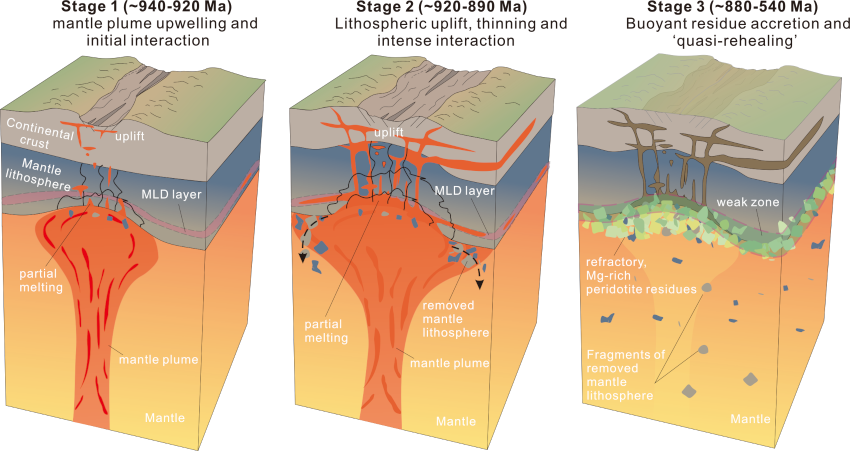
Figure 3. Schematic model illustrating the three‑stage evolution of the lithospheric mantle beneath the eastern NCC in response to the ~0.9 Ga Xuhuai mantle plume event. Stage 1 (left): plume upwelling and initial interaction (940–920 Ma). Stage 2 (middle): lithospheric thinning and intense interaction (920–890 Ma). Stage 3 (right): accretion of buoyant residues and quasi‑rehealing (880–540 Ma), producing a heterogeneous, weakened root that preconditioned Mesozoic delamination. MLD = mid‑lithosphere discontinuity. Modified from Su et al. (2026).
Implications for cratonic destabilization and deep mantle dynamics
The quasi‑rehealed state of the eastern NCC lithospheric mantle, combined with the presence of a rheologically weak MLD, effectively preconditioned the craton for its eventual Mesozoic destruction. When the palaeo‑Pacific plate began subducting beneath eastern Asia in the Mesozoic, the already‑weakened lithosphere was primed for delamination. The ~100 km depth of the MLD corresponds precisely to the inferred detachment interface for the wholesale lithospheric delamination documented by (Chen et al., 2023).
This framework has implications beyond the North China craton. The Wyoming craton, which also experienced lithospheric thinning and destruction, contains the 2.01 Ga Kennedy LIP, a potential plume event that may have induced a similar quasi‑rehealed state. More broadly, the recognition that plume‑induced rehealing can produce metastable lithosphere rather than fully restored cratonic stability provides a new perspective on the long‑term evolution of continental roots.
In a companion study, Peng et al. (2025) demonstrate that the global 940–720 Ma LIPs, including the Xuhuai LIP, define a coherent ring around the Rodinia supercontinent that resembles the product of an ancient large low shear‑wave velocity province (LLSVP). This Rodinian LLSVP was partially regenerated (replenished and migrated) to become the Pangean LLSVP, linking the Xuhuai plume event to deep mantle dynamics operating over supercontinent cycles (Peng et al., 2025).
Conclusions
The ~0.9 Ga Xuhuai LIP in the eastern North China craton was generated by a deep mantle plume, as shown by radial dyke geometry, high Tp (1520 °C), and depleted mantle Os isotope signatures (initial 187Os/188Os = 0.106 ± 0.080). Sr‑Nd‑Hf‑Os isotopes record progressive thinning of the cratonic lithosphere, from early OIB‑like magmas formed under thick lithosphere to late MORB‑like magmas formed under thinned lithosphere. Re‑depletion model ages (TRD) of mantle xenoliths show a prominent peak at 1.0–0.8 Ga, coincident with the Xuhuai LIP, providing direct evidence for accretion of buoyant melt residues and lithospheric rehealing. However, the rehealed root is only “quasi‑rehealed”, a heterogeneous patchwork with inherited rheological weaknesses (MLD) and without the mechanical strength of the original Archean keel. This quasi‑rehealed state preconditioned the eastern NCC for its eventual Mesozoic delamination, offering a new framework for evaluating cratonic stability after plume events.
References:
Chen, H., Tang, M., and Song, S., 2023, Catastrophic craton destruction via wholesale lithosphere delamination: Geology, v. 51, no. 5, p. 460-464.
Hu, J., Liu, L., Faccenda, M., Zhou, Q., Fischer, K. M., Marshak, S., and Lundstrom, C., 2018, Modification of the Western Gondwana craton by plume–lithosphere interaction: Nature Geoscience, v. 11, no. 3, p. 203-210.
Liu, J., Pearson, D. G., Wang, L. H., Mather, K. A., Kjarsgaard, B. A., Schaeffer, A. J., Irvine, G. J., Kopylova, M. G., and Armstrong, J. P., 2021, Plume-driven recratonization of deep continental lithospheric mantle: Nature, v. 592, no. 7856, p. 732-736.
Pearson, D. G., Scott, J. M., Liu, J., Schaeffer, A., Wang, L. H., van Hunen, J., Szilas, K., Chacko, T., and Kelemen, P. B., 2021, Deep continental roots and cratons: Nature, v. 596, no. 7871, p. 199-210.
Peng, P., Bleeker, W., Ernst, R. E., Söderlund, U., and McNicoll, V., 2011a, U–Pb baddeleyite ages, distribution and geochemistry of 925 Ma mafic dykes and 900 Ma sills in the North China craton: Evidence for a Neoproterozoic mantle plume: Lithos, v. 127, no. 1-2, p. 210-221.
Peng, P., Mitchell, R. N., Zhang, N., Su, X., Li, Y., Sun, F., Wang, C., Guo, J., and Zhai, M., 2025, Basal mantle structure regenerated through supercontinents: Nature Communications, v. 16, no. 1.
Peng, P., Zhai, M.-G., Li, Q., Wu, F., Hou, Q., Li, Z., Li, T., and Zhang, Y., 2011b, Neoproterozoic (~900 Ma) Sariwon sills in North Korea: Geochronology, geochemistry and implications for the evolution of the south-eastern margin of the North China Craton: Gondwana Research, v. 20, no. 1, p. 243-254.
Shi, Y. N., Li, Z. H., Chen, L., and Morgan, J. P., 2021, Connection Between a Subcontinental Plume and the Mid‐Lithospheric Discontinuity Leads to Fast and Intense Craton Lithospheric Thinning: Tectonics, v. 40, no. 9.
Su, X. D., and Peng, P., 2025, Sequence and genesis of the Early Neoproterozoic magmatism (ca. 940~890 Ma) in the North China Craton and São Francisco-Congo Craton: Acta Petrologica Sinica, v. 41, no. 1, p. 167-182 (in Chinese with English abstract).
Su, X. D., Peng, P., Chu, Z., Liou, P., and Tang, Y., 2026, Quasi-rehealing of eastern North China craton by 0.9 Ga plume event: Earth and Planetary Science Letters, v. 685, p. 120040.
Su, X. D., Peng, P., Foley, S., Teixeira, W., and Zhai, M.-G., 2021, Initiation of continental breakup documented in evolution of the magma plumbing system of the ca. 925 Ma Dashigou large igneous province, North China: Lithos, v. 384-385, p. 105984.
Su, X. D., Peng, P., Wang, C., Sun, F., Zhang, Z., and Zhou, X., 2018, Petrogenesis of a ~900 Ma mafic sill from Xuzhou, North China: Implications for the genesis of Fe-Ti-rich rocks: Lithos, v. 318-319, p. 357-375.
Su, X. D., Peng, P., Zhu, R., Mao, Y.-j., Zhang, Z., and Sun, F., 2020, Multi-stage evolution of the Xuhuai rift: Insights from the occurrence and compositional profiles of doleritic sills in the southeastern margin of the North China Craton: Gondwana Research, v. 82, p. 221-240.
Su, X. D., Wang, G., Peng, P., and Tang, Y., 2023, Keel of the eastern North China craton weakened by Proterozoic large igneous provinces: International Geology Review, p. 1-13.
Wu, F.-Y., Yang, J.-H., Xu, Y.-G., Wilde, S. A., and Walker, R. J., 2019, Destruction of the North China Craton in the Mesozoic: Annual Review of Earth and Planetary Sciences, v. 47, no. 1, p. 173-195.