
2026 August LIP of the Month
Dyke swarm history of the northeastern margin of Central Ovda Regio, Venus: Evidence for mantle plume arrival and triple junction rifting.
N. Hannour1, H. El Bilali1, R.E. Ernst1, K.L. Buchan2, M. Ben Marzoug1, J.W. Head3.
1Department of Earth Sciences, Carleton University, Ottawa, Ontario, Canada; 2273 Fifth Ave., Ottawa, Ontario, Canada; 3Department of Earth, Environmental and Planetary Sciences, Brown University, Providence, Rhode Island, USA.
Extracted and modified from:
Hannour, N., El Bilali, H., Ernst, R.E., Buchan, K.L., Ben Marzoug, M., Head, J.W. (2026). Dyke swarm history of the northeastern margin of Central Ovda Regio, Venus: Evidence for mantle plume arrival and triple junction rifting. Planetary and Space Science, 280, 106309. https://doi.org/10.1016/j.pss.2026.106309
Abstract
Venusian tesserae, among the planet’s oldest preserved geological terrains, record complex histories of tectonic deformation and magmatism. This study examines tessera terrain in the northeastern part of Central Ovda Regio (~800,000 km²), where lineaments—interpreted mainly as grabens, fissures and fractures—were mapped at 1:500,000 scale using full-resolution Magellan SAR imagery. We distinguish 26 lineament systems: 10 radiating, 12 circumferential, and 4 linear. These are interpreted as surface expressions of underlying mafic dyke swarms associated with mantle plume activity. Cross-cutting relationships indicate the following sequence of events: (1) arrival of a mantle plume (~250 km radius); (2) emplacement of a radiating dyke swarm and development of triple-junction rifting; (3) volcanic flooding of the central and rifted areas; (4) a ~300 km shift in the centre of magmatic activity, accompanied by a second radiating swarm and a second centre of triple-junction rifting; and (5) emplacement of coronae and radiating swarms preferentially along thinned crust within the rifts. Our results support a two-phase geological history for the tesserae. The first, “Tessera Formation” phase, which may extend back to ~4 Ga, involved tectonic deformation and lateral accretion of crustal blocks. The second, “Post-Tessera Formation” phase, involved magmatic and tectonic activity in the absence of significant erosion, including dyke-swarm emplacement and rifting linked to mantle plumes.
Introduction
Although Venus is broadly comparable to Earth in size and internal structure, it differs fundamentally in being a single-plate planet (e.g., Solomon and Head, 1982; Solomon et al., 1992; Phillips and Hansen, 1994) whose surface evolution has been strongly dominated by volcanism (Head et al., 1992; Ivanov and Head, 2011, 2013; Hahn and Byrne, 2023). Volcanic plains cover ~80% of the Venusian surface (Head et al., 1992; Ivanov and Head, 2011) and show similarities to terrestrial flood basalts (Head and Coffin, 1997; Ernst, 2014). The remaining surface consists of moderately to highly deformed terrains, including mountain and ridge belts, rift zones, fracture belts, and tessera terrains (Basilevsky and Head, 2000, 2003; Ivanov and Head, 2011). Tesserae account for ~8% of Venus and are tectonically complex units. They commonly form high-standing crustal plateaus thousands of kilometres across, as well as smaller isolated inliers, up to hundreds of kilometres in extent, that are surrounded and embayed by younger volcanic deposits (Ivanov and Head, 1996; Hansen et al., 1999; Hansen, 2018; Gilmore and Head, 2018; Hanmer, 2020; Chetty et al., 2010; Ivanov and Head, 2011).
Recent work has suggested that tesserae may represent ancient, stable crustal provinces comparable to terrestrial cratons, potentially preserving a record of complex folding and tectonic deformation that extends back to ~4 Ga (Khawaja et al., 2020; Ernst et al., 2023; Byrne et al., 2023; Wratchford et al., 2025). Evidence has also been presented for possible lateral accretion of terrains, analogous to plate-tectonic processes on Earth (e.g., Gilmore and Head, 2018).
Here (Fig. 1), we concentrate on the later history of the tesserae, as recorded by widely
distributed lineament systems of multiple orientations together with associated rift-like troughs.
We use the term Tessera Formation Time for the earlier interval during which the tessera terrain developed. The subsequent history includes superimposed younger deformation, modification of tessera topography, and widespread volcanic resurfacing; these younger events are grouped here within Post-Tessera Formation Time.
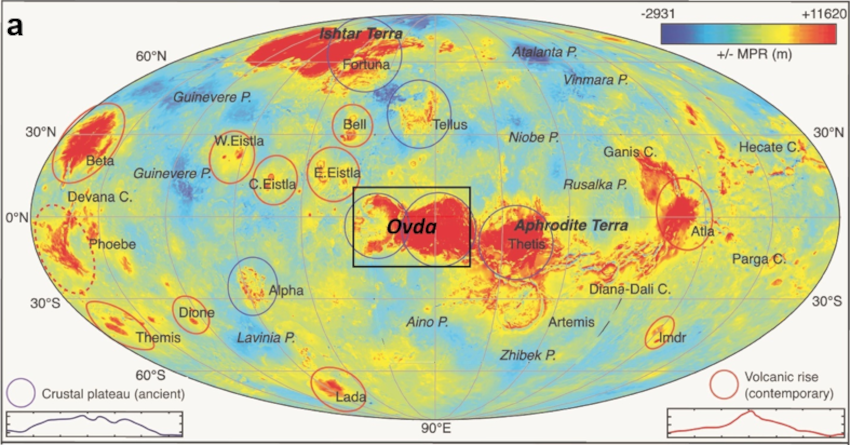
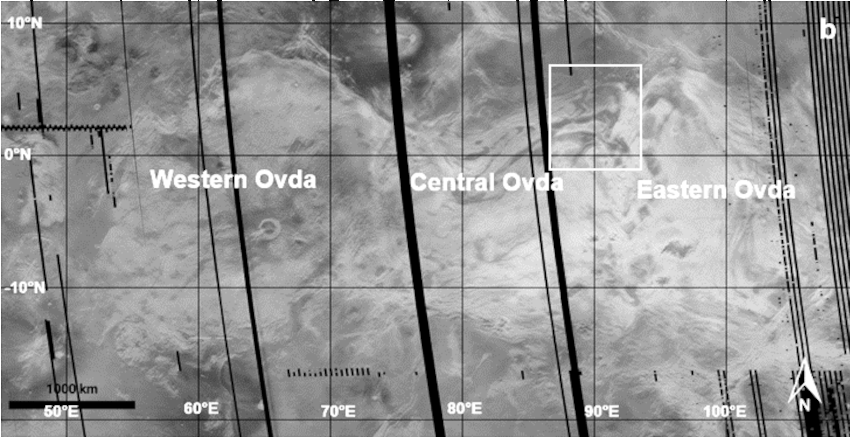
Figure 1. Location of study area. a) Altimetry of Venus with labels of key elevated regions on a Mollweide projection (modified after Hansen, 2018). Highlands, red; mesolands, yellow; lowlands, blues; Ishtar Terra and Aphrodite Terra are composite highlands; highland features include crustal plateaus and volcanic rises, and hybrid Phoebe Regio. Planitiae are indicated by “P.,” chasmata by “C.”. Black box = Ovda Regio and location of part b. b) Magellan SAR image showing Eastern, Central and Western Ovda and the study area (white box). Image taken from JMARS.
Results
More than 300,000 lineaments have been mapped across Eastern Ovda and NE Central Ovda (Fig. 2), including 33,830 within the smaller NE Central Ovda study area outlined by the white box in Figure 2. Within this study area, the lineaments were grouped into systems according to their geometry—radiating, circumferential, or linear—and are generalized in Figure 3. We interpret these radiating, circumferential, and linear systems as the surface expressions of underlying mafic dyke swarms.
The centres of the radiating and circumferential swarms are clustered along several broad, elongate topographic depressions. We interpret these depressions as failed rift arms belonging to triple-junction rift systems, rather than as synclinal folds produced by compression, and infer that they may be related to mantle plume activity.
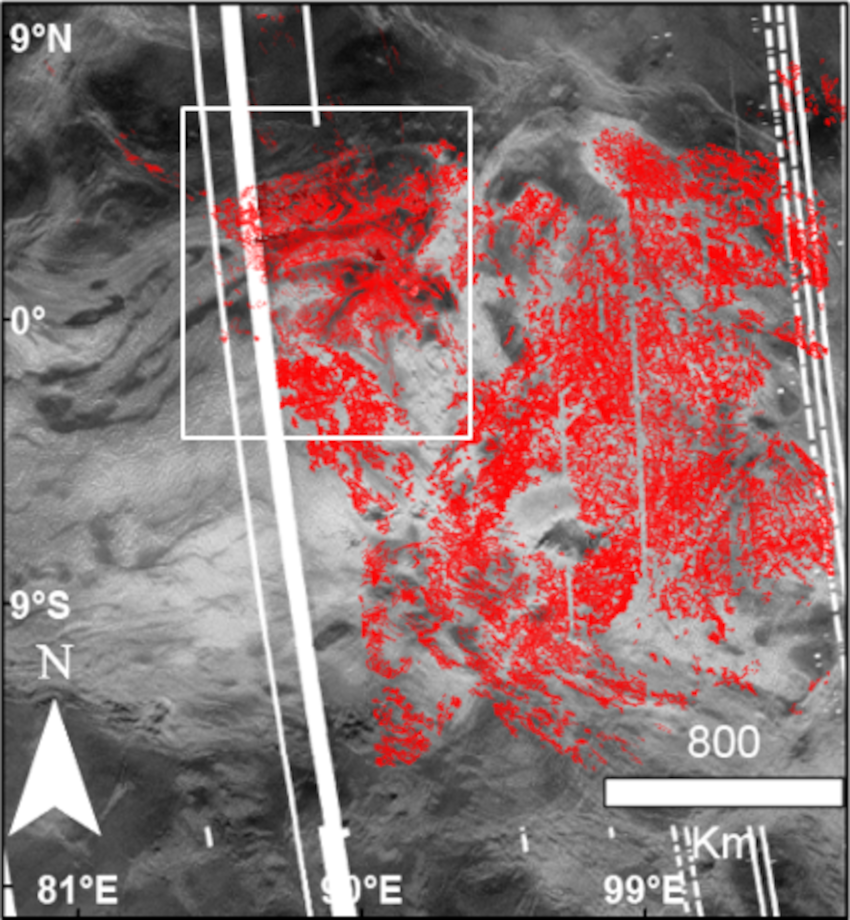
Figure 2. Detailed mapping of lineaments of Eastern Ovda Regio and NE Central Ovda Regio superimposed on Magellan SAR image (left looking and right looking images used). The white box corresponds to the detailed analysis of this study in NE Central Ovda). The lineament mapping of the broader Eastern Ovda area will be the focus of a subsequent study.
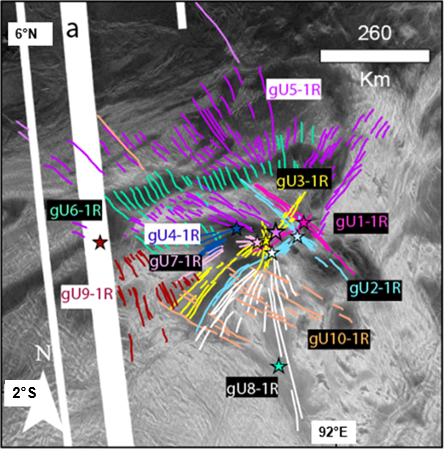
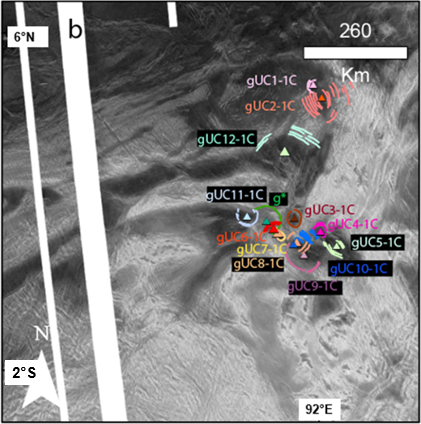
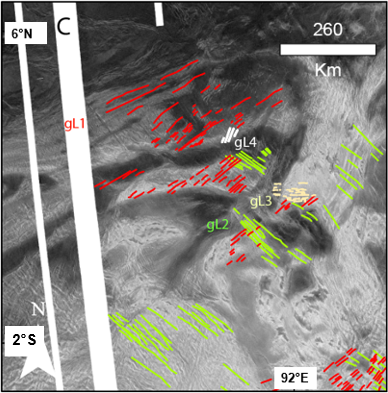
Figure 3. Generalized mapping of lineament systems in the study area, superimposed on Magellan SAR image (left-look and right-look) with information on each system presented in Table 1. a) Radiating systems are labelled, with their foci marked by similarly-coloured stars. b)Circumferential systems and a circular annulus labelled g*, with centres marked by triangles. The annulus is centred on the focus of radiating system gU5-1R.c) Linear systems. In part a) system gU10-1R (light brown) seems to have a slight convergence to the SE and it is hypothesized that its centre is outside the study area to the SE. In partb) the circumferential systems are mostly small enough in size that they could represent arcuate caldera collapse faults above a crustal magma reservoir (Head et al., 1992; MacLellan et al., 2021).
Discussion:
Geological history of the study area based on the lineament systems interpreted as dyke swarms and troughs interpreted as plume-generated triple junction rifting
The geological evolution of the study area began with formation of the tessera during Tessera Formation Time and was followed, during Post-Tessera Formation Time, by emplacement of the lineament systems interpreted as dyke swarms and by rifting—the younger history emphasized here. After emplacement of several linear swarms, mantle plume activity appears to have been associated with the development of radiating swarms, rifting, and possibly the later circumferential swarms. Beginning with plume arrival, we divide this younger geological history into three stages (Figs. 4 and 5).
Stage 1. In the first stage (Figs. 4, 5a), a plume arrived beneath magmatic centre U5, producing domal uplift and emplacement of the large radiating dyke swarm gU5-1R (purple). Terrestrial models of plume arrival (e.g., Campbell, 2007; Friedrich et al., 2018) indicate that the resulting dome can reach ~2500 km in diameter and as much as 2 km in height. The same models show that both the elevation and width of uplift may change rapidly over a few tens of millions of years as a plume rises through the mantle and approaches the lithosphere. Where the lithosphere is particularly thick, or where the plume is less buoyant, surface uplift may be only a few hundred metres or less and therefore at or below the ~100 m elevation resolution of the Magellan data, making it difficult to identify topographically. Even in such cases, however, a radiating dyke swarm can be sensitive to, and therefore record, relatively minor domal uplift.
The radiating dykes are interpreted to have been supplied from a magmatic centre, shown by the purple star, above the plume head. None of the proposed magmatic centres inferred from the radial swarms has a clear surface topographic or geological expression. Nevertheless, the position of centre U5 is supported by the convergence of troughs and radiating lineament systems, interpreted respectively as rift zones and dyke swarms.
Following a pattern commonly associated with mantle plumes on Earth (e.g., Burke and Dewey, 1973), continued uplift is interpreted to have produced triple-junction rifting (Figs. 4, 5b), with five rift arms, T1 to T5, extending outward from plume centre U5. These rift arms were subsequently flooded by younger radar-dark material (Figs. 4, 5c), probably representing lava flows and/or sedimentary deposits, which largely obscured the portions of gU5-1R lying within the rifts. On Earth, rift arms are commonly flooded by lavas generated through decompression melting of an underlying mantle plume (cf. White and McKenzie, 1989), and a similar process may have operated here. Alternatively, the lava flows may be unrelated to the plume and instead represent younger plains lavas that entered the rifts from outside the tessera, possibly along T1 in Figures 4 and 5b.
Stage 2. The second stage (Figs. 4, 5d) records a shift to a new magmatic centre, U6 (green star), situated 300 km south of U5 and defined by the second radial swarm gU6-1R (green). Centre U6 is associated with a second episode of triple-junction rifting, represented by three rift arms (T7–T9) radiating from it. This stage could represent a secondary pulse of the original plume following motion of the lithosphere, displacement of the underlying plume, or the arrival of a separate plume (cf. El Bilali et al., 2023). The dyke grabens of gU6-1R (green) are especially prominent within rift zones T6 and T5 (Fig. 5) and post-date the flooding event.
Stage 3. The third stage is divided into two sub-stages. The first (Figs. 4, 5e) involved emplacement of five radiating swarms—gU1-1R, gU2-1R, gU3-1R, gU4-1R, and gU7-1R—along different rift arms of the U5 triple junction. This distribution suggests that the rift zones experienced broad lithospheric and crustal thinning, which focused renewed plume-related melting and permitted the plume, or parts of it, to rise to shallower levels where decompression melting generated the associated magmatic centres (cf. White and McKenzie, 1989, for the terrestrial case; Jha and Parmentier, 1994, for application to Venus). The observed age progression is gU3-1R<gU2-1R<gU1-1R. The second sub-stage (Figs. 4, 5f) is represented by circumferential graben systems associated with younger coronae, many of which are aligned along the proposed rift arms. The inferred age progressions are gUC2-1C<gUC1-1C along T1, gUC7-1C<gUC6-1C along T3, and gUC10-1C<gUC8-1C<gUC9-1C along T3.
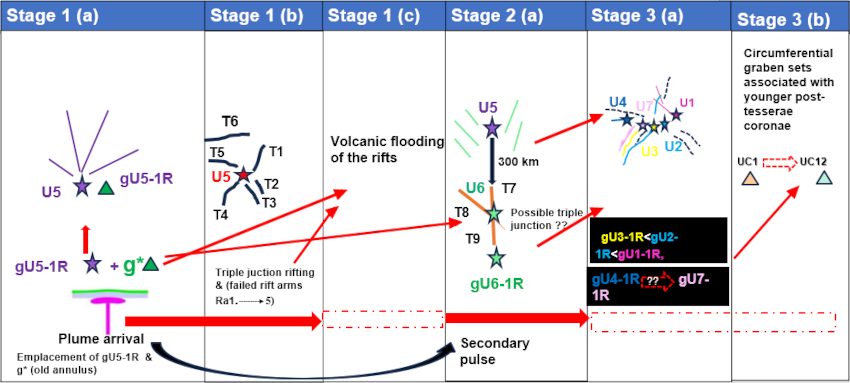
Figure 4. Geological history of the study area from the time of plume arrival. Age relationships between different events are shown by single headed arrows, where the arrow-head points towards the younger feature. R = radiating swarm, C = circumferential swarm. Stars represent centres for radiating swarms, triangles for circumferential swarms.
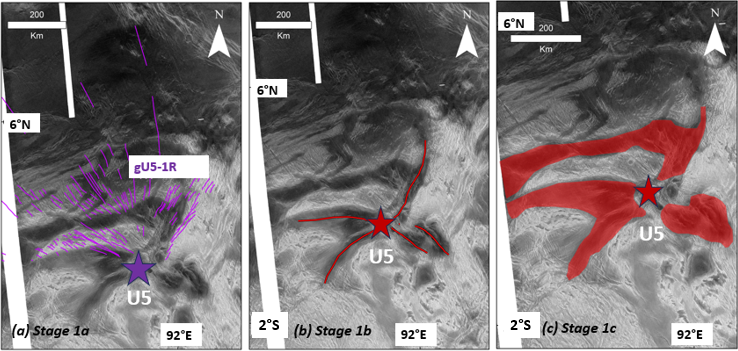
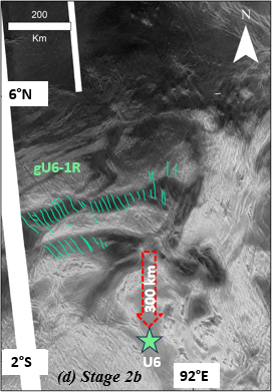
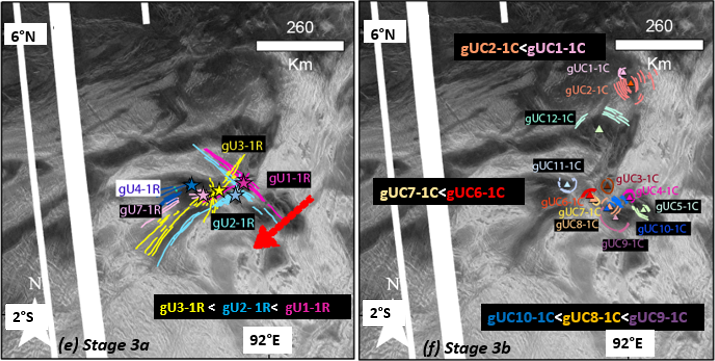
Figure 5. History of magmatic centres, dyke swarms and rift systems in the study area as outlined in Figure 4. a) Stage 1a. b) Stage 1b. c) Stage 1c. d) Stage 2b. e) Stage 3a. f) Stage 3b. The dashed red arrow shows age progression from U1 to U3; the age relationship between U4 and U7 is ambiguous.
References
Basilevsky, A.T., Head, J.W., 2000. Rifts and large volcanoes on Venus: global assessment of their age relations with regional plains. J. Geophys. Res. Planets 105 (E10), 24583–24611. https://doi.org/10.1029/2000JE001260
Basilevsky, A.T., Head, J.W., 2003. The surface of Venus. Rep. Prog. Phys. 66 (10), 1699–1735. https://doi.org/10.1088/0034-4885/66/10/R04.
Burke, K.C., Dewey, J.F., 1973. Plume-generated triple junctions: key indicators in applying plate tectonics to old rocks. J. Geol. 81, 406–433.
Byrne P. K., Şengör A. M., Ghail R. C., Klimczak C., James P. B., 2023. Venus’ Highland Tesserae are Tectonic Counterparts to Earth’s Cratons. In: Lunar and Planetary Science, Abstract #2924. Lunar and Planetary Institute, Houston.
Chety, T.R.K., Venkatrayudu, M., Venkatasivappa, V., 2010. Structural architecture and new tectonic perspective of Ovda Regio, Venus. Planet. Space Sci. 58, 1286–1297.
El Bilali, H., Ernst, R.E., Buchan, K.L., Head, J.W., 2023. Dyke swarms record the plume stage evolution of the Atla Regio superplume on Venus. Commun. Earth Environ. 4 (1), 235.
Ernst, R.E., 2014. Large Igneous Provinces. Cambridge University Press, Cambridge, p. 653.
Friedrich, A.M., 2018. Stratigraphic framework for the plume mode of mantle convection. Geol. Soc. Am. Abstr. Programs 49 (6). https://doi.org/10.1130/abs/2017AM-308724.
Gilmore, M.S., Head, J.W., 2018. Morphology and deformational history of Tellus Regio, Venus: evidence for assembly and collision. Planet. Space Sci. 154, 5–20.
Hahn, R., Byrne, P.K., 2023. A morphological and spatial analysis of volcanoes on Venus. J. Geophys. Res. Planets 128 (4). https://doi.org/10.1029/2023JE007753
Hanmer, S., 2020. Tessera terrain ribbon fabrics on Venus reviewed: could they be dyke swarms? Earth-Sci. Rev. 201, 103077. https://doi.org/10.1016/j.earscirev.2019.103077.
Hansen, V.L., Banks, B.K., Ghent, R.R., 1999. Tessera terrain and crustal plateaus, Venus. Geology 27, 1071–1074. https://doi.org/10.1130/0091.
Hansen, V.L., 2018. Global tectonic evolution of Venus, from exogenic to endogenic over time, and implications for early Earth processes. Philos. Trans. R. Soc. A 376. https://doi.org/10.1098/rsta.2017.0412
Head, J.W., Crumpler, L.S., Aubele, J.C., Guest, J., Saunders, S.R., 1992. Venus volcanism: classification of volcanic features and structures, associations, and global distribution from Magellan data. J. Geophys. Res. 97, 13,153–13,197.
Head, J.W., Coffin, M.F., 1997. Large igneous provinces: a planetary perspective. In: Mahoney, J.J., Coffin, M.F. (Eds.), Large Igneous Provinces: Continental, Oceanic and Planetary Flood Volcanism. American Geophysical Union, Geophysical Monograph 100, pp. 411–438. https://doi.org/10.1029/GM100p0411
Ivanov, M.A., Head, J.W., 2011. Global geological map of Venus. Planet. Space Sci. 59, 1559–1600.
Ivanov, M.A., Head, J.W., 2013. The history of volcanism on Venus. Planet. Space Sci. 84, 66–92.
Jha, K., Parmentier, E.M., 1994. Buoyant mantle flow and rift associated volcanism: application to Venus. 25th Lunar and Planetary Science Conference, Abstract #1312.
Khawaja, S., Ernst, R.E., Samson, C., Byrne, P.K., Ghail, R.C., MacLellan, L.M., 2020. Tesserae on Venus may preserve evidence of fluvial erosion. Nat. Commun. 11, 5789. https://doi.org/10.1038/s41467-020-19544-9
MacLellan, L.M., Ernst, R.E., El Bilali, H., Ghail, R.C., Bethell, E., 2021. Volcanic history of the Derceto large igneous province, Astkhik Planum, Venus. Earth-Sci. Rev. 220, 103619.
Phillips, R.J., Hansen, V.L., 1994. Tectonic and magmatic evolution of Venus. Annu. Rev. Earth Planet. Sci. 22, 597–656.
Solomon, S.C., Head, J.W., 1982. Mechanisms for lithospheric heat transport on Venus: implications for tectonic style and volcanism. J. Geophys. Res. Solid Earth 87 (B11), 9236–9246.
Solomon, S.C., Smrekar, S., Bindschadler, D.L., Grimm, R.E., Kaula, W.M., McGill, G.E., Phillips, R.J., Saunders, R.S., Schubert, G., Squyres, S.W., Stofan, E.R., 1992. Venus' tectonics: an overview of Magellan observations. J. Geophys. Res. Planets 97 (E8), 13,199–13,255. https://doi.org/10.1029/92JE01418
White, R., McKenzie, D., 1989. Magmatism at rift zones: the generation of volcanic continental margins and flood basalts. J. Geophys. Res. 94, 7685–7729.
Wratchford, L.E., Byrne, P.K., Crane, K., 2025. Comparative structural mapping of highlands on Venus and cratons on Earth. 56th Lunar and Planetary Science Conference, Abstract #2689.