
2026 April LIP of the Month
Weathering of the Emeishan large igneous province enhanced the nutrient flux to the oceans and led to late Permian climate cooling
Kunyue Ling1,*, Hanjie Wen2,3,*, Shengtao Gong4, Ce Chen1,3, Shengjiang Du5, Runsheng Yin1
1State Key Laboratory of Critical Mineral Research and Exploration, Institute of Geochemistry, Chinese Academy of Sciences, Guiyang 550081, China. lingkunyue@mail.gyig.ac.cn
2School of Earth Science and Resources, Chang’an University, Xi’an 710054, China.
3College of Earth and Planetary Sciences, University of Chinese Academy of Sciences, Beijing 100049, China.
4School of Earth Sciences, East China University of Technology, Nanchang 330013, China.
5School of Mining Engineering, Guizhou Institute of Technology, Guiyang 550025, China.
Extracted and modified from:
Ling, K., Wen, H., Gong, S., Chen, C., Du, S., & Yin, R. (2026). Weathering of the Emeishan large igneous province enhanced the nutrient flux to the oceans and led to late Permian climate cooling. Geochemistry, Geophysics, Geosystems, 27, e2025GC012795. https://doi.org/10.1029/2025GC012795
Eruption of mafic continental large igneous provinces (LIPs) are often linked to dramatic climate changes, such as global warming, volcanic winters, and even mass extinction events (Ernst and Youbi, 2017; Gong et al., 2023). Specifically, LIPs can emit large volumes of greenhouse gas (e.g., CO2), causing rapid warming, or emit substantial sulfate, leading to short-term cooling (Sheth, 2007; Ganino and Arndt, 2009; Landwehrs et al., 2020). Furthermore, the large basaltic outflow during continental LIPs activities formed basaltic plateaus (Shellnutt et al., 2020). Subsequent weathering of basaltic plateaus consumes atmospheric CO2, associated with enhanced input of terrestrial nutrients (e.g., P, Fe, and Si) to the ocean (e.g., Li et al., 2016; Chen et al., 2020). This increased nutrient input increases oceanic productivity, which further decreases atmospheric CO2 levels (through organic carbon burial) and global temperature(Boyd and Ellwood, 2010; Longman et al., 2021; Hülse and Ridgwell, 2025). Hence, in response to the rapid perturbations of the Earth system induced by LIP eruptions, such as episodes of rapid warming, LIPs may play a critical role in setting Earth’s long-term climate state, potentially as drivers of prolonged cooling (Longman et al., 2021). This self-regulating response to initial climatic forcing represents a negative feedback mechanism that counteracts global warming by accelerating the drawdown of atmospheric CO2 through enhanced silicate weathering and associated input of nutrients (Hülse and Ridgwell, 2025).
The Emeishan LIP, erupted during the middle–late Permian (ca. 260 Ma), generated flood basalts covering an area of >2.5 × 10⁵ km2 with a thickness of hundreds of meters to up to 5 km in southwestern China (Fig. 1; Xu et al., 2001). Such a magnitude in basaltic eruption caused significant perturbations of the atmosphere–land–ocean system (Bond et al., 2020). Subsequent basalt weathering produced substantial detritus and nutrients that were exported to the ocean and potentially affected the long-term global C cycle (Algeo and Twitchett, 2010). Provenance and paleogeographic studies have identified a closed source–sink depositional system from the Emeishan LIP to the western Yangtze Cratonic Basin (WYCB) and Youjiang Basin (He et al., 2007; Yang et al., 2014; Deng et al., 2020; Wang et al., 2020). About 95% of the sediment was trapped in the adjacent upper Permian sedimentary systems of the WYCB to the east of the LIP (Wang et al., 2020). Therefore, analyzing these clastic sediments allows a quantitative estimate of the eroded volume of the Emeishan LIP and related nutrient fluxes to the ocean (Fig. 1).
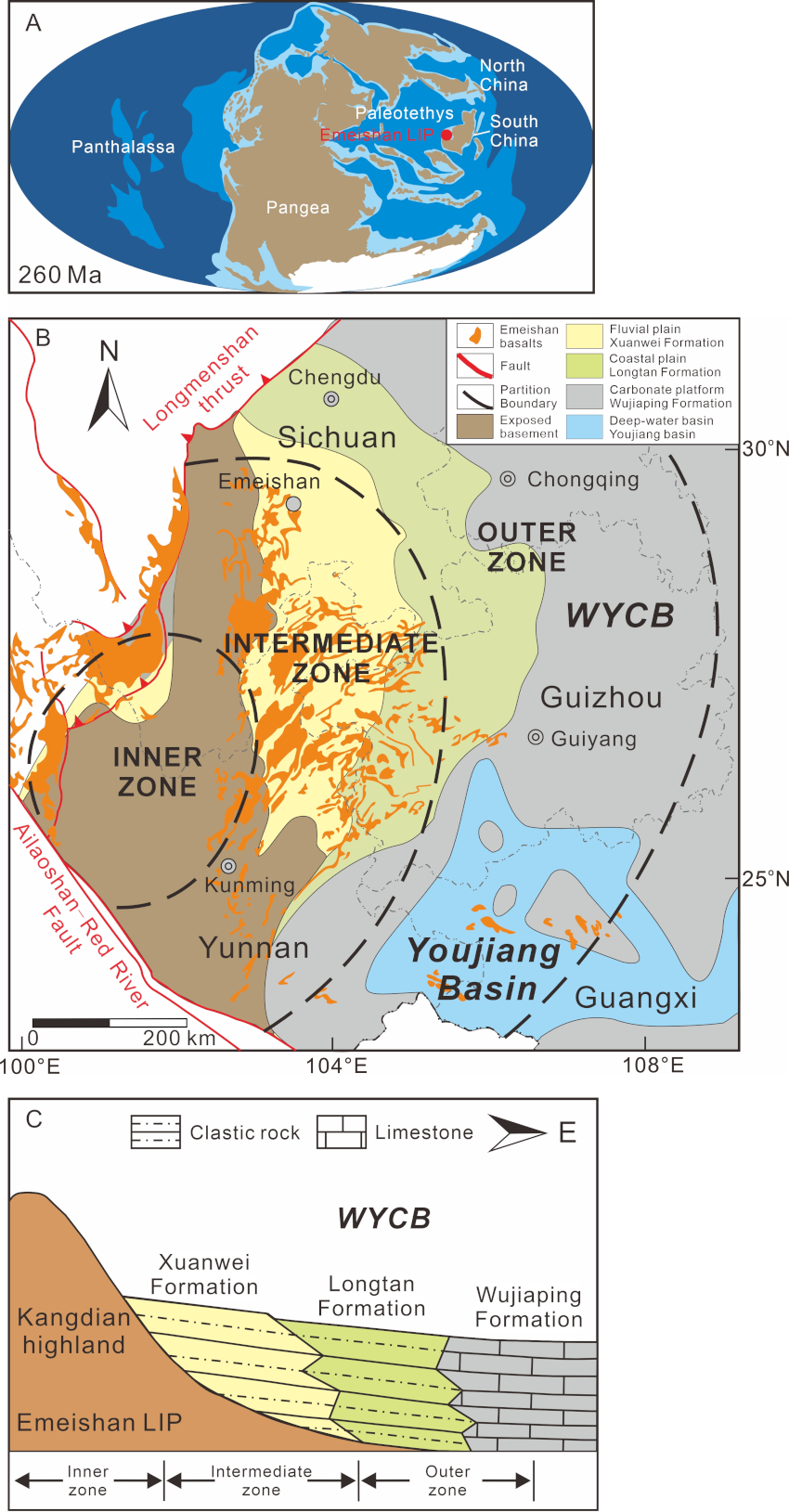
Figure 1. Simplified palaeogeographic map of South China in the late Permian (ca. 260 Ma). (A) Late Permian global palaeogeographic reconstruction (modified after Yang et al., 2018). (B) Simplified geological map showing the palaeogeography of southwestern China (modified after Feng et al., 1996; Shao et al., 1999; Shellnutt et al., 2020). (C) Cross-section of southwestern Chinashowing the major upper Permian formationswithin the WYCB (modified after He et al., 2003). WYCB = Western Yangtze Cratonic Basin.
In this study, based on the well-constrained stratigraphy and depositional timescale, as well as the abundant data for the clastic sediments that have been published as a result of decades of coal mining and exploration in the WYCB, the mass change calculation (MC) methods were employed to estimate the volume of eroded Emeishan LIP and associated solute flux to the ocean. Our MC calculations show that the minimum denudation rate of the Emeishan LIP basalts was 170.8 t/km²/yr during the late Permian (Wuchiapingian), which is much higher than the present-day global average (~84 t/km²/yr) and that of modern tropical basaltic regions such as Hawaii (~140 t/km²/yr). This indicates that increased atmospheric CO₂ consumption during the late Permian contributed to global cooling. The estimated minimum dissolved Si, P, and Fe fluxes to the surface ocean are 2.29 × 10⁶, 11.7 × 10³, and 68 × 10³ t/yr, respectively, which are 1.3%–3.4% of the total dissolved fluxes of these elements in modern global rivers. This high nutrient input resulted in a high removal rate of atmospheric CO2 of 8.5–85 × 106 t/yr due to enhanced biological productivity, as inferred from the Fe fertilisation model and dissolved Fe flux (Fig. 2). This rate is approximately one order of magnitude higher than those due to weathering of the Emeishan LIP basalts and accounts for 0.05%–0.5% of the modern global CO2 sink, which could have led to a reductionin atmospheric CO2 concentration. This likely had a major effect on the oceanic C cycle and may have ultimately led to global cooling during the late Permian.Our results highlight the key role of LIPs in modulating Earth’s climate over long time periods and in driving long-term cooling due to enhanced CO2 drawdown caused by enhanced nutrient input to the surface ocean.
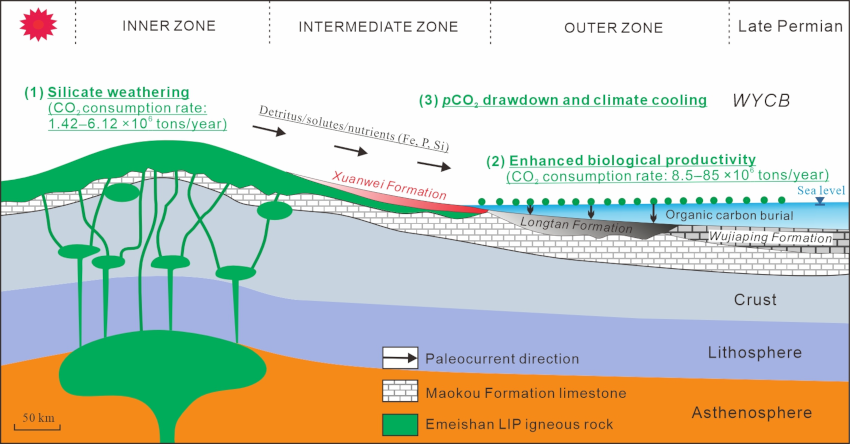
Figure 2. Schematic model of the source–sink system of the Emeishan LIP and its potential links to late Permian climate cooling. Silicate weathering of the Emeishan LIP (1) consumed atmospheric CO2; (2) delivered high nutrient fluxes to the oceans, enhanced the biological pump, and increased organic C burial; and (3) reduced atmospheric CO2 levels, resulting in climate cooling. WYCB = West Yangtze Cratonic Basin.
References:
Algeo, T. J., & Twitchett, R. J. (2010). Anomalous Early Triassic sediment fluxes due to elevated weathering rates and their biological consequences. Geology, 38(11), 1023–1026. https://doi.org/10.1130/g31203.1
Bond, D. P. G., Wignall, P. B., & Grasby, S. E. (2020). The Capitanian (Guadalupian, Middle Permian) mass extinction in NW Pangea (Borup Fiord, Arctic Canada): A global crisis driven by volcanism and anoxia. GSA Bulletin, 132(5–6), 931–942. https://doi.org/10.1130/b35281.1
Boyd, P., & Ellwood, M. (2010). The biogeochemical cycle of iron in the ocean. Nature Geoscience, 3(10), 675–682. https://doi.org/10.1038/ngeo964
Chen, Y., Hedding, D. W., Li, X., Greyling, A. C., & Li, G. (2020). Weathering dynamics of Large Igneous Provinces (LIPs): A case study from the Lesotho Highlands. Earth and Planetary Science Letters, 530, 115871. https://doi.org/10.1016/j.epsl.2019.115871
Deng, X.-S., Yang, J., Cawood, P. A., Wang, X.-C., Du, Y., Huang, Y., et al. (2020). Detrital record of late-stage silicic volcanism in the Emeishan large igneous province. Gondwana Research, 79, 197–208. https://doi.org/10.1016/j.gr.2019.09.015
Ernst, R., & Youbi, N. (2017). How large igneous provinces affect global climate, sometimes cause mass extinctions, and represent natural markers in the geological record. Palaeogeography, Palaeoclimatology, Palaeoecology, 478, 30–52. https://doi.org/10.1016/j.palaeo.2017.03.014
Feng, Z., Yang, Y., Jin, Z., He, Y., Wu, S., Xin, W., et al. (1996). Lithofacies paleogeography of the Permian of South China. Acta Sedimentologica Sinica, 14, 1–11. (in Chinese with English abstract).
Ganino, C., & Arndt, N. T. (2009). Climate changes caused by degassing of sediments during the emplacement of large igneous provinces.Geology, 37(4), 323–326. https://doi.org/10.1130/g25325a.1
Gong, Z., Zhang, M., Li, J., & Huang, C. (2023). Late Permian ∼6 My cooling induced by basaltic weathering of the Emeishan large igneous province: Evidence from interbasaltic paleosols. Palaeogeography, Palaeoclimatology, Palaeoecology, 609, 111305. https://doi.org/10.1016/j.palaeo.2022.111305
He, B., Xu, Y.-G., Chung, S.-L., Xiao, L., & Wang, Y. (2003). Sedimentary evidence for a rapid, kilometer-scale crustal doming prior to the eruption of the Emeishan flood basalts. Earth and Planetary Science Letters, 213(3–4), 391–405. https://doi.org/10.1016/s0012-821x(03)00323-6
He, B., Xu, Y.-G., Huang, X.-L., Luo, Z.-Y., Shi, Y.-R., Yang, Q.-J., & Yu, S.-Y. (2007). Age and duration of the Emeishan flood volcanism, SW China: Geochemistry and SHRIMP zircon U–Pb dating of silicic ignimbrites, post-volcanic Xuanwei Formation and clay tuff at the Chaotian section. Earth and Planetary Science Letters, 255(3–4), 306–323. https://doi.org/10.1016/j.epsl.2006.12.02
Hulse, D., & Ridgwell, A. (2025). Instability in the geological regulation of Earth's climate. Science, 389(6767), eadh7730. https://doi.org/10.1126/science.adh7730
Landwehrs, J. P., Feulner, G., Hofmann, M., & Petri, S. (2020). Climatic fluctuations modeled for carbon and sulfur emissions from end-Triassic volcanism. Earth and Planetary Science Letters, 537, 116174. https://doi.org/10.1016/j.epsl.2020.116174
Li, G., Hartmann, J., Derry, L. A., West, A. J., You, C.-F., Long, X., et al. (2016). Temperature dependence of basalt weathering. Earth and Planetary Science Letters, 443, 59–69. https://doi.org/10.1016/j.epsl.2016.03.015
Longman, J., Mills, B. J. W., Manners, H. R., Gernon, T. M., & Palmer, M. R. (2021). Late Ordovician climate change and extinctions driven by elevated volcanic nutrient supply. Nature Geoscience, 14(12), 924–929. https://doi.org/10.1038/s41561-021-00855-5
Shao, L., Hao, L., Yang, L., Zhang, P., & Tian, B. (1999). High resolution sequence stratigraphy of the Late Permian coal measures in southwestern China. Mining Science and Technology, 99, 239–242.
Shellnutt, J. G., Pham, T. T., Denyszyn, S. W., Yeh, M.-W., & Tran, T.-A. (2020). Magmatic duration of the Emeishan large igneous province: Insight from northern Vietnam. Geology, 48(5), 457–461. https://doi.org/10.1130/g47076.1
Sheth, H. C. (2007). ‘Large Igneous Provinces (LIPs). Definition, recommended terminology, and a hierarchical classification. Earth-Science Reviews, 85(3–4), 117–124. https://doi.org/10.1016/j.earscirev.2007.07.005
Wang, X., Shao, L., Eriksson, K. A., Yan, Z., Wang, J., Li, H., et al. (2020). Evolution of a plume-influenced source-to-sink system: An example from the coupled central Emeishan large igneous province and adjacent western Yangtze cratonic basin in the Late Permian, SW China. Earth-Science Reviews, 207, 103224. https://doi.org/10.1016/j.earscirev.2020.103224
Xu, Y., Chung, S. L., Jahn, B.-M., & Wu, G. (2001). Petrologic and geochemical constraints on the petrogenesis of Permian-Triassic Emeishan flood basalts in southwestern China. Lithos, 58(3–4), 145–168. https://doi.org/10.1016/S0024-4937(01)00055-X
Yang, J., Cawood, P. A., Du, Y., Huang, H., & Hu, L. (2014). A sedimentary archive of tectonic switching from Emeishan Plume to Indosinian orogenic sources in SW China. Journal of the Geological Society, 171(2), 269–280.