
2025 November LIP of the Month
The Colíder SLIP: Stratigraphy, Petrogenesis, and Metallogenic Significance in the Southern Amazonian Craton
André Massanobu Ueno Kunifoshita1; Maria José Mesquita1; Felipe Holanda dos Santos2; Carlos Augusto Sommer3.
1: Instituto de Geociências, Universidade Estadual de Campinas (UNICAMP), Rua Carlos Gomes, 250 CEP: 13083-855, Campinas, São Paulo, Brazil; andrekunifoshita@gmail.com
2: Departamento de Geologia, Universidade Federal do Ceará, Campus do Pici, Bloco 912, CEP: 60440-554, Fortaleza, Ceará, Brazil.
3: Instituto de Geociências, Universidade Federal do Rio Grande do Sul, Av. Bento Gonçalves, 9500, Porto Alegre, Rio Grande do Sul, Brazil.
Extracted and modified from:
Kunifoshita, A.M.U., Santos, F.H., Mesquita, M.J., 2024. The Colíder Paleoproterozoic felsic volcanism: New insights into stratigraphy and petrogenesis in the southern Amazonian Craton. Geosci. Front. 101722. https://doi.org/10.1016/j.gsf.2023.101722
Kunifoshita, A.M.U., Mesquita, M.J., Santos, F.H., Sommer, C.A., 2025. Reconstructing Paleoproterozoic volcanic environments: Eruptive styles and evidence of phreatomagmatism in the Amazonian Craton’s Colíder Group. J. South Am. Earth. Sci. 159, 105531. https://doi.org/10.1016/j.jsames.2025.105531
1. Introduction
Volcanic and plutonic activities were essential in generating the Earth’s crust in the Archean and Proterozoic (Mueller and Thurston, 2004; Cawood et al., 2013), with one of the most significant intervals of continental crust formation occurring between 2.1 and 1.7 Ga (Hawkesworth et al., 2010). In the Amazonian Craton, at least two episodes of large-scale volcano-plutonism mark the generation of Paleoproterozoic crust in the Central Amazonian and Tapajós–Parima Provinces (Santos et al., 2008), events classified as SLIPs (Silicic Large Igneous Provinces) following Bryan and Ernst (2008) and Bryan and Ferrari (2013) called Orocaima SLIP and Uatumã SLIP.
The Orocaima SLIP (~200.000 km2) has an approximate age of 2.0 Ga (Barbosa et al., 2021; Fraga et al., 2024). These authors indicate a post-collisional geochemical affinity in a convergent context or late-orogenic magmatism for these volcano-plutonism event. Conversely, Ibañez-Mejia et al. (2025), suggested a mantle plume link based on the identification of a radiating swarm of dikes associated with the coeval Yanomami LIP. The spatial and temporal proximity to the Orocaima SLIP supports a plume-triggered mechanism for SLIP development. The Uatumã SLIP (~1.500.000 km2) has an age of 1.88 Ga (Juliani and Fernandes, 2010; Roverato et al., 2019). The geochemical affinity suggests the origin of post-collisional or post-orogenic to anorogenic environment magmatism (Fernandes et al.,2011; Fernandes and Juliani, 2019; Roverato et al., 2019).
In recent decades, these Proterozoic volcano-plutonic events have attracted worldwide attention due to the various associated mineral deposits, such as low and high-sulfidation epithermal systems (Au-Ag) (e.g., Chapéu do Sol/V6 and Botica Velho/V3 deposits), porphyry-type systems (Cu-Au-Mo) (e.g., Palito mine, Tocantinzinho mine, Paraíba mine, and Jaca deposit) (Assis et al., 2017; Juliani et al., 2021; Mesquita et al., 2022).
The Alta Floresta Mineral Province (AFMP), during the Staterian (~1.79 Ga), is the scene of an extensive (~85.000 km2) felsic volcano-plutonic event. Rizzotto et al. (2019b) and Almeida et al. (2021, 2022) called these events Colíder SLIP, composed of the volcanic rocks from the Colíder Group and its plutonic counterpart, the Teles Pires Intrusive Suite (Alves et al., 2019; Rizzotto et al., 2019b; Almeida et al., 2021) (Fig. 1B). The geochemical characteristics suggest a post-collisional to an intraplate environment (Santos et al., 2019; Kunifoshita et al., 2024). Reis et al. (2022) have observed an age match with the Avanavero LIP, which could suggest a genetic link between these two magmatic events.

Fig. 1. Regional geological context. (A) Simplified map of the Amazonian Craton; Red polygon - Alta Floresta Mineral Province. (B) Simplified map of the Alta Floresta Mineral Province (modified from Rizzotto et al., 2019a).
2. Geology and geochronology
The Colíder SLIP rocks outcrop along a preferential WNW-ESE trend in an area of approximately 85.000 km2 (Rizzoto et al., 2019b; Almeida et al., 2021). It is part of the Juruena – Roosevelt Domain (Rio Negro – Juruena Province) and constitutes a large region of the Alta Floresta Mineral Province (Fig. 1B). In the eastern sector of the AFMP, these rocks outcrop along a general NE trend and surround the oldest rocks of the Peixoto domain. In the western sector, they outcrop along the entire southern edge of the Cachimbo graben. In the south of AFMP, they outcrop to the north of the edge of the Parecis basin (Souza et al., 2005) (Fig. 1B).
The Colíder Group is divided into three formations from base to top: the Bom Jaguar, Braço Sul, and Braço Norte (Rizzotto et al., 2016; Alves et al., 2019) (Fig. 2). The Bom Jaguar Formation comprises subvolcanic rocks and lava flows composed mainly of rhyolite and dacite, besides andesite and basalt. The subvolcanic rocks occur in flagstones and in situ blocks with positive morphological geometry, suggesting a small dome or coulee (Fig. 2A). These rocks are massive and hypocrystalline with different ratios of phenocrysts vs. groundmass (Fig. 2B and C), with a porphyritic texture with subhedral alkali feldspar, quartz, and plagioclase phenocrysts dispersed in much finer-grained quartz-feldspar groundmass (Fig. 2B and C). The lava flow is composed of rhyolitic hololeucocratic and hypocrystalline rock with a porphyritic texture, where aligned and rotated crystals define the flow structure (Fig. 2D).
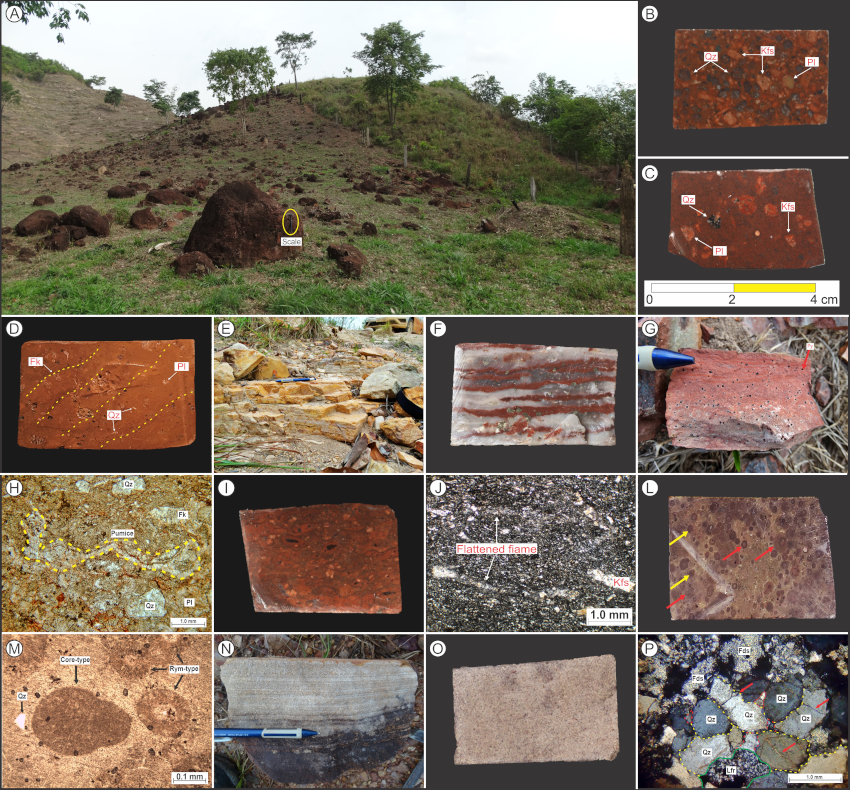
Fig. 2. Characteristics of the Colíder Group rocks. (A) Characteristic outcrop of rhyolite with blocks and boulders in situ in hills of domic topography; (B and C) Holocrystalline to hypocrystalline massive porphyritic rhyolite; (D) Rhyolite with flow foliation; (E and F) Stratified lapilli tuff; (G) Massive tuff; (H) Deformed pumice (yellow line); (I and J) Welded lapilli tuff; (L and M) Lapilli tuff with lapilli accretionary; (N) Stratified sandstone; (O and P) Massive sandstone. Qz – quartz, Pl – plagioclase, Kfs - alkaline feldspar, Lc - lithic clasts, Op - opaque mineral.
The Braço Sul Formation comprises stratified lapilli tuff (Fig. 2E and F), massive lapilli tuff (Fig. 2G and H), lapilli tuff and tuffs with varying degrees of welding (Fig. 2I and J), with an origin associated with pyroclastic density currents. In addition, phreatomagmatic deposits are characterized by lapilli tuff with accretionary lapilli (Fig. 2L and M). The Braço Norte Formation is composed of volcano-sedimentary rocks, consisting of lithic sandstones (Fig. 2N, O, and P), argillites, and siltstones of volcanogenic origin, with planar or low-angle cross-stratification (Fig. 2N).
The U-Pb zircon crystallization ages of the Colíder SLIP indicate an older age of 1838 Ma ±17 Ma from a welded lapilli tuff (Kunifoshita et al., 2024) and a younger age of 1757 ± 14 Ma from an ignimbrite (Bini et al., 2015) (Fig. 3). This suggests that the volcanic rocks of the Colíder Group were formed over an approximately 88-million-year period, possibly by multiple volcanic pulses or distinct events (Kunifoshita et al., 2024).
Santos et al. (2019) raised two hypotheses for the temporal and genetic evolution of the Colíder Group in the northern AFMP. The first hypothesis is based on differences in petrographic and geochronological features, suggesting two distinct magmatic events (one at ~1.81 Ga and another at ~1.76 Ga) originating from a similar magmatic source, given the geochemical similarity of the rocks. The second hypothesis is that the rocks were derived from the same magmatic event, which lasted from ~1.81 Ga to ~1.76 Ga, with minor variations in crystallization conditions in the source and the magma chamber. The paleoenvironment of Colíder Group volcanism is related to a model of eroded volcanic calderas in União do Norte village, with epiclastic rocks associated with a fluvial-deltaic environment.
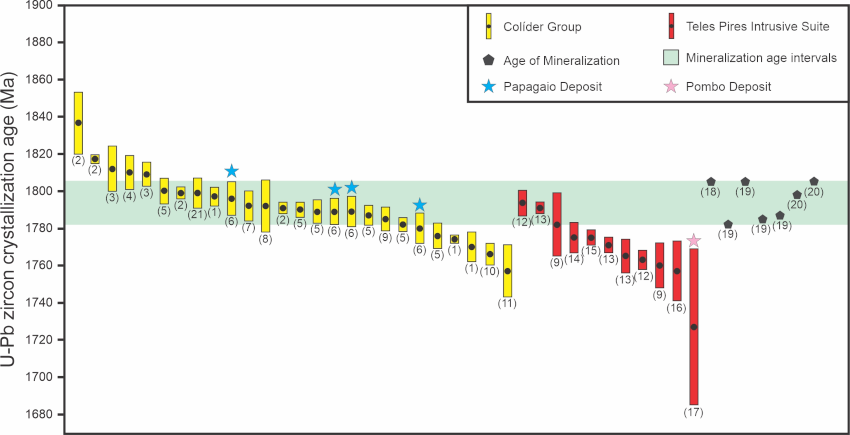
Fig. 3. Boxplot diagram of U–Pb (zircon) geochronological data of the AFMP Colíder Group. Stars indicate mineral occurrences. The pale green band is the mineralization ages’ intervals. Yellow bars are the Colíder Group rock ages, and the red bars are the Teles Pires Intrusive Suite. (The number corresponding to each sample from Kunifoshita et al., 2024).
3. Petrogenesis of the Colíder Group
The volcanic rocks studied in the Colíder Group are mostly rhyolite, with rhyodacite to trachyte, with high SiO2 (>70 %) and K2O content. Subordinately intermediate rocks, mainly andesite to trachyandesite (Fig. 4A). Regarding the MALI index (Frost et al. 2001), most rocks show the distribution in the alkali-calcic field, with a slight tendency towards calc-alkalic (Fig. 4B). The Colíder rocks show strong negative anomalies in Sr, P, and Ti, a less intense negative anomaly in Nb and Ta, and positive anomalies in Rb-Th, La, and Nd. The rocks formed prominently in post-collisional magmas; however, a progressive increase in Rb, particularly in Y+Nb, suggested an evolution from a post-collisional to an intraplate environment (Pearce 1996) (Fig. 4C). In addition, the high Y/Nb ratio suggests an A2-type granite subdivision, which, according to Eby (1992) and Bonin (2007), is formed by magmas derived in post-collisional to post-orogenic environments with contributions from a metasomatized mantle edge and crustal fragments (Fig 4D).
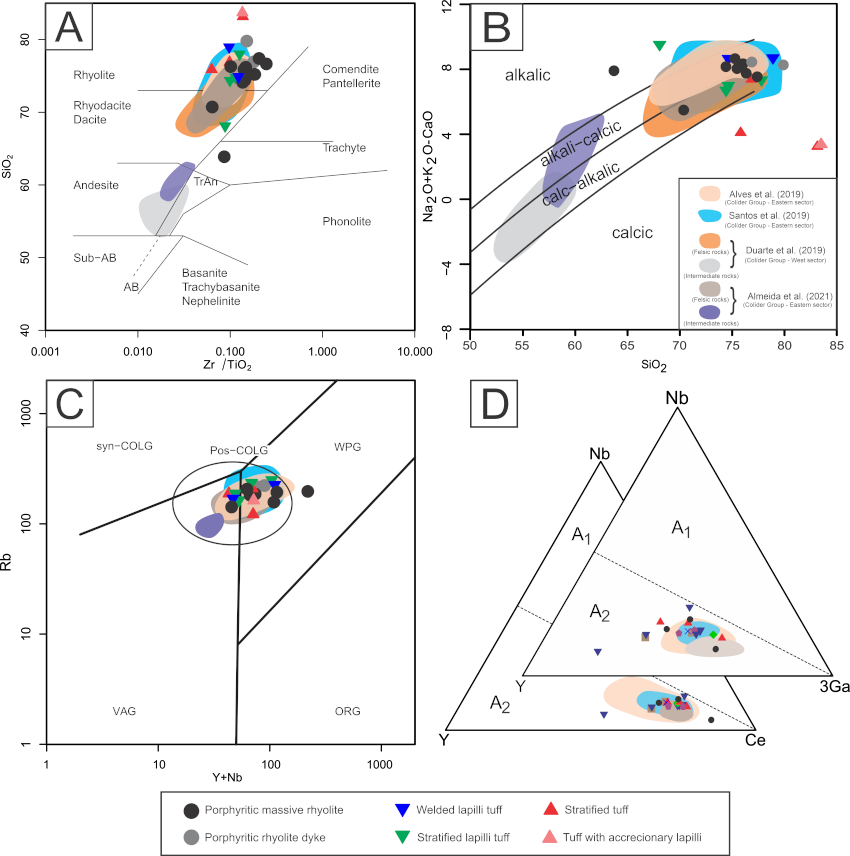
Fig. 4. Geochemical characterization of the Colíder Group rocks. (A) Diagram of SiO2 vs. Zr/TiO2 (Winchester and Floyd, 1977). (B) Alkali-lime index (MALI - Na2O + K2O - CaO) vs. SiO2 diagram (Frost et al., 2001). (C) Rb vs. Y + Nb diagram (Pearce, 1996). (D) Chemical classification diagrams of A-type granite (Eby, 1992).
4. Metallogenesis
The Colíder Group has aroused metallogenic interest since the discovery that it has ages similar to those of the Au-Cu mineralizations of the AFMP (1.78 to 1.80 Ga; Acevedo, 2014; Assis et al., 2017; Rocha et al., 2020) (Fig. 3), and in some cases hosts Cu-Au porphyry and epithermal deposits, such as the Maria Bonita, Papagaio, Pombo, Juruena, and Guarantã Ridge deposits (Mesquita et al., 2022). According to Assis et al. (2017), the rocks of the Colíder Group are associated with the mineralization event in the AFMP, related to the final stages of the evolution of the Juruena magmatic arc (ca. 1.88 – 1.75 Ga). Furthermore, based on zircon chemistry data, the most fertile geological units for Cu and Au in the eastern portion of the AFMP are the rocks of the Colíder Group, followed by the Teles Pires, due to their high-water content and high oxidation state of the magmas (Trevisan et al., 2021).
5. Conclusions
The Colíder SLIP is a volcanic province characterized by the interplay of multiple magmatic phases, including effusive, dry explosive, and phreatomagmatic volcanism, as well as plutonism. It extends over approximately 85.000 km², following a preferential WNW–ESE structural trend. Based on the geochemical data, the Colíder Group has a geochemical characteristic of high potassium calc-alkaline, with some suggestive affinities of A-type magmas produced in a post-collisional to an intraplate environment. The enrichment in REE, high LREE contents, slight HREE fractionation, negative Eu anomalies, and high HFS elements (Ce + Y + Nb + Zr + Ga values above 340 ppm) suggest an influence of an intra-plate mantle source, with contributions of a metasomatized mantle edge, and crustal fragments because of the negative Nb, Ti, and P anomalies.
References
Acevedo, A.A., 2014. The Juruena Gold Deposit, Northwestern Sector of The Alta Floresta Province: an example of Paleoproterozoic gold-rich porphyry system?. Master thesis, Institute of Geosciences, University of Campinas, Brazil, p.83 (in Portuguese).
Almeida, B.S., Geraldes, M.C., Sommer, C.A., Corrales, F., de Barros, A.J.P., 2021. The Colider and Roosevelt volcanic rocks (sw Amazonian craton): geochemistry and sm-nd isotope characteristics of a silicic large igneous province. Acta Geochim. 40, 1023–1049. https://doi.org/10.1007/s11631-021-00490-2.
Almeida, B.S., Sommer, C.A., Chemale, F., Paes de Barros, A.J., Geraldes, M.C., 2022. The 1800–1770 Ma Colider silicic large igneous province in the Amazonian craton: crustal evolution using zircon in situ REE compositions, U-Pb ages, and Hf isotope analyses. Int. Geol. Rev. 00, 1–17. https://doi.org/10.1080/00206814.2022.2056717.
Alves, C.L., Rizzotto, G.J., Rios, F.S., Gonçalves, G.F., 2019. Áreas de Relevante Interesse Mineral: Projeto Evolução Crustal e Metalogenia da Província Mineral Juruena-Teles-Pires. CPRM. Serviço Geológico do Brasil, Brasília. in Portuguese.
Assis, R.R., Xavier, R.P., Creaser, R.A., 2017. Linking the timing of disseminated granite hosted gold-rich deposits to paleoproterozoic felsic magmatism at Alta Floresta Gold Province, Amazon Craton, Brazil: insights from pyrite and molybdenite Re-Os geochronology. Econ. Geol. 112, 1937–1957. https://doi.org/10.5382/econgeo.2017.4535.
Barbosa, N.A., Fuck, R.A., Souza, V.S., Dantas, E.L., Tavares Júnior, S.S., 2021. Evidence of a Palaeoproterozoic SLIP, northern Amazonian Craton, Brazil. J. South Am. Earth Sci. 111. https://doi.org/10.1016/j.jsames.2021.103453.
Bini, E.G., Barros, M.A.S., Pierosan, R., Santos, J.O.S., 2015. Petrography and geochronology of felsic volcanic rocks at the eastern portion of Serra do Cachimbo, southcentral Amazonian Craton, Brazil. In: 6◦ Simpósio de Vulcanismo e Ambientes. São Paulo-SP. Anais. CD-ROM. (in Portuguese).
Bonin, B., 1990. From orogenic to anorogenic settings: evolution of granitoid suites after a major orogenesis. Geol. J. 25, 261–270. https://doi.org/10.1002/gj.3350250309.
Bryan, S.E., Ernst, R.E., 2008. Revised definition of large igneous provinces (LIPs). Earth-Science Rev. 86 (1–4), 175–202. https://doi.org/10.1016/j.earscirev.2007.08.008.
Bryan, S.E., Ferrari, L., 2013. Large igneous provinces and silicic large igneous provinces: progress in our understanding over the last 25 years. Bull. Geol. Soc. Am. 125, 1053–1078. https://doi.org/10.1130/B30820.1.
Cawood, P.A., Hawkesworth, C.J., Dhuime, B., 2013. The continental record and the generation of continental crust. Bull. Geol. Soc. Am. 125, 14–32. https://doi.org/ 10.1130/B30722.1.
Eby, G.N., 1992. Chemical subdivision of the A-type granitoids: petrogenetic and tectonic implications. Geology 20, 641–644. https://doi.org/10.1130/00917613(1992)020<0641:CSOTAT>2.3.CO;2.
Fernandes, C.M.D., Juliani, C., 2019. The tectonic controls on the Paleoproterozoic volcanism and the associated metallogeny in the South Amazonian craton, Brazil: Sr–Nd–Pb isotope constraints. Precambrian Res. 331, 105354. https://doi.org/10.1016/j.precamres.2019.105354
Fernandes, C.M.D., Juliani, C., Monteiro, L.V.S., Lagler, B., Echeverri-Misas, C.M., 2011. High-K calc-alkaline to A-type fissure-controlled volcano-plutonism of the São Félix do Xingu region, Amazonian craton, Brazil: Exclusively crustal sources or only mixed Nd model ages?. J. South Am. Earth Sci. 32, 351–368. https://doi.org/10.1016/j.jsames.2011.03.004
Fraga, L.M, Cordani, U., Maria Dreher, A., Sato, K., Joaquim Reis, N., Nadeau, S., De Roever, E., Kroonenberg, S., Camara Maurer, V., 2024. Early Orosirian belts of the central Guiana Shield, northern Amazonian Craton: U-Pb geochronology and tectonic implications. Precambrian Res. 407, 107362. https://doi.org/10.1016/j.precamres.2024.107362
Frost, B.R., Barnes, C.G., Collins, W.J., Arculus, R.J., Ellis, D.J., Frost, C.D., 2001. A geochemical classification for granitic rocks. J. Petrol. 42, 2033–2048. https://doi.org/10.1093/petrology/42.11.2033.
Hawkesworth, C.J., Dhuime, B., Pietranik, A.B., Cawood, P.A., Kemp, A.I.S., Storey, C. D., 2010. The generation and evolution of the continental crust. J. Geol. Soc. London 167, 229–248. https://doi.org/10.1144/0016-76492009-072.
Ibañez-Mejia, M.,Ernst, R.E., Kroonenberg, S., Urbani, F., Söderlund, U., Kamo, S., Lewis, M., Eddy, M.P., Maclennan, S.A., Antonio, P., Mason, P.R.D., El Bilali, H., 2025. A mantle-plume trigger for one of Earth’s largest Precambrian silicic large igneous provinces in the Amazonian Craton. Geology, 53(8), 647-651. https://doi.org/10.1130/G53164.1
Juliani, C., Assis, R.R., Monteiro, L.V.S., Fernandes, C.M.D., Martins, J.E.Z.S., Costa, R., Costa, J., 2021. Gold in Paleoproterozoic (2.1 to 1.77 ga) continental magmatic arcs at the Tapajós and Juruena mineral provinces (Amazonian craton, Brazil): a new frontier for the exploration of epithermal–porphyry and related deposits. Minerals 11. https://doi.org/10.3390/min11070714.
Juliani, C., Fernandes, C.M.D., 2010. Well-preserved Late Paleoproterozoic volcanic centers in the São Félix do Xingu region, Amazonian Craton, Brazil. J. Volcanol. Geotherm. Res. 191, 167–179. https://doi.org/10.1016/j.jvolgeores.2010.01.016
Kunifoshita, A.M.U., Holanda dos Santos, F., Jos´e Mesquita, M., 2024. The Colíder Paleoproterozoic felsic volcanism: new insights into stratigraphy and petrogenesis in the southern Amazonian Craton. Geosci. Front., 101722 https://doi.org/10.1016/j. gsf.2023.101722
Mesquita, M.J., Boscato, G.M.E., Camargo, M.I. de, Sampaio, P.R.A., Silva, M.H.E. da, Henrique, M.J., Alberto, R., Guilherme, P., Fernando, D.D., Luciano, P., Vanessa, P., Zanchetta, de L.L., Kunifoshita, A.M.U., 2022. Paleoproterozoic gold deposits at Alta Floresta Mineral Province, Brazil: two overprinted mineralising events? Geol. Soc. London, Spec. Publ. 516, SP516-2021–64. https://doi.org/10.1144/SP516-2021-64.
Mueller, W.U., Thurston, P.C., 2004. Precambrian volcanism: an independent variable through time, in: P.G. Eriksson, W. Altermann, D.R. Nelson, W.U. Mueller, O. Catuneanu (Eds.), The Precambrian Earth: Tempos and Events. Developments in Precambrian Geology 12, 271–358.
Pearce, J., 1996. Sources and settings of granitic rocks. Episodes. https://doi.org/10.18814/epiiugs/1996/v19i4/005.
Reis, N.J., Teixeira, W., D’Agrella-Filho, M.S., Bettencourt, J.S., Ernst, R.E., Goulart, L.E.A., 2022. Large igneous provinces of the Amazonian Craton and their metallogenic potential in Proterozoic times. Geol. Soc. London Spec. Publi. 518, SP518-2021–7. https://doi.org/10.1144/SP518-2021-7
Rizzotto, G.J., Alves, C.L., Rios, F.S., Barros, M.A.S., 2019a. The Western Amazonia Igneous Belt. J. S. Am. Earth Sci. 96,. https://doi.org/10.1016/j.jsames.2019.102326
Rizzotto, G.J., Alves, C.L., Rios, F.S., Barros, M.A.S., 2019b. The Nova Monte Verde metamorphic core complex: tectonic implications for the southern Amazonian craton. J. S. Am. Earth Sci. 91, 154–172. https://doi.org/10.1016/j.jsames.2019.01.003.
Rizzotto, G.J., Alves, C.L., Rios, F.S., Lopes, L.L., Duarte, T.B., Gonçalves, G.F., Silva, A.B., Eberhardt, D.B., Alves, F.M., 2016. Carta Geológica Preliminar: Arim Juruena – Teles Pires, vol. 1. pp. 1 CPRM (Programa Geologia do Brasil, escala 1:300.000), Goiânia (in Portuguese).
Rocha, M.L.B.P., Chemale, F., Santos, J.O.S., De Sant’Ana Barros, M.A., Pinho, F.E.C., McNaughton, N.J., da Costa, P.C.C., Roberts, M., 2020. U-Th-Pb Shrimp dating of hydrothermal monazite from the Trairão Gold Deposit - Alta Floresta Gold Province (Amazon Craton). Brazilian J. Geol. 50(1), e20190063. https://doi.org/10.1590/2317-4889202020190063.
Roverato, M., Giordano, D., Giovanardi, T., Juliani, C., Polo, L., 2019. The 2.0–1.88 Ga Paleoproterozoic evolution of the southern Amazonian Craton (Brazil): An interpretation inferred by lithofaciological, geochemical and geochronological data. Gondw. Res. 70, 1–24. https://doi.org/10.1016/j.gr.2018.12.005.
Santos, F.S., Pierosan, R., Aparecida de Sant’Ana Barros, M., Geraldes, M.C., Faustino de Lima, M., 2019. Petrology of the Colíder Group volcanic successions in the northernmost Mato Grosso, Brazil: a contribution to the knowledge of the felsic volcanism of the alta floresta gold province. J. South Am. Earth. Science 89, 10–29. https://doi.org/10.1016/j.jsames.2018.10.007.
Santos, J.O.S., Rizzotto, G.J., Potter, P.E., McNaughton, N.J., Matos, R.S., Hartmann, L. A., Chemale, F., Quadros, M.E.S., 2008. Age and autochthonous evolution of the Sunsás Orogen in West Amazon Craton based on mapping and U-Pb geochronology. Precambr. Res. https://doi.org/10.1016/j.precamres.2008.06.009.
Souza, J.P., Frasca, A.A.S., Oliveira, C.C., 2005. Geologia e Recursos Minerais da Província Mineral de Alta Floresta. Relatório Integrado. Brasília, Serviço Geológico Brasileiro, CPRM, 164p (in Portuguese).
Trevisan, V., Xavier, R., Hagemann, S., Loucks, R., Motta, J., Petersson, A., Kemp, A., Henríquez, G., Parra-Avila, L., Gao, J., Assis, R., 2021. Crustal Evolution, Tectonics, and Magma Fertility of the Paleoproterozoic Alta Floresta Mineral Province, Amazonian Craton. SEG 100 Conference : Celebrating a Century of Discovery SEG 100 Conference : Celebrating a Century of Discovery 100. Whistler, Canada.
Winchester, J.A., Floyd, P.A., 1977. Geochemical discrimination of different magma series and their differentiation products using immobile elements. Chem. Geol. 20, 325–343. https://doi.org/10.1016/0009-2541(77)90057-2.