
2025 December LIP of the Month
The role of metasomatized lithospheric mantle in generating the Norilsk 1 Ni–Cu–platinum-group element sulfide deposit: Cu isotope evidence.
Aleksandr Marfina, Matthew Jacek Brzozowskib, Peter Lightfootc, Xin Dingd, Michael Bizimise, Shelby True Radera, Molly Karnesa, Valeriya Brovchenkof, Tatyana Radomskayag, Alexei Ivanovh, Olga Belozerovag
a Department of Earth and Atmospheric Sciences, Indiana University, Bloomington, IN, USA
b Key Laboratory of Western China's Mineral Resources and Geological Engineering, Ministry of Education, School of Earth Science and Resources, Chang'an University, Xi'an 710054, China
c Department of Earth Sciences, University of Western Ontario, ON N6A 5B7, Canada
d University of Science and Technology of China, PR China
e School of Earth, Ocean, and Environment, University of South Carolina, Columbia, SC 29208, USA
f Institute of Geology of Ore Deposits Mineralogy, Petrography, and Geochemistry, Russian Academy of Sciences, Staromonetny per. 35, Moscow 119017, Russia
g Vinogradov Institute of Geochemistry SB RAS, Irkutsk 664033, Russia
h Institute of the Earth's Crust SB RAS, Irkutsk 664033, Russia
Extracted and modified from:
Marfin, A., Brzozowski, M.J., Lightfoot, P., Ding, X., Bizimis, M., Rader, S.T., Karnes, M., Brovchenko, V., Radomskaya, T., Ivanov, A. and Belozerova, O., 2025. The role of metasomatized lithospheric mantle in generating the Norilsk 1 Ni–Cu–platinum-group element sulfide deposit: Cu isotope evidence. Chemical Geology, p.123034. https://doi.org/10.1016/j.chemgeo.2025.123034
Abstract
Nickel–copper–platinum group element (Ni–Cu–PGE) magmatic sulfide deposits are an important source of metals for high-tech applications and global industry. They are actively studied, but several questions remain open. One of the key questions is the nature of the mantle source for these systems. Possible sources include a lower-mantle–derived plume, the subcontinental lithospheric mantle (SCLM), and in some cases crustal material. The Norilsk 1 deposit is an excellent example for evaluating contributions from different sources. It is the largest magmatic Ni–Cu–PGE sulfide deposit in the world and has been studied for more than 70 years, making it a good natural laboratory for exploring ore-forming processes. We analyzed 14 samples from different parts of the Norilsk 1 intrusion: seven massive sulfide samples and seven samples with disseminated sulfides. The trace-element and PGE data match published datasets. Copper isotope compositions in chalcopyrite (reported as 65Cu/⁶³Cu, δ65Cu, relative to NIST SRM 976) are also consistent with previous work and show both lower and higher values than typical unmodified mantle-derived rocks (mantle δ65Cu ≈ −0.14 to 0.26‰). Disseminated sulfides range from −0.30 to 0.42‰, and massive sulfides range from −0.34 to 0.35‰. There are no correlations between δ65Cu and (1) alteration processes or (2) fractional-crystallization/contamination proxies (MgO, TiO₂, Th/Nb, S/Se). Instead, we interpret the isotope variability as reflecting a heterogeneous mantle source. Our model proposes that the heavier δ65Cu values in disseminated sulfides indicate involvement of a pyroxenitic component in the subcontinental lithospheric mantle. This pyroxenite was likely produced during an earlier subduction event, as “frozen” fluids derived from the slab. After this component was exhausted, δ65Cu values returned to the normal mantle range. The variability in massive sulfides is explained by fractionation of 40–60% monosulfide solid solution (MSS) from the original sulfide liquid. Overall, our study provides evidence for a significant contribution from metasomatized lithospheric mantle to the formation of the Norilsk 1 deposit and highlights the importance of such enriched components in generating metal-rich magmas.
Geology and samples
The Ni–Cu–PGE magmatic sulfide deposits of the Norilsk–Talnakh camp are associated with the Siberian Trap Large Igneous Province (ST-LIP) (see Barnes et al., 2020, and references therein). The Norilsk 1 deposit formed at ~252–250 Ma and is hosted at the stratigraphic boundary between the terrestrial Tunguska sediments and the Late Permian Ivakinsky Formation (for more details on ST-LIP geology see Fedorenko et al., 1996).
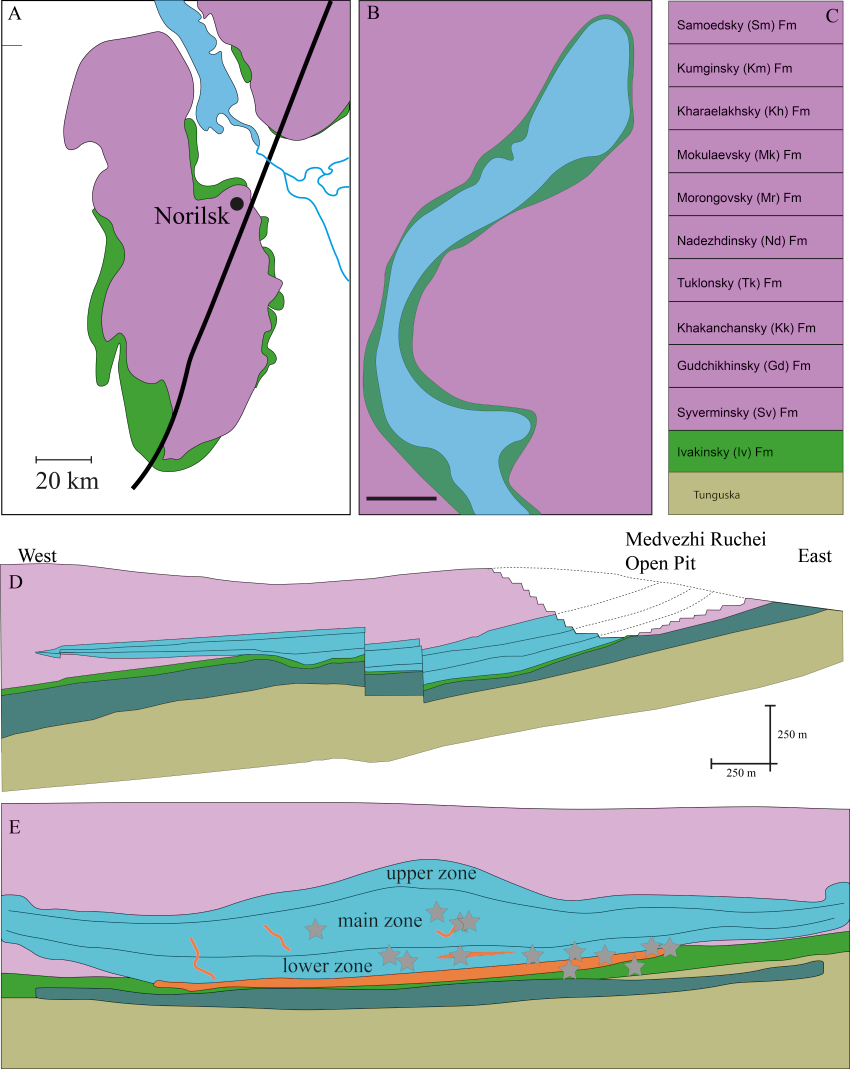
Figure 1. A geological map and cross section of the Norilsk 1 Ni–Cu–PGE deposit. (A) Geological map of the Norilsk area. (B) Schematic geological plan of the Norilsk 1 intrusion. (C) Volcanic sequence of the Siberian Trap basalts. (D) Longitudinal cross section of the Norilsk 1 intrusion. (F) Cross section of the Norilsk 1 intrusion. Stars – sample locations.
The mafic–ultramafic Norilsk 1 intrusion has a chonolith shape and displays well-developed magmatic layering. It is divided into three zones: the lower, main, and upper zones. Our samples come from the lower and main zones (Fig. 1E) and represent two styles of mineralization: disseminated and massive. The disseminated sulfide samples contain 1–12% modal sulfide minerals, including pyrrhotite, chalcopyrite, and pentlandite. Sulfides occur as globules and blebs, often associated with amphibole and chlorite alteration caps. Disseminated sulfides are the dominant ore type in the Norilsk 1 deposit and are mainly concentrated within the lower and main zones.
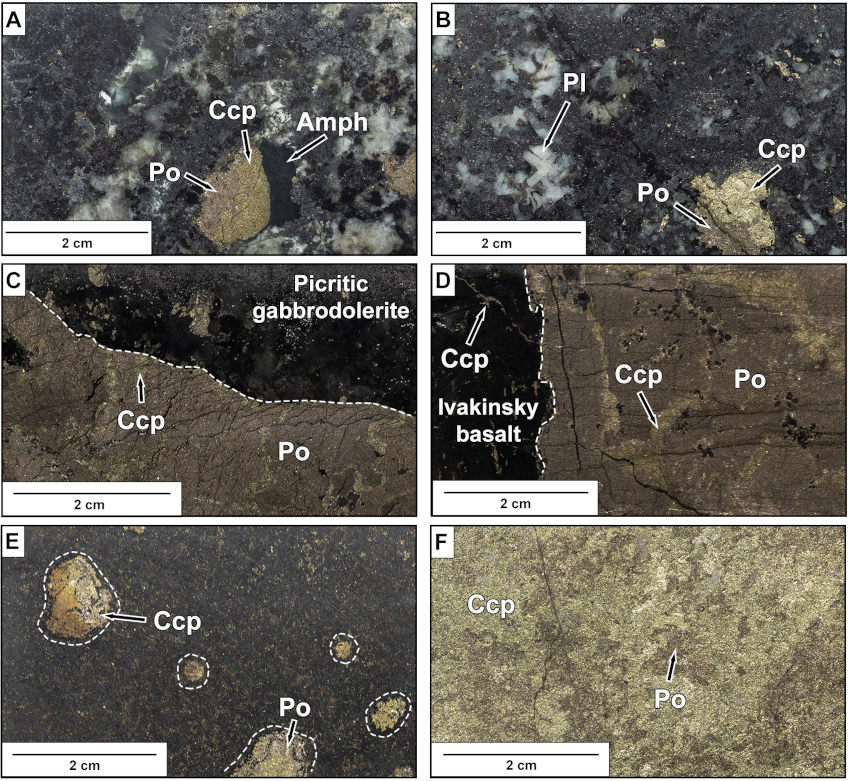
Figure 2. Photographs of representative samples from this study. (A) Taxitic gabbrodolerites (N-05-18) with a differentiated sulfide globule and an amphibole-rich region adjacent to the droplet (“cap”). (B) Differentiated sulfide bleb in a taxitic gabbrodolerite sample (N-04-18) with plagioclase segregations. (C) Contact of pyrrhotite-rich massive sulfide (N-07-18) and olivine-bearing gabbrodolerite (N-01–18) containing disseminated sulfides. (D) Contact of the Ivakinsky basalts and pyrrhotite-rich massive sulfide (N-12-18). (E) Copper-rich mineralization within the Ivakinsky Formation (often referred to as “cuprous”) containing blebs that are morphologically similar to those within the intrusion (N-14-18). (F) Massive chalcopyrite–pyrrhotite vein in the lower zone of the Norilsk 1 deposit (N-08-18).
Massive sulfides are rare in the Norilsk 1 deposit and occur as small lenses and veins within the lower and main zones, as well as at the contact between the Ivakinsky basalts and the Tunguska sediments. Although the massive ores do not form large bodies, they are important for understanding the mineralization processes in the Norilsk 1 deposit.
Major-, trace-elements, PGE and copper isotope data
The MgO and Cao content in the Norilsk 1 samples are similar to the content in ST-LIP lavas and imply olivine and clinopyroxene accumulation/fractionation processes (see Schoneveld et al. (2020) and references therein).
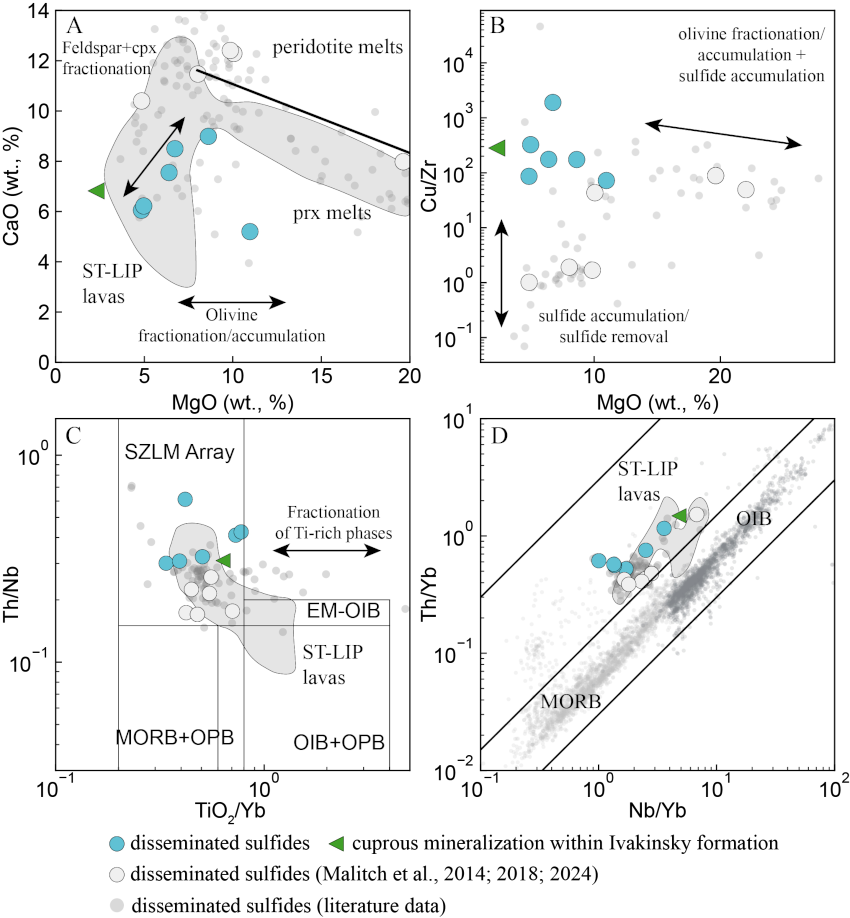
Figure 3. (A) MgO–CaO plot, (B) MgO–Cu/Zr plot, (C) TiO2/Yb–Th/Nb plot, and (D) Nb/Yb–Th/Yb plot for disseminated sulfide ores of the Norilsk 1 deposit. Gray dots represent the compositions of the Norilsk 1 intrusive rocks (from Hawkesworth et al. (1995), Czamanske et al. (1998), Malitch et al. (2018) and Chayka et al. (2023)). White circles are data from Malitch et al. (2018). Gray field in (A) is the composition of ST-LIP lavas (Lightfoot et al., 1990; Lightfoot et al., 1994). Small light gray points in (D) are MORB from Gale et al. (2013). Dark-gray points in (D) are OIB data (Hawaiian Islands) from the GEOROC database (https://georoc.eu/; accessed on May 18, 2022).
The samples show enriched trace-element patterns: high Th/Yb at a given Nb/Yb and elevated Th/Nb, which can be interpreted either as upper-crustal assimilation or as an inherited signature from an enriched mantle source. Chalcopyrite from disseminated sulfide samples ranges from −0.27‰ to 0.42‰, and chalcopyrite from massive sulfides ranges from −0.34‰ to 0.35‰. These values extend beyond the typical mantle range and therefore require an explanation. We do not find any correlations between δ65Cu in disseminated sulfides and post-magmatic alteration, degassing, or regional metamorphism. There are also no correlations with fractional-crystallization or crustal-contamination proxies and thus we interpret the δ65Cu variability as reflecting primary mantle heterogeneity.
R-factor modeling
An important mechanism in forming large magmatic sulfide deposits is the interaction between sulfide liquid and silicate melt. The extent of this interaction is commonly described using the R-factor, which represents the ratio of silicate melt volume to the volume of sulfide liquid with which it equilibrates. The Norilsk 1 deposit is characterized by an R-factor of 10,000–25,000 (Fig. 4A), indicating that a very large volume of silicate melt equilibrated with a relatively small amount of sulfide liquid. During this process, the lighter isotope ⁶³Cu is preferentially partitioned into the sulfide liquid, making the resulting crystallized sulfides isotopically lighter (Fig. 4B).
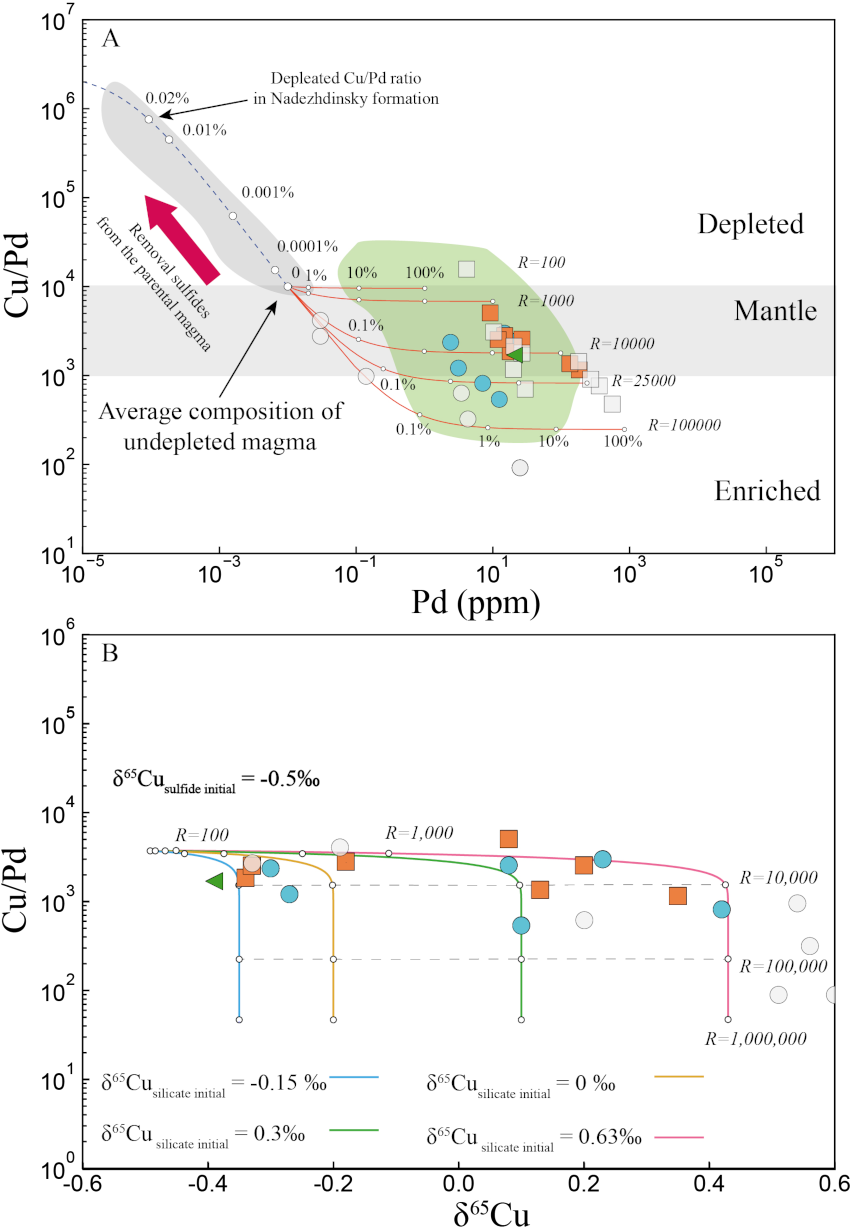
Figure 4. Bivariate diagram showing the modeled variations in Cu/Pd ratios and Pd contents as a function of R factor and sulfide liquid removal. The orange and blue curves are the R factor and sulfide removal models, respectively. The green field is literature data from the Norilsk 1 deposit (Duran et al., 2017). The gray field is the composition of the Nadezhdinsky Formation (Lightfoot and Keays, 2005). The average composition of undepleted magma is from Duran et al. (2017). (B)Diagram showing the modeled variations in δ65Cu values and Cu/Pd ratios as a function of R factor. The colored lines represent different initial δ65Cu values for the undepleted silicate melt that fluxed through the Norilsk system. White dots are data from Malitch et al. (2014; 2018; 2024).
An important result of our model (Fig. 4) is that the Cu isotope variability cannot be explained by a single pulse of isotopically heavy (δ65Cu) magma. This scenario would require samples plotting on the left side of Figure 4B to have unrealistically low R-factors (<1000). Therefore, the mineralization at Norilsk 1 must have formed from multiple pulses of magmas with variable Cu isotope compositions. Our model shows that the δ65Cu variability in disseminated sulfides can be explained by different degrees of interaction between sulfide liquid and isotopically heavy silicate melt. In contrast, the massive sulfides show a strong correlation between δ65Cu and Cu/(Cu+Ni). The isotopically heavier massive ores correspond to ∼40–60% MSS fractionation, which is consistent with their high Cu content. A similar correlation between δ65Cu and Cu/(Cu+Ni) has been reported in other magmatic sulfide systems, including Partridge River (Smith et al., 2022), Kalatongke (Tang et al., 2024), and Tulaergen (Zhao et al., 2017). This suggests that sulfide-liquid evolution plays an important role in controlling Cu isotope compositions in massive sulfide ores.
Metasomatically altered mantle source for the Norilsk 1 deposit
The Norilsk 1 deposit is located close to the margin of the Siberian Craton and long time beneath the Siberian Craton subducting processes were accured. Thus, lithospheric mantle of the craton is likely modified by fluids realized from the subducting slab/s. This is supported by the presence of eclogite xenoliths in kimberlite pipes in the Siberian Craton, which are interpreted as remnants of subducted oceanic crust (MORB-type eclogites) (Sun et al., 2020 and references therein). The presence of earlier subduction events implies that the SCLM was metasomatized by slab-derived fluids or melts that originated as a result of slab melting. Notably, such metasomatic agents have been demonstrated to contribute significantly to the formation of the heavy Cu isotope values in arc-related lavas (Chen et al., 2022). Accordingly, subduction-related metasomatism has the potential to impact a heavy Cu isotope composition on the SCLM. The exact mechanism by which such metasomatism could have increased the δ65Cu value of the Norilsk 1 magma remains ambiguous. For example, it may have involved the formation of pyroxenite veins in the mantle source through reactions between metasomatic melts and lithospheric mantle peridotites. Kempton et al. (2022) interpreted the wide range of bulk-rock δ65Cu values (−0.08 to 1.44 ‰) in pyroxenite xenoliths (Arizona) as evidence for the pyroxenite melt having been produced via interaction of lithospheric mantle and slab-derived fluids. Leached sulfides from these xenoliths are characterized by δ65Cu values of −0.78 ‰ to 3.88 ‰, which cannot be explained by equilibrium isotope fractionation and reflects initial source heterogeneity.
We propose the following sequence of formation for the Norilsk 1 intrusion. 1) Subduction-derived fluids with isotopically heavy Cu interacted with the SCLM beneath the Siberian Craton, forming pyroxenite veins. The silicate portion of the pyroxenite veins was characterized by heavy δ65Cu values, whereas the sulfide fraction was characterized by non-equilibrium δ65Cu values. 2) Shortly before or during the early stages of the ST-LIP event, these veins partially melted, and may have mixed with peridotite derived melts. 3) The first pulse of magma, characterized by heavy δ65Cu values in silicate portion (+0.63 ‰) and light δ65Cu values in sulfide liquid (−0.5 ‰) (based on our model; see previous section), formed the high R factor disseminated ores within the Main Series of the Norilsk 1 intrusion (Fig. 1 D, E), which are characterized by δ65Cu values of >0 ‰ (Fig. 4B). 4) After the pyroxenitic component was exhausted, the δ65Cu value of the silicate melt and sulfide liquid returned to that of typical mantle, and these subsequent magma pulses formed disseminated ores whose δ65Cu values are similar to that expected as a result of equilibrium Rayleigh fractionation (δ65Cu < 0) (Fig. 10B). 6) The massive sulfides formed by accumulation of disseminated sulfides that equilibrated with isotopically normal mantle melt (−0.14 to 0.26 ‰). We explain the variability of δ65Cu in the massive sulfides as a result of 40–60 % fractionation of MSS.
An important uncertainty that we have to mention is the potential involvement of asthenospheric mantle. While our model emphasizes the role of metasomatized SCLM, we cannot reject the possibility that slab-derived fluids also metasomatized portions of the asthenosphere. Such metasomatized asthenosphere could generate isotopically heavy Cu signatures similar to those attributed to metasomatized SCLM. Given the limited volume and melting capacity of the SCLM, metasomatized asthenosphere may represent an additional or complementary source of Cu, Ni, and PGE, and carry heavy δ65Cu. Distinguishing between these two reservoirs remains challenging, however, and no unambiguous geochemical data are currently available to resolve this in the case of Norilsk.
Regardless of the details of sulfide precipitation and ore formation, the variable δ65Cu values observed in the Norilsk 1 deposit reflect a source composition in which the initial silicate melt had a δ65Cu value of 0.63 ‰ and the initial sulfide liquid had a δ65Cu value of −0.5 ‰. These signatures were inherited from subcontinental lithospheric mantle that was altered by fluids derived from a subducting slab and from a pyroxenitic mantle source.
References
Fedorenko, V.A., Lightfoot, P.C., Naldrett, A.J., Czamanske, G.K., Hawkesworth, C.J., Wooden, J.L., Ebel, D.S., 1996. Petrogenesis of the flood-basalt sequence at Noril’sk, North Central Siberia. Int. Geol. Rev. 38 (2), 99–135.
Barnes, S.J., Malitch, K.N., Yudovskaya, M.A., 2020. Introduction to a special issue on the Norilsk-Talnakh Ni-Cu-platinum group element deposits. Econ. Geol. 115 (6), 1157–1172.
Schoneveld, L., Barnes, S.J., Williams, M., Vaillant, M.L., Paterson, D., 2020b. Silicate and oxide mineral chemistry and textures of the Norilsk-Talnakh Ni-Cu-platinum group element ore-bearing intrusions. Econ. Geol. 115 (6), 1227–1243.
Hawkesworth, C.J., Lightfoot, P.C., Fedorenko, V.A., Blake, S., Naldrett, A.J., Doherty, W., Gorbachev, N.S., 1995. Magma differentiation and mineralisation in the Siberian continental flood basalts. Lithos 34 (1–3), 61–88.
Czamanske, G.K., Gurevitch, A.B., Fedorenko, V., Simonov, O., 1998. Demise of the Siberian plume: paleogeographic and paleotectonic reconstruction from the prevolcanic and volcanic record, north-Central Siberia. Int. Geol. Rev. 40 (2), 95–115.
Malitch, K.N., Badanina, I.Yu., Tuganova, E.V., 2018. Ore-Bearing Intrusions of the Polar Siberia: Age, Conditions of Formation, and Criteria of Prediction. IGG UrO RAN, Yekaterinburg (in Russian).
Chayka, I.F., Izokh, A.E., Kamenetsky, V.S., Sokol, E.V., Lobastov, B.M., Kontonikas- Charos, A., Zelenski, M.E., Kutyrev, A.V., Sluxhenikin, S.F., Zhitova, L.M., Shvedov, G.I., Shevko, A.Ya., Gora, M.P., 2023. Origin of chromitites in the Norilsk-1 intrusion (Siberian LIP) triggered by assimilation of argillaceous rocks by Cr-rich basic magma. Lithos 454, 107254.
Gale, A., Dalton, C.A., Langmuir, C.H., Su, Y., Schilling, J.G., 2013. The mean composition of ocean ridge basalts. Geochem. Geophys. Geosyst. 14 (3), 489–518.
Lightfoot, P.C., Keays, R.R., 2005. Siderophile and chalcophile metal variations in flood basalts from the Siberian trap, Noril’sk region: implications for the origin of the Ni- Cu-PGE sulfide ores. Econ. Geol. 100 (3), 439–462.
Duran, C.J., Barnes, S.J., Pleˇ se, P., Praˇsek, M.K., Zientek, M.L., Pag´ e, P., 2017. Fractional crystallization-induced variations in sulfides from the Noril’sk-Talnakh mining district (polar Siberia, Russia). Ore Geol. Rev. 90, 326–351.
Smith, J.M., Ripley, E.M., Li, C., Wasylenki, L.E., 2022. Cu and Ni isotope variations of country rock-hosted massive sulfides located near midcontinent rift intrusions. Econ. Geol. 117 (1), 195–211.
Tang, D., Qin, K., Evans, N.J., Wang, H., 2024. Sulfide copper-iron isotopic fractionation during formation of the Kalatongke magmatic Cu-Ni sulfide deposit in the Central Asian Orogenic Belt. Geochem. Geophys. Geosyst. 25 (6), e2023GC011406.
Zhao, Y., Xue, C., Liu, S.A., Symons, D.T., Zhao, X., Yang, Y., Ke, J., 2017. Copper isotope fractionation during sulfide-magma differentiation in the Tulaergen magmatic Ni–Cu deposit, NW China. Lithos 286, 206–215.
Sun, J., Tappe, S., Kostrovitsky, S., Kalashnikova, T., Zhou, S.H., Smart, K.A., 2025. Timing of subduction along the northern margin of the Siberian craton: Lu-Hf and Sm-Nd isochrons for kimberlite-borne mantle eclogite xenoliths. Lithos 508–509, 108062.
Chen, Z., Chen, J., Tamehe, L.S., Zhang, Y., Zeng, Z., Xia, X., Cui, Z., Zhang, T., Guo, K., 2022. Heavy copper isotopes in arc-related lavas from cold subduction zones uncover a sub-arc mantle metasomatized by serpentinite-derived sulfate-rich fluids. J. Geophys. Res. Solid Earth 127 (10), e2022JB024910.
Kempton, P.D., Mathur, R., Harmon, R.S., Bell, A., Hoefs, J., Shaulis, B., 2022. Cu-isotope evidence for subduction modification of lithospheric mantle. Geochem. Geophys. Geosyst. 23 (8).